
PeakTech 40xx Series Manual
PDF manual · 68 Pages
English



Quick check
Incorrect answer, please try again.
Chat with your PeakTech 40xx Series manual using AI
Get instant AI answers from your PeakTech 40xx Series manual
Ask anything about the PeakTech 40xx Series. Answers come from this manual, with the pages they are based on.
40xx Series Maintenance Schedule
The manual recommends calibrating the unit again after 1 year to ensure accuracy.
Disconnect power and leads. Use a wet soft cloth not dripping water. Do not use corrosive agents or sprays.
Keep the area well-ventilated and inspect the intake regularly to prevent overheating or damage.
Free maintenance reminders
Timed to your purchase date. Always free, unsubscribe anytime.
Ask a Question
Do you recommend 40xx Series?
Yes NoFrequently Asked Questions
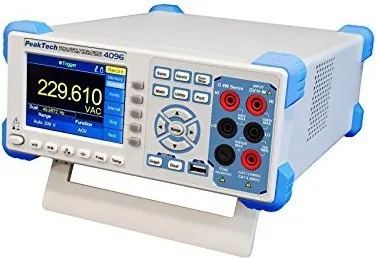
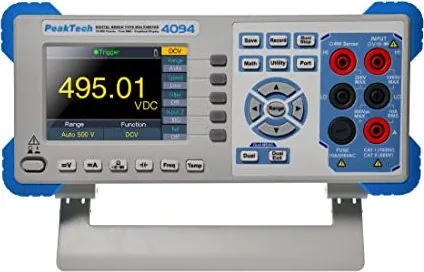
The range includes the PeakTech P 4094, P 4095, and P 4096 graphical bench multimeters. Their core functions are similar, but resolution, ranges, frequency capability, display capacity, and accuracy differ by model.
Is this answer helpful?
It measures DC and AC voltage, DC and AC current, two-wire and four-wire resistance, continuity, diodes, capacitance, frequency, period, and temperature. Temperature support includes several thermocouple types plus PT100 and PT385 RTD sensors.
Is this answer helpful?
Four-wire resistance measurement separates the current-carrying and sensing paths. This reduces the influence of test lead and contact resistance, making it particularly useful when measuring resistances below 100 kOhm.
Is this answer helpful?
Yes. Manual saving stores up to 1,000 readings. Automatic logging can record to internal memory or a USB device, and results can be exported in CSV format for analysis on a computer.
Is this answer helpful?
The instruments provide USB Type-B, RS-232, and LAN connections. They also support SCPI communication, making them suitable for remote control, data collection, and automated test arrangements.
Is this answer helpful?
The HI and LO measurement inputs are rated up to 1000 V DC or 750 V AC for measurement. The safety category rating is 1000 V CAT I and 600 V CAT II. Maximum limits must never be exceeded.
Is this answer helpful?
Advantages and Disadvantages
Advantages

- Comprehensive bench measurement set includes voltage, current, resistance, continuity, diode, capacitance, frequency, period, and temperature.
- True RMS AC measurement, graphical display modes, dual readings, statistics, limits, REL, and dB/dBm support detailed analysis.
- Four-wire resistance measurement helps minimize lead and contact resistance errors in low-resistance applications.
- USB, RS-232, LAN, SCPI, external trigger, and CSV export support automated and PC-connected workflows.
- Automatic logging supports up to 1 million internal points or 100 million points on external USB storage.
Disadvantages

- The three models have different resolution, bandwidth, frequency range, and accuracy specifications, so selection requires careful comparison.
- AC True RMS readings are AC-coupled; AC plus DC RMS requires combining separate DC and AC measurement results.
- High-current operation above 7 A is limited by a recommended 30-seconds-on, 30-seconds-off duty cycle.
- Automatic range changes can create temporarily invalid logged readings during relay switching.
- The instruments are intended for indoor use and are not designed for high-energy circuits.
Product Specification
Package contents
Test leads, power cord
Product Description
PeakTech P 40xx TrueRMS Digital-Multimeter Manual
The PeakTech P 40xx TrueRMS Digital-Multimeter range brings bench-grade measurement capability to electronics labs, service departments, development benches, and educational environments. Covering the P 4094, P 4095, and P 4096 models, these graphic tabletop multimeters combine a large LCD interface with practical controls for repeatable everyday testing. The PeakTech P 40xx TrueRMS Digital-Multimeter Manual keyword is especially relevant for users comparing functions, connections, safety limits, and model-specific performance.
Broad measurement capability
These instruments measure DC and AC voltage, DC and AC current, resistance, continuity, diode voltage, capacitance, frequency, period, and temperature. True RMS AC measurement supports more dependable readings on non-sinusoidal signals within the specified bandwidth. The P 4095 and P 4096 offer AC voltage bandwidth up to 100 kHz and AC current bandwidth up to 10 kHz, while the P 4096 reaches frequency measurements up to 1 MHz.
Four-wire resistance capability is a key advantage for low-resistance work. By separating current and sense connections, it helps reduce errors caused by test leads and contact resistance. Temperature measurement supports multiple thermocouple types, including B, E, J, K, N, R, S, and T, along with PT100 and PT385 RTD sensors.
Clear data on screen and beyond
A configurable graphical display can present values as large digits, a bar meter, trend graph, or histogram. Dual-display operation allows compatible primary and secondary measurements to be viewed together, such as voltage with frequency. Mathematical tools include relative readings, statistics, pass/fail limits, and dB/dBm calculations for voltage-based work.
For data capture, manual storage holds up to 1,000 readings. Automatic recording supports up to 1 million internal points or up to 100 million points on external USB storage, depending on configuration. Saved results can be exported as CSV data for review in spreadsheet or analysis software.
Connectivity and controlled measurement workflows
USB, RS-232, and LAN interfaces make the P 40xx range suitable for PC-connected measurement setups. SCPI support assists integration with automated test systems. Auto, single, and external trigger modes support controlled acquisitions, while the rear auxiliary output can signal measurement completion or pass/fail status.
Notes
- Choose the correct mains voltage setting and matching fuse before powering the instrument.
- Observe the 1000 V CAT I and 600 V CAT II input safety ratings.
- For best specified accuracy, allow a 30-minute warm-up period and use appropriate measurement speed settings.
- Continuous currents above 7 A require a 30-seconds-on, 30-seconds-off duty cycle.
Search for 67,706 Manuals online


Type-in Brand or Model