
Doepke DRCCB 5 STR Manual
PDF manual · 5 Pages
English



Quick check
Incorrect answer, please try again.
Chat with your Doepke DRCCB 5 STR manual using AI
Get instant AI answers from your Doepke DRCCB 5 STR manual
Ask anything about the Doepke DRCCB 5 STR. Answers come from this manual, with the pages they are based on.
DRCCB 5 STR Maintenance Schedule
With AUTO ON selected, the device performs an uninterrupted automatic selftest. The monthly timer starts when operating voltage is applied or SET is pressed.
For the Selftest Restart version, insulation resistance is measured after a trip. The device automatically restarts when a safe resistance value is reached.
The auxiliary contact opens for 500 ms to perform an electronics check, regardless of its configuration.
Free maintenance reminders
Timed to your purchase date. Always free, unsubscribe anytime.
Ask a Question
Do you recommend DRCCB 5 STR?
Yes NoFrequently Asked Questions
The DRCCB 5 STR is a Type A residual current circuit breaker that performs monthly selftests without interrupting supply and, after a trip, measures insulation resistance to permit controlled automatic reclosing when safe.
Is this answer helpful?
Move the slider to AUTO ON (left). This activates the monthly uninterruptible selftest and, for the STR variant, enables the automatic reclosing cycle that performs insulation checks before restarting.
Is this answer helpful?
Press the SET button to initiate an automatic test. If LED 1 remains yellow after the test, a qualified technician should inspect the device and the installation for faults or electronic issues.
Is this answer helpful?
No. Due to safety risks and regulatory requirements, installation and configuration must be performed by qualified electricians. Automatic reclosing is permitted only in restricted areas per DIN VDE 0100-530.
Is this answer helpful?
The DRCCB 5 STR snaps onto an EN 60715 DIN mounting rail. Feed-in must come from the top and all active conductors plus the neutral must be routed through the breaker following the provided wiring diagram.
Is this answer helpful?
It uses two LEDs (LED 1 red/yellow and LED 2 green) with defined blink codes for selftest, insulation checks, trips, blocked restart and faults. An auxiliary contact provides remote pulses after successful selftests and status signaling.
Is this answer helpful?
After a trip the STR variant measures insulation resistance every two minutes; if the resistance reaches the configured safe threshold the device will automatically attempt reclosing, unless blocked by fault conditions or restart counters.
Is this answer helpful?
Advantages and Disadvantages
Advantages

- Monthly uninterruptible selftest maintains protection without cutting supply
- Automatic reclosing after insulation check reduces downtime where allowed
- Clear LED blink codes and SET/manual test functions aid diagnostics
- Auxiliary contact for remote signaling and integration with building systems
- DIN-rail mounting and top feed-in simplify professional installation
Disadvantages

- Automatic restart allowed only in areas with trained electrical personnel (DIN VDE)
- Not suitable for environments with corrosive gases—may impair long-term function
- Automatic reclosing can mask persistent insulation problems if not monitored
- Installation and configuration require qualified electricians; not DIY-friendly
- Complex LED codes and modes may require consulting manual for full interpretation
Product Specification
Type
RCCB
Rated Voltage
400 V
Residual Current Type
A
Degree of Protection
IP20
Special Features
short-time delayed
Product Description
Doepke DRCCB 5 STR — Reliable self-testing RCCB with auto-restart
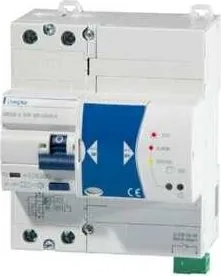
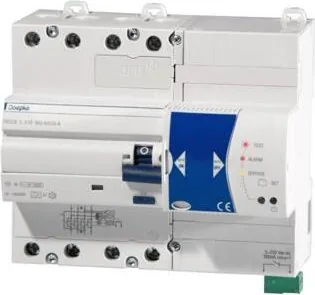
The Doepke DRCCB 5 STR is a two-/four-pole Type A residual current circuit breaker (RCCB) designed for modern electrical installations that require continuous safety monitoring and automatic restoration after a trip. Built around a monthly uninterruptible selftest and an automatic reclosing function, the DRCCB 5 STR combines fault detection, insulation monitoring and controlled restart logic to reduce downtime while keeping people and equipment protected.
Featuring a dedicated Selftest Restart mode, the device measures insulation resistance periodically after a trip and attempts automatic reclosing only when the measured resistance meets preset safety thresholds. This makes it particularly suitable for installations where selective automatic recovery is desired—such as industrial subcircuits, critical building services and restricted-access electrical rooms where only trained personnel are present.
Practical controls and status indicators include a slider to enable/disable automatic testing and restart (AUTO ON / AUTO OFF), a SET button to initiate manual tests, and multi-color LED signaling for selftest progress, system checks, faults, trips and blocked restart conditions. An auxiliary remote contact reports test pulses and status changes for building automation or remote monitoring systems.
Installation is straightforward for qualified electricians: the unit snaps onto EN 60715 DIN rail, requires top feed-in, and all active conductors plus neutral must be routed through the device as per the wiring diagram. The DRCCB 5 STR complies with relevant standards and includes PTC overcurrent protection for auxiliary contacts, clear LED blink codes for diagnostics, and configuration options via the SET key (long press cycles through modes). Safety notes stress operation only in corrosive-gas-free environments and prohibit installation by non-qualified personnel.
Key user interactions are simple: after power-up move the slider to AUTO ON to enable automatic monthly selftests and restart behaviour; press the SET button to force a manual selftest; use the test (T) opening to verify trip operation. If LED 1 shows persistent yellow, perform the automatic test via SET and consult a technician if it remains yellow.
Overall, the Doepke DRCCB 5 STR targets installations where both automatic self-diagnostics and cautious automatic reclosing are required, balancing protection and availability while giving installers clear diagnostic feedback.
Notes
- Only qualified electricians should install and configure the device. Follow DIN VDE and local rules for automatic restart permissions.
- Avoid use in atmospheres with corrosive gases (chlorine, ammonia, sulfur).
- Keep the wiring diagram and installation instructions available for maintenance.
Search for 67,706 Manuals online


Type-in Brand or Model