
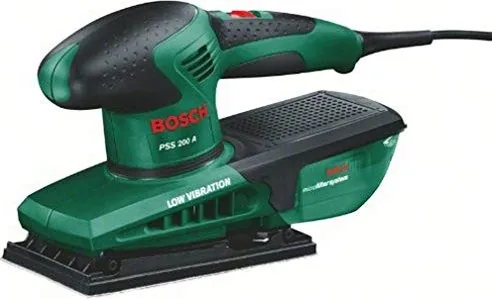
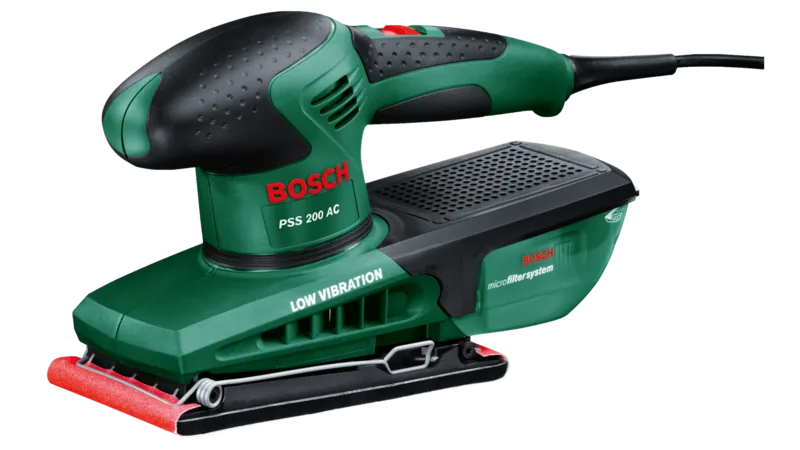
Bosch DIY PSS 200 A Manual
PDF manual · 65 Pages
English



Quick check
Incorrect answer, please try again.
Chat with your Bosch DIY PSS 200 A manual using AI
Get instant AI answers from your Bosch DIY PSS 200 A manual
Ask anything about the Bosch DIY PSS 200 A. Answers come from this manual, with the pages they are based on.
PSS 200 A Maintenance Schedule
Inspect for proper function, binding, broken or damaged parts. Repair before use.
Empty dust box and clean filter element slats with a soft brush to prevent clogging.
Keep machine and ventilation slots clean to ensure safe and proper operation.
Remove debris from plate and replace sheet to maintain performance and reduce wear.
Ask a Question
Do you recommend PSS 200 A?
Yes NoFrequently Asked Questions
The PSS 200 A is intended for dry sanding of wood, plastics, filler compounds and painted or lacquered surfaces. It is not designed for wet sanding or for continuous heavy industrial use.
Is this answer helpful?
The sander has an integrated dust box with a microfilter for basic extraction. For better dust control, mount a vacuum hose to the extraction outlet and connect to a suitable vacuum cleaner; use a special vacuum for carcinogenic or very fine dusts.
Is this answer helpful?
The PSS 200 A accepts sanding sheets sized typically 93 x 185 mm or 93 x 230 mm depending on the model. The sanding plate supports Velcro (hook-and-loop) backed sheets for quick attachment; other variants use clamp-style attachment—follow the manual for correct mounting.
Is this answer helpful?
Wear eye protection, hearing protection (sound pressure about 82 dB(A)), and a P2-class respirator when sanding materials that generate harmful dust. Maintain good ventilation and avoid sanding hazardous materials without appropriate extraction and PPE.
Is this answer helpful?
Use coarse grits (40–60) for aggressive material removal, medium grits (80–120) for leveling and intermediate sanding, and fine grits (180–320) for finishing and preparing primers before coating. Test on a scrap piece to confirm desired results.
Is this answer helpful?
Always unplug before maintenance. Empty and clean the dust box and gently brush the filter element regularly. Keep ventilation slots clean, replace worn sanding sheets, and use only original Bosch accessories. For repairs use authorized Bosch service centers.
Is this answer helpful?
Typical sound pressure is ~82 dB(A) and vibration total value ah is ~5.5 m/s². These levels warrant hearing protection and consideration of vibration exposure for prolonged use; organize work and rest periods to reduce cumulative vibration.
Is this answer helpful?
Advantages and Disadvantages
Advantages

- Lightweight (≈1.6 kg) and ergonomic insulated handle for comfortable DIY use
- Velcro-compatible sanding plate allows fast, tool-free paper changes
- Integrated microfilter dust box plus external vacuum hookup for improved dust control
- Wide grit range supported (40–320) for coarse to fine sanding tasks
- Clear safety and maintenance guidance, and access to Bosch service and parts
Disadvantages

- Designed for dry sanding only; not suitable for wet applications
- Dust box is basic; may require external vacuum for heavy dust or hazardous materials
- Not intended for heavy industrial workloads—best for DIY and light trades use
- Noise (~82 dB(A)) and vibration (~5.5 m/s²) require PPE for extended use
- Some sanding-sheet sizes and hole patterns must be matched carefully for good extraction
Product Specification
Type
Orbital sander
Power
200W (230V)
No-load speed
12000/min
No-load stroke rate
24000/min
Oscillation orbit
0.08 in
Sanding surface
7.17x3.62 in (LxW)
Sanding paper size
7.28x3.66 in (Hook and loop)
Tool attachment
Hook and loop fastening
Features
Softgrip, Dust extraction
Weight
3.53lb
Included in delivery
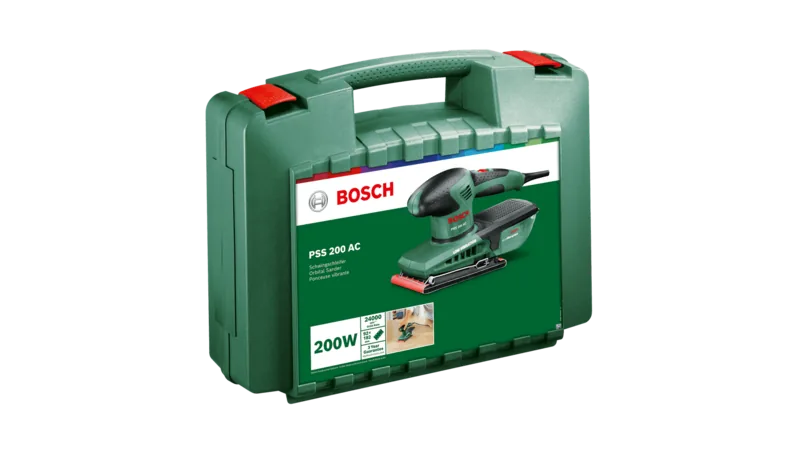
Case, Dust collection box
Product Description
Bosch DIY PSS 200 A Electric Orbital Sander incl. case Manual
The Bosch DIY PSS 200 A Electric Orbital Sander is a compact, user-friendly sander designed for dry sanding of wood, plastics, fillers and painted surfaces. Lightweight and well balanced at around 1.6 kg, it delivers consistent orbital motion (2.0 mm orbit) and a no-load speed suitable for general DIY tasks. Its Velcro-compatible sanding plate accepts standard 93 x 185 or 93 x 230 mm sheets and allows quick paper changes. The integrated dust box with a microfilter system provides basic dust collection, and the machine can also be connected to an external vacuum via the extraction outlet for improved cleanup.
Ergonomics and controls are straightforward: a single on/off switch and a secure insulated handle make operation comfortable for extended periods. The PSS 200 A focuses on ease of use — simple sanding-sheet attachment, clear guidance for selecting grits (from coarse 40 to fine 320), and practical maintenance notes like emptying the dust box and cleaning the filter element. Bosch emphasizes safety, recommending hearing protection (typical sound pressure 82 dB(A)), adherence to electrical safety guidelines, and using suitable dust extraction when sanding hazardous materials.
Performance-wise, the sander is intended for moderate DIY workloads rather than heavy industrial use. Proper technique—uniform pressure, correct grit selection, and replacing worn sheets—ensures efficient material removal and longer accessory life. The manual also highlights specific cautions: avoid overheating workpieces, empty the dust collector before breaks to reduce fire risk, and avoid using sheets contaminated with metal on other materials.
The PSS 200 A integrates with Bosch’s accessory program, and users are advised to use original Bosch sanding sheets and replacement parts. For repairs and spare parts, Bosch recommends authorized service centers and provides contact and disposal guidance, including environmental recycling notes for end-of-life equipment.
Notes:
- Intended for dry sanding only; do not expose to water.
- Typical noise/vibration values: sound pressure ~82 dB(A); vibration ah ~5.5 m/s² — use hearing protection and consider vibration exposure.
- Use appropriate dust extraction and a P2 respirator when working with hazardous or carcinogenic dusts.
- Match sanding-sheet holes to the plate holes for optimal dust extraction.
- Follow local regulations for disposal and recycling.
Search for 67,706 Manuals online


Type-in Brand or Model
juul26
8 months ago
Does this sanding solution create dust inside the house when I sand a dining table or staircase steps?
Manual.ly
8 months ago
Reviews indicate it produces little to no visible dust indoors. For example, it has been used for sanding an entire dining table and staircase treads with no dust settling in the room. To get the best result, make sure the dust extraction/collection setup is properly connected and that all connections are sealed. Using the correct sanding attachments and running at an appropriate speed also helps reduce airborne particles. If you are sanding heavily or for long periods, periodically check and empty/replace the dust container or bag to maintain suction performance.