
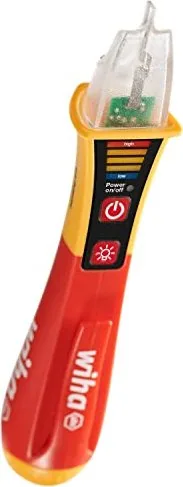

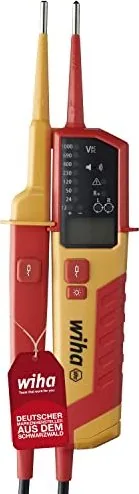
Wiha Voltage Tester Manual
PDF manual · 18 Pages
English



Quick check
Incorrect answer, please try again.
Chat with your Wiha Voltage Tester manual using AI
Get instant AI answers from your Wiha Voltage Tester manual
Ask anything about the Wiha Voltage Tester. Answers come from this manual, with the pages they are based on.
Voltage Tester Maintenance Schedule
Remove from all test points. Use a damp cloth with mild detergent. Do not use abrasives or solvents.
Take out batteries to prevent leakage damage if the device is stored for an extended time.
Ask a Question
Do you recommend Voltage Tester?
Yes NoFrequently Asked Questions
It measures AC up to 1000V and DC up to 1500V within appropriate safety categories.
Is this answer helpful?
Yes, it can perform a trip test on RCDs with 10mA or 30mA nominal leakage currents.
Is this answer helpful?
You should use two AAA 1.5V batteries, specifically type IEC LR03 for best results.
Is this answer helpful?
It has an IP64 rating which protects against dust and water splashes from any direction.
Is this answer helpful?
The device performs an automatic self-test when batteries are inserted or probes are shorted.
Is this answer helpful?
Yes, it can distinguish between operating and interference voltages within technical limits.
Is this answer helpful?
Phase detection works reliably with voltages exceeding approximately 100 V AC.
Is this answer helpful?
Advantages and Disadvantages
Advantages

- High measurement category ratings provide enhanced safety in live environments.
- Supports multiple test types including continuity and RCD verification.
- Built-in LED torch and vibration motor provide clear feedback in low light.
- Auto power on and off functions save battery life during intermittent use.
- Robust IP64 construction resists dust and water splashes effectively.
Disadvantages

- Requires specific AAA batteries which must be replaced when indicator shows low.
- Single pole phase test accuracy depends on good grounding conditions available.
- May indicate interference voltage on disconnected parts requiring further diagnostics.
- Self-test must pass before every use to ensure safe operation conditions.
- Battery compartment must remain closed to maintain safety while operating.
Product Description
Introduction to Electrical Safety Tools
Working with high voltage electricity requires precision and the correct equipment to ensure personal safety on every job site. The Wiha Voltage tester is a versatile instrument designed specifically for professionals who demand absolute reliability in their diagnostics. This powerful device helps electricians quickly verify the presence of live voltage before commencing work on any circuit. Understanding the Wiha Voltage tester Manual is crucial for maximizing the utility and long-term safety of this essential tool. Whether you are checking simple single-phase systems or complex industrial three-phase setups, this tester covers the broad requirements needed for modern electrical maintenance tasks.
Comprehensive Testing Capabilities
This unit operates within a broad voltage range suitable for standard low-voltage installations globally. It supports AC measurements up to 1000V and DC measurements reaching 1500V with high accuracy. The CAT IV 600V and CAT III 1000V safety ratings ensure robust protection even in harsh grid environments or outdoor conditions. Users benefit from multiple distinct testing modes including standard continuity checks and rotary field determinations for phase sequence. A dedicated RCD trip test allows for verifying safety switch function without external tools. The built-in LED light assists in darker locations while the vibration motor provides immediate tactile feedback during operation.
Operational Safety Guidelines
Safety is paramount when utilizing this professional equipment in live environments. Always consult the official Wiha Voltage tester Manual before attempting first use. Inspect the device thoroughly for physical damage and ensure batteries are correctly installed inside the compartment. Do not operate with an open battery compartment under any circumstances. The tester includes a self-test function that activates automatically upon power insertion or shorting the probes. If indicators fail during this check, the unit must not be used to prevent serious electric shock hazards for the user.
Technical Specifications and Care
The device meets international safety standards including EN 61243-3 and complies with EU directives. It features an IP64 rating for resistance against dust ingress and water splashes from any direction. Operating temperature ranges extend from minus 15 to 50 degrees Celsius for reliable performance. Cleaning should involve a soft damp cloth with mild detergent avoiding harsh solvents completely. Proper storage requires battery removal during long periods of inactivity to prevent leakage damage.
Notes: Ensure grounding conditions are optimal for single-pole phase tests. Verify functionality before and after each usage to maintain strict safety standards. Replace batteries of type AAA IEC LR03 when the low battery symbol appears.
Search for 67,706 Manuals online


Type-in Brand or Model