
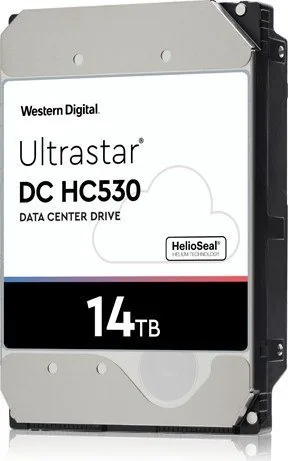
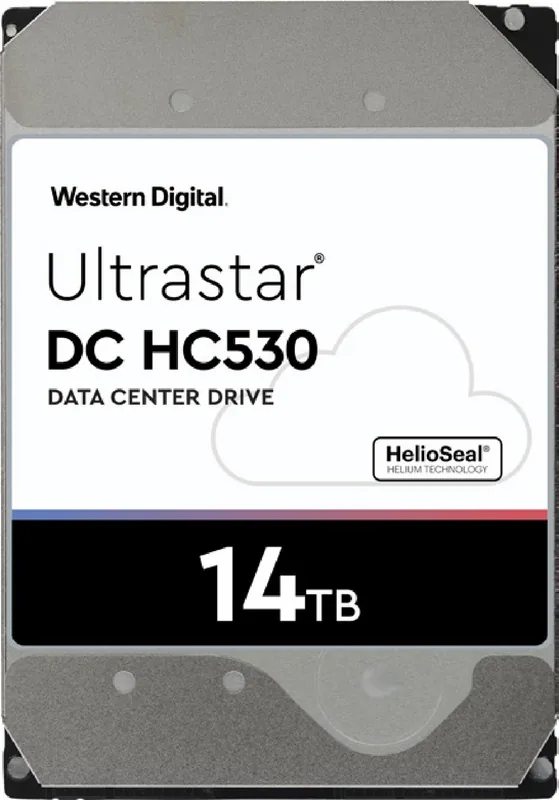
Western Digital Ultrastar DC HC530 Manual
PDF manual · 381 Pages
English



Quick check
Incorrect answer, please try again.
Chat with your Western Digital Ultrastar DC HC530 manual using AI
Get instant AI answers from your Western Digital Ultrastar DC HC530 manual
Ask anything about the Western Digital Ultrastar DC HC530. Answers come from this manual, with the pages they are based on.
Ask a Question
Do you recommend Ultrastar DC HC530?
Yes NoFrequently Asked Questions
The Ultrastar DC HC530 uses a 29-pin Serial Attached SCSI (SAS) interface, supporting full SAS PHY, link, and transport layer features for enterprise connectivity and multi-initiator environments.
Is this answer helpful?
The HC530 is optimized for enterprise datacenter workloads requiring high capacity and sustained throughput such as archival storage, backup, object stores, cold/hot tiering, and high-density capacity arrays where sequential throughput and reliability are priorities.
Is this answer helpful?
Reliability features include robust head/disk assembly design, load/unload controls, error recovery and reallocation strategies, preventive maintenance guidance, vibration/shock tolerance, drive-level logging, and RAID rebuild assist diagnostics to preserve data integrity under heavy use.
Is this answer helpful?
Security includes support for TCG-related encryption constructs, AES-based encryption tables, firmware signing and controlled downloads, PSID and administrative PIN tables, access-control behaviors for locked/unlocked states, and procedures for zeroization to securely decommission drives.
Is this answer helpful?
Operational limits include specified temperature and humidity ranges, vibration and shock profiles for operating and non-operating states, and corrosion/atmospheric considerations. Maintaining recommended environmental controls is important for performance and longevity.
Is this answer helpful?
Yes. The drive provides detailed SCSI and SAS behavior for multi-initiator systems, persistent reservation commands, command queuing guidance, and recommendations for initiator ERP and system-side error handling to support RAID arrays and shared storage.
Is this answer helpful?
Power input ranges, typical power consumption, power noise limits, physical dimensions, connector locations, mounting guidelines, and acoustic ratings are included in the HC530 specification to aid system design and integration.
Is this answer helpful?
Advantages and Disadvantages
Advantages

- High-capacity 3.5" SAS HDD built for enterprise storage with sustained throughput and large formatted capacities.
- Extensive SCSI and SAS support including detailed mode pages, command sets, and transport/error handling for integration.
- Robust reliability features: vibration/shock tolerance, load/unload controls, and RAID rebuild assist for data integrity.
- Security and compliance: TCG/AES-related encryption support, firmware signing, PSID/administrative controls and zeroization.
- Comprehensive electrical/mechanical specs and power efficiency data for accurate system planning and deployment.
Disadvantages

- Mechanical HDDs have higher latency and lower IOPS compared with NVMe/SAS SSDs for random workloads.
- Large-form-factor drives consume more rack space and may require additional cooling in dense deployments.
- Complex configuration and diagnostics require experienced system integration and careful firmware management.
- Sustained performance depends on proper environment controls; sensitivity to extreme temperature/humidity exists.
- Enterprise features and security functions add configuration overhead and may require procedural controls for compliance.
Product Specification
Capacity
14 TB (corresponds to approx. 13,038.52 GiB or 12.73 TiB, further information on this)
Form Factor
3.5" (Width)
Interface
SAS 12 Gb/s
Rotational Speed
7,200/min
Cache
512 MB
Power Consumption
8.5 W (Operation), 5.9 W (Idle)
Noise Level
36 dB(A) (Operation), 20 dB(A) (Idle)
Recording Method
Conventional Magnetic Recording (CMR), Two Dimensional Magnetic Recording (TDMR)
Reliability Prediction
2.5 million hours (MTBF)
Special Features
suitable for continuous operation (24/7), helium-filled
Warranty
60 months
Warning/Note/Trivia
Note: Unmarked OEM/System Builder hard drives in circulation. Reduced warranty performance possible. Manufacturer's warranty verifiable via serial number.Important: For use within a RAID array, hard drives with different recording methods (CMR, SMR) should not be combined. When using SMR hard drives in a RAID array, it is important to ensure that the RAID controller (or the NAS system) is compatible with SMR hard drives, so that the partially blocked recording behavior of SMR is not falsely interpreted as a "hardware defect".Trivia: The hard drive division of HGST/Hitachi was acquired by Western Digital WDC in 2012. In 2018, most Ultrastar models received a visual overhaul with Western Digital Corporate Design. Technical data and product numbers remained unchanged.
Product Description
Western Digital Ultrastar DC HC530 HDD SAS Manual
The Western Digital Ultrastar DC HC530 HDD SAS is a high-capacity, enterprise-class 3.5-inch SAS hard drive designed for demanding datacenter and storage infrastructure. Built on proven Ultrastar heritage, the HC530 emphasizes reliability, sustained performance, and efficient power usage for dense storage arrays, backup systems, and archival environments. Engineered for continuous operation, it pairs large formatted capacities with features that address vibration tolerance, error recovery, and secure data handling.
This drive family offers detailed mechanical and electrical specifications including form factor, connector pinouts for 29-pin SAS interfaces, voltage and power characteristics, and environmental limits (temperature, humidity, shock, and vibration). Performance attributes such as seek times, rotational latency, drive ready times, and operating modes are documented to help architects estimate throughput and I/O behavior under real workloads. The HC530’s design includes robust head-disk assembly and actuator control to maintain data integrity and longevity across high-duty cycles.
On the firmware and protocol side, the Ultrastar DC HC530 supports the SAS transport stack and an extensive SCSI command set, covering read/write operations, cache and cache synchronization, diagnostic commands, persistent reservation services, and advanced logging. Detailed command descriptors, mode pages, and sense data formats facilitate integration with enterprise initiators, RAID controllers, and multipath environments. Special attention is given to error handling, command timeout guidance, and recommendations for system-level recovery and preventive maintenance.
Security and compliance features include support for encryption mechanisms aligned with TCG and AES implementations, firmware signing and download controls, FIPS-related operational instructions, and access control tables for locked/unlocked states. The manual outlines cryptographic key handling, PSID/administrative controls, and revert/zeroization behavior for secure decommissioning.
Reliability metrics and operational guidance describe start/stop cycles, load/unload procedures, recommended power-off sequences, cable noise considerations, and strategies for RAID rebuild assist and data recovery. Acoustic ratings, identification labeling, and safety/flammability standards compliance are provided for full deployment planning.
Notes:
- The HC530 targets enterprise workloads requiring high capacity, predictable latency, and sustained throughput.
- SAS interface and comprehensive SCSI support make it suitable for multi-initiator and RAID environments.
- Extensive diagnostic, logging, and security features facilitate maintenance, auditability, and secure lifecycle management.
Search for 67,706 Manuals online


Type-in Brand or Model