

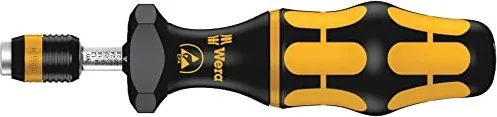
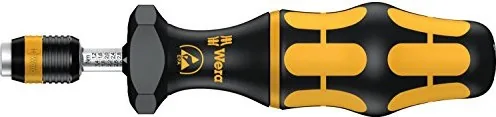
Wera Kraftform Series 7400 ESD Manual
PDF manual · 2 Pages
English



Quick check
Incorrect answer, please try again.
Chat with your Wera Kraftform Series 7400 ESD manual using AI
Get instant AI answers from your Wera Kraftform Series 7400 ESD manual
Ask anything about the Wera Kraftform Series 7400 ESD. Answers come from this manual, with the pages they are based on.
Kraftform Series 7400 ESD Maintenance Schedule
Check calibration at least once a year after first use. Check more frequently under intensive use.
Check the torque calibration after 5,000 load cycles. Contact Wera for service or recalibration questions.
Free maintenance reminders
Timed to your purchase date. Always free, unsubscribe anytime.
Ask a Question
Do you recommend Kraftform Series 7400 ESD?
Yes NoFrequently Asked Questions
The screwdriver delivers an uncertainty of ±6%, complying with EN ISO 6789 and related standards, ensuring reliable torque control for precision fastening tasks.
Is this answer helpful?
Push down and rotate the adjustment ring; each 180° changes the torque and clicks into place. Read the preset value on the clear laser-etched scale directly above the indicator arrow, visible from either side.
Is this answer helpful?
No. The ESD material is conductive to safely dissipate static and is not insulated. Never use ESD tools on live voltage components as they can conduct current and pose a safety risk.
Is this answer helpful?
Wera recommends checking calibration at least annually or after approximately 5,000 load cycles. For intensive professional use, perform checks more frequently and contact Wera service for recalibration or repair.
Is this answer helpful?
The screwdriver mechanically releases with audible and tactile feedback (a slip/‘click’), preventing further tightening and protecting fasteners from over-torque damage.
Is this answer helpful?
No. The manual loosening torque is not limited by the tool’s release mechanism, allowing removal of seized screws, but care is needed when reversing to avoid damage.
Is this answer helpful?
Store it set to the smallest adjustable torque value to relieve spring tension and prolong mechanism life, especially during long periods of inactivity.
Is this answer helpful?
Advantages and Disadvantages
Advantages

- High precision: ±6% accuracy meeting ISO 6789/EN standards.
- Clear laser-etched scale for easy torque reading from either side.
- Kraftform ergonomic handle for superior grip and reduced fatigue.
- ESD-safe material (<10^9 Ω) protects sensitive components from static.
- Interchangeable 4 mm Halfmoon/HIOS bit system for fast, secure changes.
Disadvantages

- Conductive ESD material — unsafe for work on live electrical circuits.
- Calibration required annually or after 5,000 cycles; more often with heavy use.
- Using torque above the engraved maximum can damage the tool and void accuracy.
- Manual loosening torque is unlimited, which may risk overtightening when reversing.
- Requires proper ESD environment to fully protect sensitive components.
Product Specification
Features
antistatic, electrically conductive
Scope of delivery
Rapidaptor bit holder
Product Description
Wera Kraftform Serie 7400 ESD Torque Screwdriver Manual
The Wera Kraftform Serie 7400 ESD torque screwdriver blends precision engineering with ergonomic design for repeatable, controlled fastening in sensitive electronic environments. Built to meet EN ISO 6789 and related standards, this adjustable torque screwdriver delivers ±6% accuracy and a tactile, audible release when the preset torque is reached. It’s intended for torque-controlled tightening only; exceeding the maximum engraved value may impair calibration or damage the tool and fasteners.
Designed for sustained professional use, the tool features a multi-component Kraftform handle that combines soft and hard zones for superior grip, efficient force transfer, and reduced operator fatigue. The adjustment ring allows torque pre-setting by pushing down and rotating; each 180° turn changes the torque and clicks into position. A clear, laser-etched scale makes reading the selected torque straightforward from either side of the indicator.
The 7400 ESD series is optimized for electrostatic-sensitive assemblies. Made from ESD-safe materials (surface resistance < 10^9 ohm), it safely dissipates static when used in an appropriate ESD-protected area. However, these tools are conductive and must never be used on live electrical circuits. The interchangeable bit system supports Halfmoon and HIOS 4 mm drives for rapid bit changes and secure locking, expanding the tool’s versatility across many fastening tasks.
Maintenance and calibration guidance are emphasized: Wera recommends checking calibration after 5,000 load cycles or at least annually after first use, with more frequent checks for heavy use. If torque limits have been exceeded, recalibration or repair will likely be necessary. Service and recalibration support contact details are provided by the manufacturer.
Key functional notes include an unlimited manual loosening torque (so seized screws can be backed out), a mechanical slip/release at the set torque to prevent over-tightening, and the recommendation to store the tool at its lowest torque setting to relieve spring tension during extended inactivity.
Notes:
- Intended strictly for controlled torque application within the engraved range.
- Not insulated — do not use on live circuits.
- Store at minimum torque to preserve spring life.
- Calibration checks: annually or every 5,000 cycles; more often with heavy use.
Search for 67,706 Manuals online


Type-in Brand or Model