
Voss VOSS.sonic 2000 Manual
PDF manual · 52 Pages
English



Quick check
Incorrect answer, please try again.
Chat with your Voss VOSS.sonic 2000 manual using AI
Get instant AI answers from your Voss VOSS.sonic 2000 manual
Ask anything about the Voss VOSS.sonic 2000. Answers come from this manual, with the pages they are based on.
VOSS.sonic 2000 Maintenance Schedule
Wipe the solar panel with a damp cloth to ensure optimal operation and charging.
Carry out visual checks and do not operate the unit if it is damaged.
Remove dirt from the sensor surface with a slightly damp cloth.
Recharge batteries only when completely empty to avoid a possible memory effect.
If using the flash for long periods, charge the device regularly with the USB charging cable.
Ask a Question
Do you recommend VOSS.sonic 2000?
Yes NoFrequently Asked Questions
It uses a motion-activated combination of ultrasonic sound sequences (14–26 kHz) and an optional LED strobe. Five frequency/settings target different animal groups; mode 5 cycles all frequencies and enables the strong flash for maximum deterrence.
Is this answer helpful?
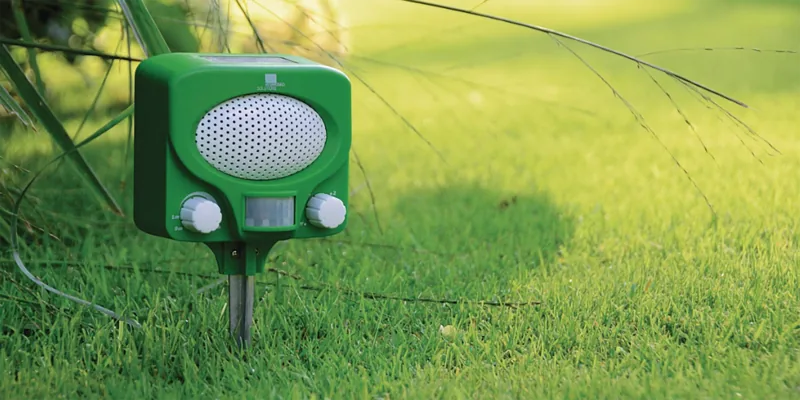
Mount it about 15 cm above ground facing the animals’ approach path, with the solar panel exposed to direct sunlight. Avoid placing behind obstacles that block ultrasonic waves; multiple units may be needed for full coverage.
Is this answer helpful?
The unit contains three AA 1.2V NiMH rechargeable batteries charged by the integrated solar panel or via the supplied USB cable. If the red LED blinks, charge via USB; steady red means fully charged. New or long-stored batteries should be conditioned with several full charge/discharge cycles.
Is this answer helpful?
Ultrasound emitted is intended to be inaudible or barely audible to humans, but can cause discomfort (headaches, pressure, tinnitus) in sensitive people and is perceived by pets. Do not operate near children, sensitive individuals, or pets; disable the unit if they are in the coverage area.
Is this answer helpful?
Common fixes: recharge or replace batteries if LED is off or blinking; clean or replace corroded contacts; replace a faulty USB cable; dry the device and move location if moisture is present. Do not open or tamper with the device.
Is this answer helpful?
Yes—the flash increases deterrence especially in darkness. Avoid using the flash if someone with epilepsy may be in range, and charge regularly if flash is used for long periods since it demands more energy.
Is this answer helpful?
Do not discard with household waste. Return the device and batteries to appropriate e-waste collection or recycling points per local regulations. Batteries may contain recyclable materials and must be disposed of separately when possible.
Is this answer helpful?
Advantages and Disadvantages
Advantages

- Solar + USB charging with preinstalled rechargeable NiMH batteries for flexible power supply.
- Multiple frequency modes and strobe flash to target a wide range of pests and reduce habituation.
- Simple controls (Sensitivity and Frequency dials) and motion-triggered operation save energy.
- Low-maintenance, weather-resistant design with mounting options (stake or wall) for versatile placement.
- Clear safety guidance and CE compliance; includes troubleshooting and disposal instructions.
Disadvantages

- Ultrasound effectiveness limited by obstacles and may require multiple units for full coverage.
- Not 100% effective—animal responses vary and some species may ignore deterrents.
- Potential discomfort for pets, children, or people with sensitive hearing; flash can trigger epilepsy.
- Intermittent operation and battery condition affect performance; requires periodic charging/conditioning.
- Ultrasonic emissions are directional and attenuate behind objects, limiting blind-spot protection.
Product Specification
Effective Area
968.75 sq ft
Battery
3x NiMh-Battery
Dimensions (HxWxD)
14.69x3.62x2.68 in
Product Description
Voss Voss.Sonic 2000 Animal Repeller Solar Manual
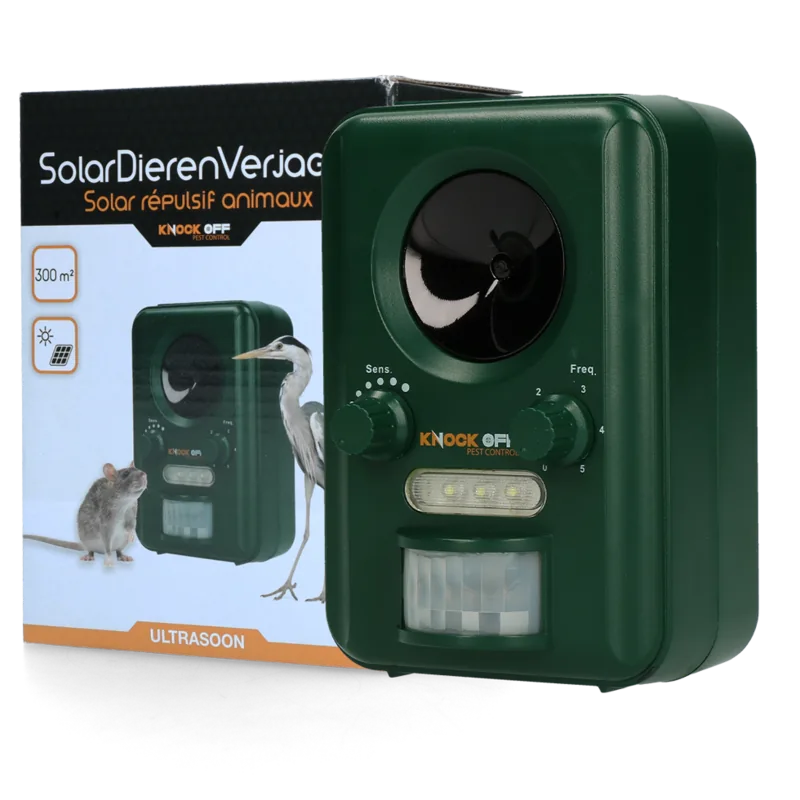
The Voss Voss.Sonic 2000 is a solar-powered ultrasonic animal repeller designed for straightforward, entry-level protection of gardens, yards, carports, attics and similar spaces. Combining selectable ultrasonic frequency modes with a strobe LED flash and passive infrared motion detection, the unit triggers brief deterrent signals only when movement is detected—reducing habituation and conserving battery. It comes preinstalled with three AA 1.2V NiMH rechargeable cells that are topped up by the integrated solar panel and can also be charged via the supplied USB cable.
What the VOSS.sonic 2000 does
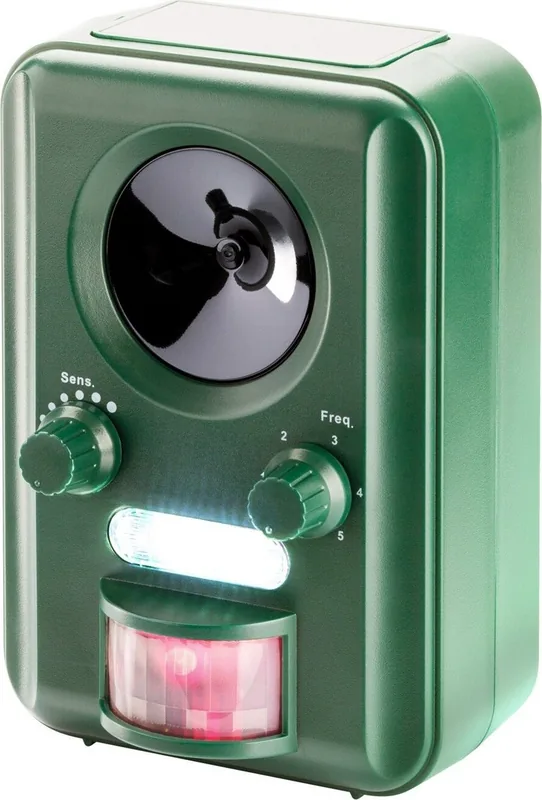
When motion is detected, the device emits sequences of ultrasonic tones (14–26 kHz) and, if enabled, a flashing LED. There are five frequency settings: three targeted frequency bands for different animal groups (small rodents, canids/mesocarnivores, large mammals), a flash mode optimized for birds, and a combined mode that cycles frequencies and activates the strong flash. The infrared sensor covers roughly a 110° arc with an 8–9 m detection range; effective ultrasonic coverage can reach up to about 90 m² depending on placement and obstacles.
Key features and usage tips
Place the unit about 15 cm above ground and point it toward the expected approach path of animals. Solar charging works best with unobstructed sunlight and occasional cleaning of the panel. If battery level is low the red LED will blink—connect to USB to recharge; a steady red LED signals full charge. For reliable performance, condition new or long-stored NiMH batteries with several full charge/discharge cycles. The Sens. dial adjusts detection range; the Freq. dial selects the deterrent mode. Always set the dial to OFF before changing modes to ensure the new setting registers correctly.
Safety and limitations
The manual emphasizes safety: avoid prolonged exposure within the device's sound field (especially for children, sensitive-hearing individuals, or pets), disable the flash if someone with epilepsy might be present, and do not place inside living rooms unless explicitly intended. Ultrasound can be attenuated by structures or objects—multiple units may be required for complete coverage. Continuous operation is not recommended and the manufacturer warns there is no 100% guarantee all animals will be repelled.
Practical maintenance
The device is low-maintenance: keep it clean, dry, and inspect periodically for damage or moisture ingress. Replace or recharge batteries if the LED indicates low power. For recycling and disposal, follow local e-waste and battery-return regulations; the product carries the crossed-out bin symbol and CE conformity.
Notes
- Includes mounting post and USB cable (single or dual-pack variants available).
- Frequency range: 14–26 kHz; ultrasonic sound pressure near device: ~80–120 dB.
- Recommended initial conditioning: 3 charge/discharge cycles for NiMH batteries.
Search for 67,706 Manuals online


Type-in Brand or Model