
TRENDnet TPE-5048WS Manual
PDF manual · 104 Pages
English



Quick check
Incorrect answer, please try again.
Chat with your TRENDnet TPE-5048WS manual using AI
Get instant AI answers from your TRENDnet TPE-5048WS manual
Ask anything about the TRENDnet TPE-5048WS. Answers come from this manual, with the pages they are based on.
Ask a Question
Do you recommend TPE-5048WS?
Yes NoFrequently Asked Questions
It fits SMBs, surveillance networks, VoIP setups, wireless AP deployments, and other installations that need many powered network ports with centralized management.
Is this answer helpful?
The switch offers a total PoE+ budget of 740W and can supply up to 30W per port, making it suitable for devices that need higher power than standard PoE.
Is this answer helpful?
Yes. The four shared uplink ports can operate as RJ-45 or SFP connections, giving you the choice between copper and fiber depending on your network design.
Is this answer helpful?
Yes. It supports IPv6 configuration, IPv6 neighbor discovery, and IPv6 management settings, so it can fit into modern mixed or IPv6-ready networks.
Is this answer helpful?
It includes a web interface plus SNMP, RMON, logs, cable diagnostics, port mirroring, VLAN tools, trunking, QoS, and spanning tree controls for advanced administration.
Is this answer helpful?
After making changes, save the configuration to flash/NV-RAM. That preserves the settings even if the switch is restarted or power cycled.
Is this answer helpful?
Advantages and Disadvantages
Advantages

- 48 PoE+ Gigabit ports and a 740W power budget support large device deployments.
- Shared RJ-45/SFP uplinks offer flexible backbone and expansion options.
- Strong management tools include VLANs, QoS, trunking, STP, LLDP, and diagnostics.
- Security and monitoring features such as ACLs, SNMP, RMON, SSL, and authentication help control access.
Disadvantages

- The large feature set may feel complex for users who only need basic switching.
- PoE budget must be planned carefully when many high-power devices are connected.
- Some advanced functions require careful configuration to avoid network loops or lockouts.
- Fiber SFP modules are optional, so separate purchases may be needed for uplink use.
Product Specification
Function
Switch
Type
Standalone, Rackmount (via mounting brackets)
Network ports
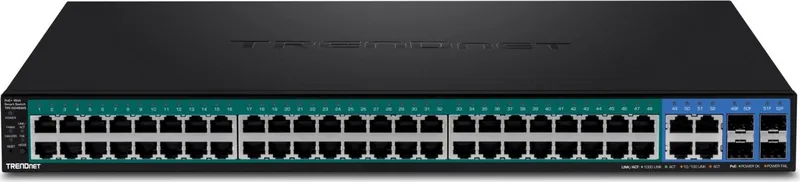
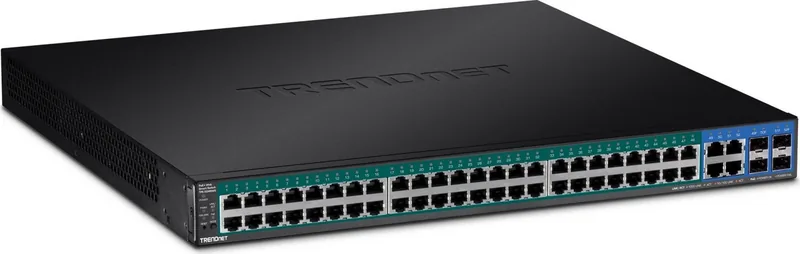
48x RJ-45, 4x RJ-45/SFP
Speeds
52x RJ-45 (10/100/1000Base-T), 4x SFP (100M/1Gb/s)
PoE
48x RJ-45 PoE+ (48x 30W), total: 740W
Backplane
104Gb/s, 77.4Mp/s, 10KB Jumbo frames, 1.5MB Packet buffer, 16K Mac addresses
Officially supported standards
802.1AX, 802.1D, 802.1Q, 802.1X, 802.1AB, 802.1p, 802.1s, 802.1w, 802.1X, 802.3, 802.3ab, 802.3af, 802.3at, 802.3az, 802.3u, 802.3x, 802.3z, IGMPv3, MLDv2
Configuration
Web interface, Configuration software (Windows)
Cooling
active, 5x fans (1.57in)
Dimensions (WxHxD)
17.32x1.73x16.93in, 1U
Weight
14.51lbs
Color
black
Special features
Metal housing, removable mounting brackets, firmware updates possible
Manufacturer warranty
three years
Note
For this device, "link aggregation" was officially specified with the obsolete standard IEEE802.3ad. Since 2008, the function is no longer managed by the IEEE "Working Group 3" (IEEE 802.3, CSMA/CD - Ethernet), but by "Working Group 1" (IEEE 802.1, High Level Interface - Internetworking) and is technically defined unchanged via IEEE 802.1AX.
Product Description
TRENDnet TPE Rackmount Gigabit Smart Switch: A Powerful PoE+ Core for Busy Networks
The TRENDnet TPE Rackmount Gigabit Smart Switch, 48x RJ-45, 4x RJ-45/SFP, 740W PoE+ Manual describes a feature-rich switch built for organizations that need speed, power, and flexible control in one rackmount unit. With 48 Gigabit PoE+ ports and 4 shared uplink ports, it is designed to support dense device deployments while keeping network traffic organized and manageable.
At the heart of this switch is a generous 740W PoE+ budget, which makes it a strong fit for powering wireless access points, IP cameras, VoIP phones, and other PoE-enabled devices. Each port can deliver up to 30W, giving installers room to scale without adding separate power injectors. The switch also includes shared RJ-45/SFP uplink options, so it can adapt to copper or fiber backbone needs depending on the environment.
Beyond raw connectivity, this model is built for practical network administration. The web-based management interface supports features like VLANs, link aggregation, QoS, LLDP, IGMP snooping, loopback detection, and spanning tree options including STP, RSTP, and MSTP. These tools help reduce loops, prioritize traffic, and keep performance stable as the network grows.
Security and visibility are equally important. The switch supports ACLs, port access control, MAC filtering, 802.1X, RADIUS, TACACS+, SNMP, and RMON monitoring. Administrators can also use logging, traffic statistics, cable diagnostics, and mirroring to troubleshoot problems before they affect users. IPv6 support and SSL/HTTPS management add modern readiness and safer remote administration.
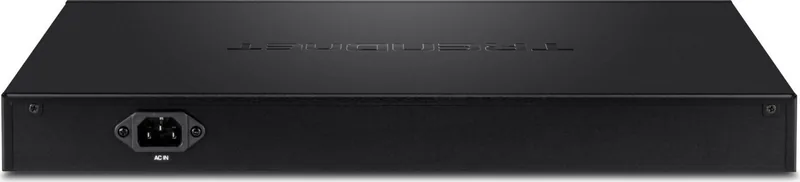
For rack-based deployments, the hardware design is straightforward and enterprise-friendly. The reset and mode buttons, status LEDs, fan monitoring, and clear port indicators make it easier to track power, link activity, and PoE load at a glance. In short, this switch is aimed at networks that need dependable PoE delivery, advanced control, and room to expand.
Notes
- Best suited for SMBs, surveillance systems, and access-point-heavy environments.
- Save configuration changes to flash to keep settings after reboot or power loss.
- Use SFP uplinks when longer-distance or fiber connectivity is needed.
- Match IP and management settings carefully before moving the switch into production.
Search for 67,732 Manuals online


Type-in Brand or Model