
Testo 835-T1 Manual
PDF manual · 74 Pages
English



Quick check
Incorrect answer, please try again.
Chat with your Testo 835-T1 manual using AI
Get instant AI answers from your Testo 835-T1 manual
Ask anything about the Testo 835-T1. Answers come from this manual, with the pages they are based on.
Ask a Question
Do you recommend 835-T1?
Yes NoFrequently Asked Questions
The Testo 835-T1 measures surface temperatures by infrared from -30 to +600 degrees C. It has 0.1 degree resolution and a 0.5-second measuring rate.
Is this answer helpful?
Yes. A compatible Type K thermocouple probe can be connected for contact measurements from -50 to +600 degrees C. Contact readings are useful for checking critical infrared results and for emissivity adjustment.
Is this answer helpful?
A 50:1 ratio indicates that the measurement spot becomes wider as distance increases. It helps the user target smaller areas from farther away, but the target must still fully fill the measured spot for dependable results.
Is this answer helpful?
Emissivity can be chosen from a material list, entered manually, or calculated automatically by comparing a contact temperature with an infrared measurement. The default setting of 0.95 suits many non-metal materials.
Is this answer helpful?
Yes. The instrument stores individual displayed readings in named locations with date and time information. Its USB interface supports transfer and configuration through compatible Testo EasyClimate software.
Is this answer helpful?
Infrared measurement reads the surface only and can be affected by dirt, frost, steam, viewing conditions, and material emissivity. A contact probe provides an important confirmation when measurement accuracy is critical.
Is this answer helpful?
Advantages and Disadvantages
Advantages

- 50:1 optics and a four-point laser support targeted infrared measurements from a practical distance.
- Measures -30 to +600 degrees C by infrared and supports Type K contact probes from -50 to +600 degrees C.
- Emissivity can be selected by material, adjusted manually, or calculated by comparison with contact readings.
- Stores timestamped individual readings, supports alarms, and transfers data through USB with compatible software.
- Runs on three AA batteries for up to 25 hours under typical conditions without laser or backlight.
Disadvantages

- Infrared measurement is limited to surface temperature and may need contact verification for critical readings.
- Bare or shiny metals can produce less reliable infrared results because of low or uneven emissivity.
- The T1 does not include the humidity, dew point, or surface-moisture functions available on the H1 model.
- Only individual displayed readings are saved; measurement series are not stored as continuous logs.
- The instrument must not be used near live electrical parts, in explosive areas, or for medical diagnosis.
Product Specification
Measurement range
-58°F to +1,112°F
Display
yes
Special features
Memory function
Power supply
Battery operation (3 x AA batteries)
Weight
1.13 lb
Product Description
Testo 835-T1 Infrared Thermometer - Read, Download & Print Free
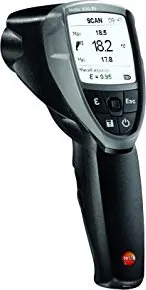
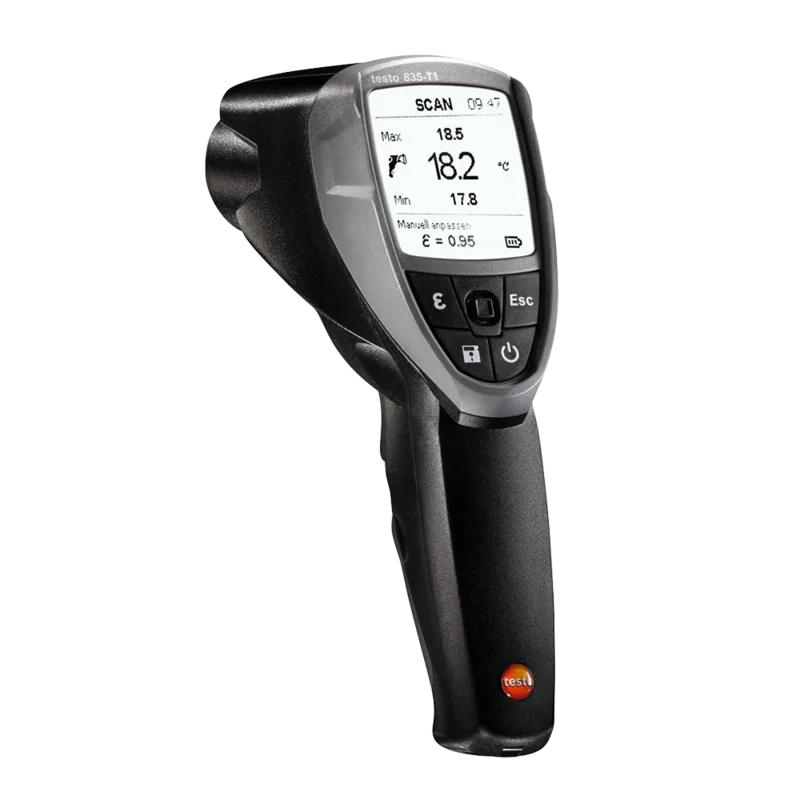
The Testo 835-T1 Infrared Thermometer is a professional instrument designed for fast, non-contact surface temperature checks in demanding maintenance, inspection, and quality-control work. Its 50:1 optics help users measure smaller targets from a safer, more practical distance, while the four-point laser clearly marks the measurement area. This makes the thermometer well suited to HVAC systems, electrical cabinets, industrial equipment, building diagnostics, and production environments.
Accurate infrared and contact measurement
The T1 model measures infrared surface temperatures from -30 to +600 degrees C, with a 0.1 degree resolution and a rapid 0.5-second measuring rate. For situations where direct confirmation is needed, the instrument accepts a Type K thermocouple probe for contact measurements from -50 to +600 degrees C. Comparing infrared and contact readings can help verify critical results and support more confident decisions.
Accurate infrared work depends on choosing the correct emissivity. The Testo 835-T1 includes material-based settings, manual adjustment, and an automatic emissivity option that compares contact and infrared temperature values. This is especially useful when measuring painted surfaces, plastics, wood, ceramics, food products, and other materials with different radiation characteristics. Shiny or bare metals may require a contact check because their emissivity can be low or uneven.
Built for efficient field work
A trigger-operated measurement system supports both normal and continuous scanning. The display can show infrared temperature, maximum and minimum values, thermocouple temperature, and the difference between contact and infrared readings. Configurable alarms provide a clear warning when readings cross selected limits, helping technicians identify potential issues quickly.
The instrument also includes internal memory for individual readings, with named locations and date-time stamps. Through its USB interface, saved values and settings can be transferred to a computer using compatible Testo EasyClimate software. The durable ABS/PC housing, backlit display, adjustable laser, and intuitive five-way joystick make daily operation straightforward.
Power and care considerations
The Testo 835-T1 uses three AA batteries and offers up to 25 hours of typical runtime without laser or display illumination. Keep the infrared lens clean, allow about 15 minutes for adjustment after major ambient temperature changes, and keep dust, steam, rain, and gases out of the measurement path. Avoid use near live electrical parts, in explosive areas, or for medical diagnostic applications.
Notes
- Infrared readings measure the outer surface only, not internal temperature.
- Confirm critical readings with a suitable contact probe.
- Clean the lens gently with water or medical alcohol on a cotton swab.
Search for 67,706 Manuals online


Type-in Brand or Model
Quentin Shaw
5 months ago
Can this device measure small or slim objects accurately?
Manual.ly
5 months ago
The measuring setup may not be suitable for very small or narrow objects, as they can be difficult to position or detect reliably. It works well for objects within its intended size range. Please check the product specifications for minimum measurable dimensions before purchase.