
Testo 410-2 Manual
PDF manual · 60 Pages
English



Quick check
Incorrect answer, please try again.
Chat with your Testo 410-2 manual using AI
Get instant AI answers from your Testo 410-2 manual
Ask anything about the Testo 410-2. Answers come from this manual, with the pages they are based on.
410-2 Maintenance Schedule
Clean the housing with a moist cloth and soapy water if dirty. Do not use aggressive cleaning agents or solvents.
Replace used batteries with new 1.5V AAA batteries observing polarity when residual capacity is low.
Ask a Question
Do you recommend 410-2?
Yes NoFrequently Asked Questions
The Testo 410-2 measures air velocity, temperature and relative humidity. It also provides derived values such as wind chill, wet-bulb temperature and dew point, selectable on the display.
Is this answer helpful?
Velocity: 0.4–20 m/s (80–4000 fpm); temperature: -10–50 °C (14–122 °F); humidity: 0–100 %rH. Accuracy: ±(0.2 m/s +2% of reading) for velocity, ±0.5 °C for temperature, ±2.5 %rH (5–95 %rH) for humidity.
Is this answer helpful?
Select the Hold Avg display mode by pressing the view key until Hold and Avg appear, then press and hold until - - - - is shown. Release to begin timed averaging; press to end and display the average.
Is this answer helpful?
The instrument uses 2 × 1.5 V AAA batteries. Typical battery life is about 60 hours without backlight. Replace batteries when remaining capacity is low or readings indicate Hi/Lo due to power.
Is this answer helpful?
Orient the instrument so the airflow enters from the rear (toward the impeller). Keep hands and other heat or moisture sources away from the sensors to avoid distorted temperature and humidity readings.
Is this answer helpful?
Yes. Cycle to the Max or Min view, then press and hold until - - - - appears to reset. Units for temperature, humidity output and velocity can be changed in configuration mode at startup.
Is this answer helpful?
The device is rated IP10, so it offers limited protection against ingress and is not recommended for wet or heavily contaminated environments. Use it in clean, dry conditions or take protective measures.
Is this answer helpful?
Advantages and Disadvantages
Advantages

- Compact, lightweight design (133×46×25 mm, 110 g) for easy handheld use and transport.
- Measures air velocity, temperature and humidity simultaneously with fast update rates (0.5 s/1 s).
- Multiple units and modes (Hold, Max, Min, Hold Avg) allow versatile field diagnostics.
- Good accuracy for HVAC checks: ±(0.2 m/s +2% reading), ±0.5 °C, ±2.5 %rH.
- Long battery life: ~60 hours on 2×AAA (without backlight) and simple battery replacement.
Disadvantages

- Protection class IP10 offers limited ingress protection, not suited to harsh or wet environments.
- No advanced data logging or connectivity — only manual readout and view modes.
- Backlight auto-off after 10 seconds can be short for dim environments without repeated presses.
- Measurement lower limit 0.4 m/s may not capture very low air movements accurately.
- Limited long-term humidity stability requires periodic sensor checks (±1 %rF/year drift).
Product Specification
Measurement range
1.31-65.62ft/s
Accuracy
+/-0.66ft/s
Product Description
Testo 410-2 vane anemometer Manual
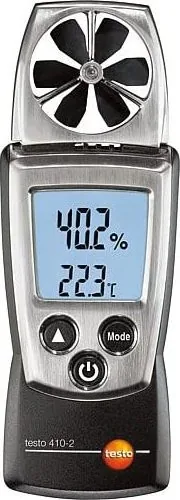
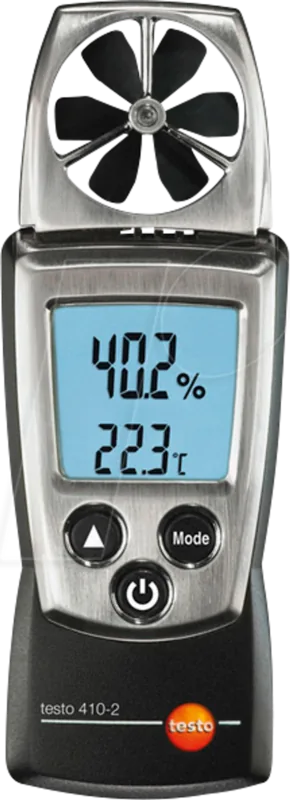
The Testo 410-2 vane anemometer is a compact, handheld instrument designed for quick and reliable air velocity, temperature, and humidity measurements. Built around a plastic impeller, NTC temperature sensor and Testo humidity sensor, it’s optimized for checking ventilation outlets, HVAC commissioning, and basic indoor climate checks. Lightweight and battery powered, it offers versatility in units and display modes so technicians can capture spot readings, extremes, and timed averages with minimal setup.
Key features and operation
The instrument measures air velocity (0.4–20 m/s; 80–4000 fpm) and environmental data (‑10–50 °C; 0–100 %rH) with fine resolution (0.1 m/s, 0.1 °C, 0.1 %rH). Accuracy specifications are industry-appropriate: ±(0.2 m/s + 2% of reading) for velocity, ±0.5 °C for temperature and ±2.5 %rH for humidity (5–95 %rH). Measurements update rapidly (velocity every 0.5 s, humidity every 1 s). The device supports multiple units (m/s, km/h, fpm, mph, kts, Beaufort; °C/°F; %rH, dew point, wet bulb) and an auto-off option to conserve battery.
A simple control layout provides: on/off, display backlight, parameter selection, and view modes (current, Hold, Max, Min, Hold Avg). Hold Avg enables timed mean calculations for flow: start a measurement, record the averaged value, and stop or restart as needed. Max/Min can be reset via long-press sequences. The impeller parks under a protective cap for transport.
Practical use and maintenance
For accurate results, position the instrument so airflow approaches the rear inlet and keep hands or heat sources away from sensors. Insert two AAA batteries for about 60 hours of operation without backlight; the display backlight runs for 10 seconds after activation. Clean the housing with a damp cloth and mild soap—avoid solvents. Dispose of batteries responsibly and follow manufacturer guidance for end-of-life disposal.
Notes:
- Ideal for spot checks on ventilation outlets and basic climate assessment.
- Fast update rate supports responsive measurements in changing conditions.
- Protective cap and compact size make it convenient for field use.
Pros and cons (short list below) are derived from usage and specifications.
Search for 67,706 Manuals online


Type-in Brand or Model