
Tenda i24 Manual
PDF manual · 118 Pages
English



Quick check
Incorrect answer, please try again.
Chat with your Tenda i24 manual using AI
Get instant AI answers from your Tenda i24 manual
Ask anything about the Tenda i24. Answers come from this manual, with the pages they are based on.
Ask a Question
Do you recommend i24?
Yes NoFrequently Asked Questions
The Tenda i24 is intended for indoor wireless coverage in business and shared environments such as offices, hotels, schools, retail spaces, and meeting areas. Its ceiling-mounted design supports neat installation and broad Wi-Fi service.
Is this answer helpful?
The access point supports AP mode and Client+AP mode. AP mode creates Wi-Fi from a wired network connection. Client+AP mode bridges an existing upstream wireless network and provides wireless access for nearby devices.
Is this answer helpful?
Yes. Multiple SSIDs can be configured across the available wireless bands. Each SSID can use separate names, security settings, client limits, isolation settings, and VLAN assignments where the surrounding network supports VLANs.
Is this answer helpful?
Use WPA2-PSK with a strong unique password for common deployments, or WPA/WPA2 with a RADIUS server for enterprise authentication. MAC access rules, hidden SSIDs, and client isolation can add controls, but they should not replace strong encryption.
Is this answer helpful?
Frequency analysis and channel scanning show nearby wireless activity. Administrators can use these results to select less congested channels. RF settings, transmit power, RSSI thresholds, and 5 GHz preference can also help improve performance.
Is this answer helpful?
Yes. It supports local and cloud deployment options for broader installations. SNMP, system logs, traffic statistics, client lists, and status views provide monitoring and troubleshooting tools for administrators.
Is this answer helpful?
Advantages and Disadvantages
Advantages

- Dual-band wireless operation supports flexible coverage planning for varied client devices.
- Multiple SSIDs allow separate guest, staff, and operational wireless networks.
- WPA2, RADIUS authentication, client isolation, and MAC rules strengthen access control.
- Channel analysis, WMM, airtime scheduling, and MU-MIMO help optimize busy Wi-Fi environments.
Disadvantages

- Advanced RF optimization settings may require networking expertise to configure safely.
- Client+AP mode does not support dual-band bridging at the same time.
- Factory reset removes current settings, so configuration backups are important.
- VLAN and enterprise authentication setups require compatible network infrastructure.
Product Specification
LAN
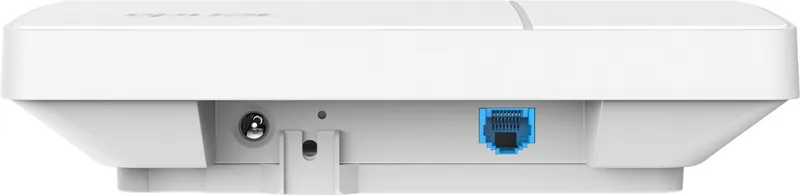
1x 1000Base-T (PoE PD)
Wireless
WLAN 802.11a/b/g/n/ac (Wi-Fi 5), simultaneous
Transmission Rate
300 Mbps (2.4 GHz), 867 Mbps (5 GHz)
Security
64/128-bit WEP, WPA, WPA2
Antennas
internal
Ports
N/A
Power Consumption
13.5 W (operating consumption), not specified (max. power supply output)
Dimensions
7.01 x 7.01 x 1.50 in
Features
MU-MIMO, VLAN
Band Capability
Dual Band (simultaneous)
Product Description
Tenda i24 - Read, Download & Print Free
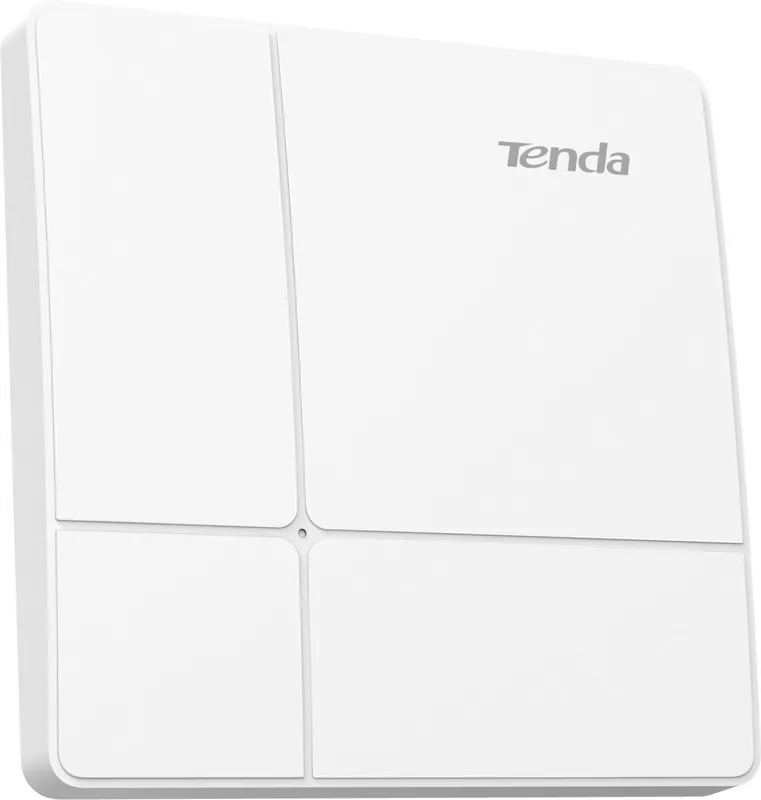
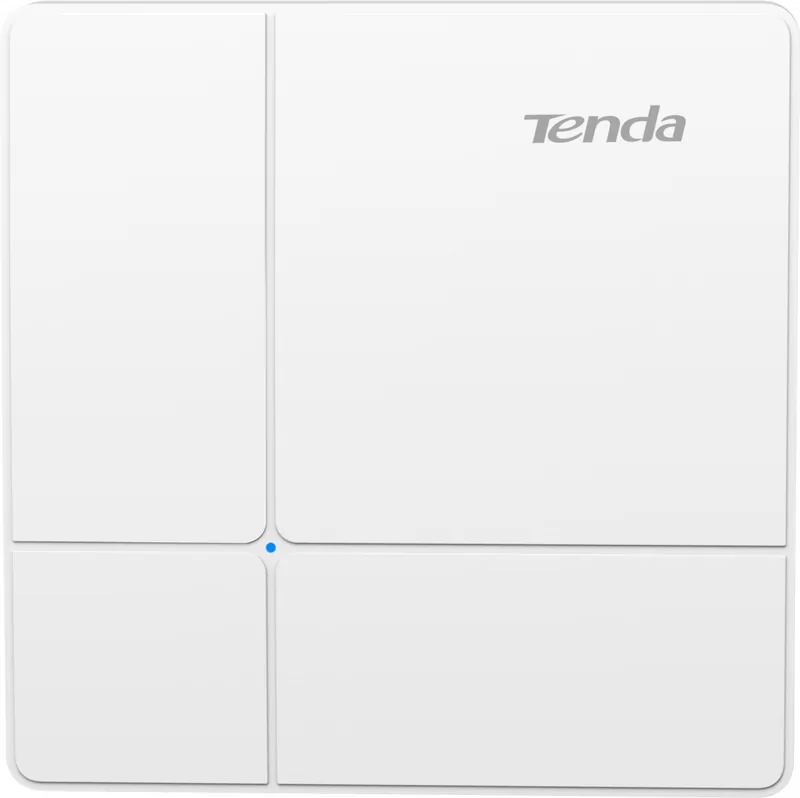
The Tenda i24 is a ceiling-mounted wireless access point designed to help businesses create dependable Wi-Fi coverage in busy indoor spaces. It is suited to offices, hotels, schools, retail areas, meeting rooms, and other locations where many users need stable wireless access. Its discreet ceiling installation helps maintain a clean appearance while placing the wireless signal where it can serve a wider area effectively.
Flexible Wireless Network Setup
This Tenda access point supports both standard AP mode and Client+AP mode. In AP mode, it turns a wired network connection into a wireless network for phones, laptops, tablets, and other Wi-Fi devices. Client+AP mode can bridge an existing wireless connection while continuing to provide local Wi-Fi access, offering a practical option for extending coverage where additional cabling is difficult.
Dual-band operation helps administrators organize wireless service across 2.4 GHz and 5 GHz bands. Multiple SSIDs can be configured, allowing separate networks for guests, employees, departments, or devices. Each network can have its own security settings, client limits, broadcast preferences, and isolation controls. This makes the Tenda i24 useful for environments that require both convenient guest access and protected internal connectivity.
Security and Traffic Control
Wireless security options include WPA2-PSK and enterprise-oriented WPA or WPA2 authentication with a RADIUS server. Administrators can also use MAC address access control through whitelist or blacklist rules. Client isolation adds another layer of separation by preventing devices on the same wireless network from communicating directly when that is appropriate.
Quality-focused features such as WMM prioritization, airtime scheduling, MU-MIMO support, RSSI thresholds, and 5 GHz preference help improve service in more demanding deployments. Frequency analysis and channel scanning provide useful visibility into nearby wireless activity, helping users choose cleaner channels and reduce interference.
Centralized Management Features
The Tenda i24 offers local and cloud deployment options for installations with multiple access points. Network teams can review wireless clients, traffic statistics, system status, and radio information from the management interface. SNMP support can assist with monitoring through compatible network management systems, while system logs and remote log server support simplify troubleshooting.
Maintenance tools include firmware upgrades, configuration backup and restore, scheduled rebooting, LED control, ping diagnostics, and uplink detection. VLAN support can map individual SSIDs to separate network segments, enabling guest, staff, and administrator networks with different access permissions.
Note: Use strong passwords, modern WPA2 or enterprise security, and carefully planned VLAN settings. Advanced radio and traffic parameters should be adjusted only when the network requirements are clearly understood.
Search for 67,732 Manuals online


Type-in Brand or Model