Manual.ly Logo

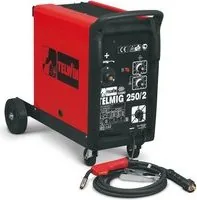
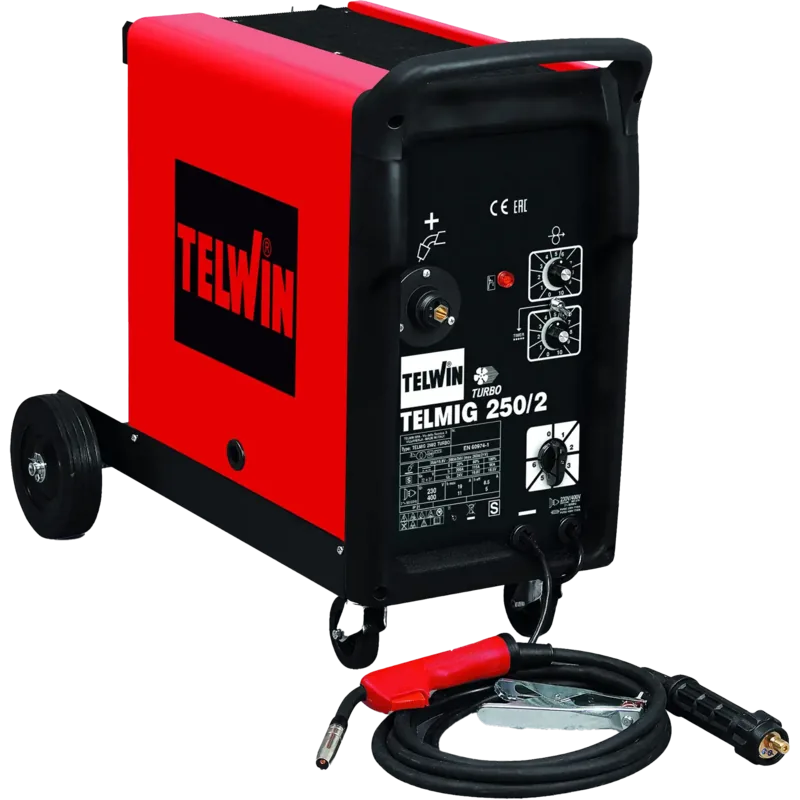
Telwin Telmig 250/2 Manual

0.0 · 0 Ratings

PDF manual · 108 Pages

English

M: QW-35-FL
page

/ 108

Loading...
150090d926629b5278fa0c7401956c69edad page 5
- 5 -
(EN)
INSTRUCTION MANUAL
WARNING:
BEFORE USING THE WELDING MACHINE READ THE INSTRUCTION
MANUAL CAREFULLY.
CONTINUOUS WIRE WELDING MACHINE FOR MIG/MAG AND FLUX
ARC WELDING DESIGNED FOR INDUSTRIAL AND PROFESSIONAL USE.
Note: In the following text the term “welding machine” will be used.
1. GENERAL SAFETY CONSIDERATIONS FOR ARC WELDING
The operator should be properly trained to use the welding machine
safely and should be informed about the risks related to arc welding
procedures, the associated protection measures and emergency
procedures.
(Please refer to the applicable standard ”EN 60974-9: Arc welding
equipment. Part 9: Installation and Use).
- Avoid direct contact with the welding circuit: the no-load voltage
supplied by the welding machine can be dangerous under certain
circumstances.
- When the welding cables are being connected or checks and
repairs are carried out the welding machine should be switched o
and disconnected from the power supply outlet.
- Switch o the welding machine and disconnect it from the power
supply outlet before replacing consumable torch parts.
- Make the electrical connections and installation according to the
safety rules and legislation in force.
- The welding machine should be connected only and exclusively to
a power source with the neutral lead connected to earth.
- Make sure that the power supply plug is correctly connected to the
earth protection outlet.
- Do not use the welding machine in damp or wet places and do not
weld in the rain.
- Do not use cables with worn insulation or loose connections.
- Do not weld on containers or piping that contains or has contained
ammable liquid or gaseous products.
- Do not operate on materials cleaned with chlorinated solvents or
near such substances.
- Do not weld on containers under pressure.
- Remove all ammable materials (e.g. wood, paper, rags etc.) from
the working area.
- Provide adequate ventilation or facilities for the removal of
welding fumes near the arc; a systematic approach is needed in
evaluating the exposure limits for the welding fumes, which will
depend on their composition, concentration and the length of
exposure itself.
- Keep the gas bottle (if used) away from heat sources, including
direct sunlight.
- Make sure there is adequate electrical insulation with respect to
the torch, the workpiece and any (accessible) earthed metal parts
in the vicinity.
This is normally achieved by wearing gloves, shoes, head coverings
and clothing designed for this purpose and by using insulating
platforms or mats.
- Always protect your eyes with the relative lters, which must
comply with UNI EN 169 or UNI EN 379, mounted on masks or use
helmets that comply with UNI EN 175.
Use the relative re-resistant clothing (compliant with UNI EN
11611) and welding gloves (compliant with UNI EN 12477) without
exposing the skin to the ultraviolet and infrared rays produced by
the arc; the protection must extend to other people who are near
the arc by way of screens or non-reective sheets.
- Noise: If the daily personal noise exposure (LEPd) is equal to or
higher than 85 dB(A) because of particularly intensive welding
operations, suitable personal protective means must be used (Tab.
1).
- The ow of the welding current generates electromagnetic elds
(EMF) around the welding circuit.
Electromagnetic elds can interfere with certain medical equipment
(e.g. Pace-makers, respiratory equipment, metallic prostheses etc.).
Adequate protective measures must be adopted for persons
with these types of medical apparatus. For example, they must
be forbidden access to the area in which welding machines are in
operation.
This welding machine conforms to technical product standards for
exclusive use in an industrial environment for professional purposes.
It does not assure compliance with the basic limits relative to human
exposure to electromagnetic elds in the domestic environment.
The operator must adopt the following procedures in order to reduce
exposure to electromagnetic elds:
- Fasten the two welding cables as close together as possible.
- Keep head and trunk as far away as possible from the welding
circuit.
- Never wind welding cables around the body.
- Avoid welding with the body within the welding circuit. Keep both
cables on the same side of the body.
- Connect the welding current return cable to the piece being
welded, as close as possible to the welding joint.
- Do not weld while close to, sitting on or leaning against the
welding machine (keep at least 50 cm away from it).
- Do not leave objects in ferromagnetic material in proximity of the
welding circuit.
- Minimum distance d= 20 cm (Fig. M).
- Class A equipment:
This welding machine conforms to technical product standards
for exclusive use in an industrial environment and for professional
purposes. It does not assure compliance with electromagnetic
compatibility in domestic dwellings and in premises directly
connected to a low-voltage power supply system feeding buildings
for domestic use.
EXTRA PRECAUTIONS
- WELDING OPERATIONS:
- In environments with increased riskof electric shock;
- In conned spaces;
- In the presence of ammable or explosive materials;
MUST BE evaluated in advance by an “Expert supervisor” and
must always be carried out in the presence of other people
trained to intervene in emergencies.
All protective technical measures MUST be taken as provided
in 7.10; A.8; A.10 of the applicable standard EN 60974-9: Arc
welding equipment. Part 9: Installation and Use”.
- Welding MUST NOT be allowed if the welding machine or wire
feeder is supported by the operator (e.g. using belts).
- The operator MUST NOT BE ALLOWED to weld in raised positions
unless safety platforms are used.
- VOLTAGE BETWEEN ELECTRODE HOLDERS OR TORCHES: working
with more than one welding machine on a single piece or on
pieces that are connected electrically may generate a dangerous
accumulation of no-load voltage between two dierent electrode
holders or torches, the value of which may reach double the
allowed limit.
An expert coordinator must be designated to measuring the
apparatus to determine if any risks subsist and suitable protection
measures can be adopted, as foreseen by section 7.9 of the
applicable standard ”EN 60974-9: Arc welding equipment. Part 9:
Installation and Use”.
RESIDUAL RISKS
- OVERTURNING: position the welding machine on a horizontal
surface that is able to support the weight: otherwise (e.g. inclined
or uneven oors etc.) there is danger of overturning.

Chat with your Telwin Telmig 250/2 manual using AI

Get instant AI answers from your Telwin Telmig 250/2 manual

Ask anything about the Telwin Telmig 250/2. Answers come from this manual, with the pages they are based on.

Telmig 250/2 Maintenance Schedule

Before every use
Check wear and assembly of torch parts

Inspect the nozzle, contact tip, and gas diffuser for wear and correct assembly before using the welding machine.

Every time wire reel is changed
Blow out wire-guide hose with dry compressed air

Use dry compressed air (max. 5 bar) to clean the wire-guide hose and check it for damage when changing the wire reel.

Frequently
Check wire feeder rollers and remove metal dust

Regularly inspect the wear state of the wire feeder rollers and remove accumulated metal dust from the feeder area.

Periodically
Check gas pipe and connector seals

Perform regular checks on the integrity of the gas pipe and connector seals to ensure no leaks.

Periodically
Clean internal components with compressed air

Remove dust from the transformer, reactance, and rectifier using a jet of dry compressed air (max. 10 bar). Frequency depends on usage and environment dustiness.

M: qwen/qwen3.8-flash

Ask a Question

0/1000

Do you recommend Telmig 250/2?

Yes No

Frequently Asked Questions

A

No, this machine is classified as Class A equipment intended exclusively for industrial and professional environments. It does not guarantee compliance with electromagnetic compatibility limits for domestic dwellings.

Is this answer helpful?

A

Absolutely not. The welding current generates electromagnetic fields that can interfere with vital medical equipment like pacemakers. Users with such devices or metal prostheses are strictly forbidden from operating the machine.

Is this answer helpful?

A

For flux welding without gas, open the reel compartment door. Connect the torch cable from the wire feeder to the black terminal (-) and the clamp return cable to the red terminal (+). Close the door securely after connecting.

Is this answer helpful?

A

You must wear protective clothing, welding gloves, and eye protection filters compliant with UNI EN 169 or 379. A protective mask or helmet complying with UNI EN 175 is also compulsory to shield against UV and IR rays.

Is this answer helpful?

A

You should frequently check the state of wear on the rollers and regularly remove metal dust deposited in the feeder area. Use dry compressed air to clean the guide hose when changing wire reels.

Is this answer helpful?

A

No, it is strictly prohibited to use the handle as a means of suspension or hanging the welding machine. Always secure the machine on a flat surface to prevent tipping.

Is this answer helpful?

M: QW-35-FL

Advantages and Disadvantages

Advantages

  • Versatile capability for MIG/MAG and Flux welding on various metals including steel and aluminum
  • Comprehensive safety warnings and clear instructions for professional environments
  • Durable design suitable for heavy industrial use with high duty cycle options
  • Includes standard accessories like torch and earth clamp for immediate setup
VS

Disadvantages

  • Not suitable for domestic use due to Class A equipment classification and EMF levels
  • Strict prohibition for users with pacemakers or metal prostheses limits accessibility
  • Requires qualified personnel for installation and extraordinary maintenance procedures
  • No built-in lifting device necessitates external handling methods for transport
M: QW-35-FL

Product Specification

Power

7kW (230V/400V)

Open circuit voltage

33V

Control range

35-260A (MIG/MAG)

Protection class

IP21

Dimensions

25.8x31.5x17.7in (HxDxW)

Weight

110.23lbs

M: QW-35-FL

Product Description

The Telwin Telmig 250/2 MIG/MAG Welding Machine Manual: A Comprehensive Guide for Professionals

The Telwin Telmig 250/2 is a robust continuous wire welding machine designed specifically for industrial and professional applications. This powerful unit excels in MIG/MAG and Flux arc welding, making it an essential tool for working with carbon steel, low-alloy steel, stainless steel, and aluminum. Whether you are using solid or cored electrode wires with CO2 or Argon shielding gases, this machine delivers consistent performance. It is engineered to handle demanding tasks while adhering to strict safety standards like EN 60974-9.

Operating this equipment requires careful attention to detail and adherence to the guidelines found within its instruction manual. The machine features advanced control systems that allow users to adjust wire feed rates and welding currents precisely. Safety is paramount; the manual emphasizes the dangers of electric shock, welding fumes, ultraviolet radiation, and fire. Users must wear protective clothing, gloves, and masks compliant with UNI EN standards to prevent injury from arcs and fumes. Additionally, specific precautions are necessary regarding electromagnetic fields, which can interfere with medical devices like pacemakers.

Installation and setup are critical steps before the first use. The machine must be connected to a power source with proper earth grounding, and all electrical connections should only be performed by qualified personnel. The unit includes standard accessories such as a torch, return cable with earth clamp, and a wheel kit for mobility. Proper ventilation is required to remove hazardous fumes, and gas bottles must be secured away from heat sources. Regular maintenance ensures longevity, involving checks on rollers, wire guides, and internal components using dry compressed air.

Essential Notes for Safe Operation

  • Always disconnect power before performing any maintenance or changing wire reels.
  • Do not lift the machine by the handle or hang it from the handle.
  • Ensure a minimum distance of 50 cm from the machine during operation to reduce EMF exposure.
  • Avoid welding in damp conditions or near flammable materials.
  • Users with metal prostheses or vital electronic implants should strictly avoid using this machine.
M: QW-35-FL

© Copyright 2026 Manual.ly