

Stanley ST-125T-KFA-E Manual
PDF manual · 65 Pages
English



Quick check
Incorrect answer, please try again.
Chat with your Stanley ST-125T-KFA-E manual using AI
Get instant AI answers from your Stanley ST-125T-KFA-E manual
Ask anything about the Stanley ST-125T-KFA-E. Answers come from this manual, with the pages they are based on.
ST-125T-KFA-E Maintenance Schedule
Flush the fuel tank with paraffin every 200 hours of operation or as needed to prevent issues.
Open heater lid and replace air filters every 500 hours of operation or sooner depending on conditions.
Open heater lid and clean fan blades at least once per heating season.
Open heater lid, remove burner head, and clean or replace the nozzle at least once per heating season.
Open heater lid, clean the spark plug, and re-gap terminals to 3.5mm every 600 hours of operation.
Open heater lid and clean the photocell at least once per heating season or more depending on conditions.
Ask a Question
Do you recommend ST-125T-KFA-E?
Yes NoFrequently Asked Questions
The heater is designed to run on diesel or paraffin fuel. It is not suitable for gasoline, benzene, alcohol, or other volatile compounds which can cause fire or explosion.
Is this answer helpful?
Always place the appliance on a flat, stable, heat-resistant surface. Ensure proper ventilation is available and keep combustibles at the recommended safety distance.
Is this answer helpful?
Drain the fuel tank completely using the drain plug or siphon. Store the heater in a dry, well-ventilated area and protect it with a tarp if stored outdoors.
Is this answer helpful?
Clean fuel lines every 200 hours, replace air filters every 500 hours, and clean fan blades or nozzles at least once per heating season.
Is this answer helpful?
No, this unit produces carbon monoxide and is only for temporary heating in well-ventilated areas. It is not suitable for bedrooms or residential homes.
Is this answer helpful?
E1 typically indicates incorrect pump pressure, dirty filters, a dirty nozzle, or issues with the photocell or electrical connections.
Is this answer helpful?
Children aged 8 and above can use it only if supervised. Children under 8 should not operate it, and younger children must be kept away while it runs.
Is this answer helpful?
Advantages and Disadvantages
Advantages

- Thermostat control allows precise temperature regulation between 5C and 45C
- Digital display shows ambient temperature and fuel levels clearly
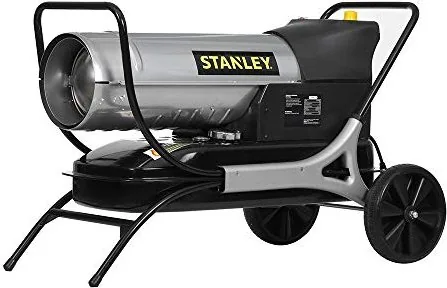
- Sturdy wheel support frame ensures mobility across rough ground
- Fuel flexibility supports diesel or paraffin usage
- High thermal power suitable for large industrial spaces
Disadvantages

- Not suitable for primary heating in homes or recreational vehicles
- Requires mandatory ventilation to prevent carbon monoxide poisoning
- Old fuel deteriorates quickly and can damage internal components
- Heavy unit requires stable flat surface for operation
- Safety supervision needed when children are present
Product Specification
Rated Heat Output
36.6 kW
Color
black, gray
Heating Area
up to 3,100 sq ft
Heat Settings
Yes
Fuel
Diesel
Features
casters, carrying handle
Mounting Type
freestanding
Dimensions
39.0 x 26.0 x 24.0 in (W x H x D)
Weight
60.63 lbs
Product Description
Reliable Heating Solutions for Construction
Maintaining a comfortable working environment on a construction site or in a large industrial space requires efficient heating solutions. The Stanley ST-125T-KFA-E Diesel Air Heater stands out as a powerful option for temporary climate control. This unit delivers substantial thermal power capable of warming significant cubic meters of space effectively. When evaluating the best equipment for your specific project needs, referencing the Stanley ST-125T-KFA-E Diesel Air Heater Manual provides critical safety and operational guidance. Understanding these instructions ensures that the appliance runs safely and efficiently over extended periods.
Key Features and Operation
The device operates using diesel or paraffin fuel, which is widely available for industrial applications. The tank capacity supports extended operation times without constant refueling interruptions. A digital thermostat allows precise temperature regulation between five degrees and forty-five degrees Celsius. The display screen provides clear visibility of room temperature and fuel levels for the operator. This feature helps prevent cold spots and ensures workers remain productive in chilly conditions.
Safety and Portability
Portability is a key design element. The heater mounts on a sturdy wheel support frame, making it easy to move across rough ground. Always place the unit on a stable, flat surface to ensure proper combustion. Safety warnings are extensive due to the nature of direct-fire heaters. Proper ventilation is mandatory to prevent carbon monoxide poisoning. You must provide specific opening sizes for outside air intake based on the heater rating. Never block the front air outlet or rear air inlet during operation.
Maintenance and Long Term Care
Maintenance routines are straightforward but must be followed strictly. Clean the air filters every five hundred hours of operation to maintain performance. The spark plug requires inspection and cleaning every six hundred hours. Always drain the fuel tank completely before storing the heater for long periods. Old fuel deteriorates and can damage internal components. Never refill the tank while the unit is hot or running to avoid fire hazards.
Final Recommendations
This heater is designed for workshops and temporary structures rather than residential living spaces. It is not suitable for primary heating in homes or recreational vehicles. If any part of the power cord shows wear, it must be replaced immediately. Keep all combustible materials away from the front clearance areas as specified. This ensures that the equipment provides reliable heat while minimizing risk factors for your workforce. It requires attention to detail regarding fuel quality and electrical connections for best results.
Troubleshooting and Notes
If troubleshooting issues arise, the LED display may show error codes like E1. This often indicates pump pressure issues or dirty filters which need immediate attention. Checking the photocell and wiring connections resolves many common faults effectively. Regular checks on the nozzle and ignitor ensure consistent combustion quality. Proper care prevents soot production and maintains thermal efficiency over time.
Search for 67,732 Manuals online


Type-in Brand or Model