
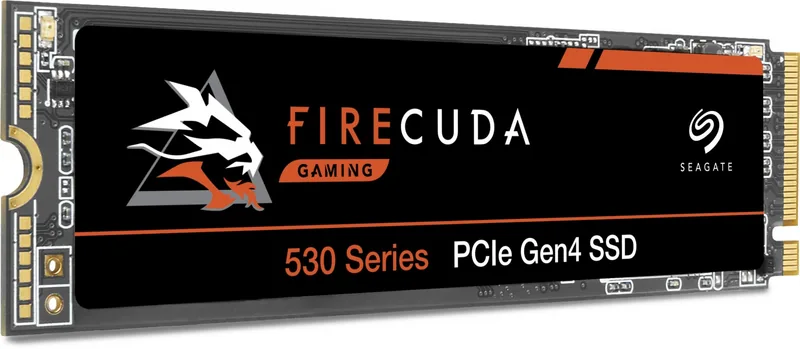
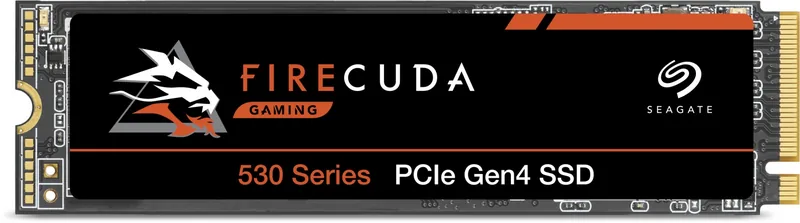
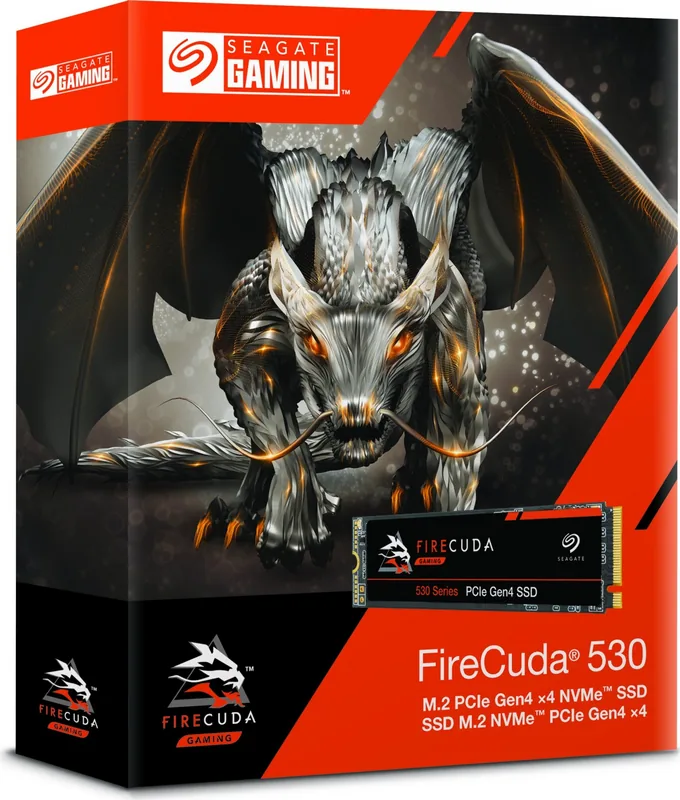
Seagate FireCuda 530 Manual
PDF manual · 32 Pages
English



Quick check
Incorrect answer, please try again.
Chat with your Seagate FireCuda 530 manual using AI
Get instant AI answers from your Seagate FireCuda 530 manual
Ask anything about the Seagate FireCuda 530. Answers come from this manual, with the pages they are based on.
Ask a Question
Do you recommend FireCuda 530?
Yes NoFrequently Asked Questions
The FireCuda 530 is an M.2 2280 NVMe SSD using the PCIe Gen4 x4 interface, compliant with NVMe 1.4 and backward compatible with PCIe Gen3/Gen2/Gen1.
Is this answer helpful?
Depending on capacity, sequential read speeds reach up to 7,300 MB/s and writes up to 6,900 MB/s. Random performance scales by model, with reads and writes up to around 1,000,000 IOPS on higher-capacity variants.
Is this answer helpful?
Endurance (TBW) varies by capacity: 500 GB ~640 TBW, 1 TB ~1,275 TBW, 2 TB ~2,550 TBW, and 4 TB ~5,100 TBW. The drive reports SMART attributes such as Percentage Used and TBW to track wear.
Is this answer helpful?
Yes. It includes on-die and on-board thermal sensors and firmware-controlled thermal throttling with documented thresholds. For sustained heavy workloads, adequate airflow or the heatsink model is recommended to avoid throttling.
Is this answer helpful?
Yes. The drive supports NVMe Format (Secure Erase) and Sanitize operations, including overwrite and block erase options. Sanitize Overwrite can be time-consuming (e.g., hours per TB) depending on passes selected.
Is this answer helpful?
Seagate lists support for Windows 10 (64-bit) and several Linux distributions such as Ubuntu 16.04/18.04 and CentOS 6/7. Compatibility may depend on system firmware and driver support for NVMe and PCIe Gen4.
Is this answer helpful?
A heatsink is not required for all use cases but is recommended for sustained high-performance workloads. Heatsink models are taller and may not fit in all M.2 sockets or compact laptops—verify clearance before purchase.
Is this answer helpful?
Advantages and Disadvantages
Advantages

- Ultra-fast PCIe Gen4 sequential reads up to 7,300 MB/s and writes up to 6,900 MB/s (capacity-dependent).
- High random IOPS (up to 1,000,000) for responsive multitasking and workloads.
- Strong endurance: TBW ratings up to 5,100 TB (4 TB model) and robust wear-leveling/ECC.
- Advanced features: NVMe 1.4, LDPC ECC, SLC caching, SMART reporting, secure erase and sanitize.
- Optional pre-installed heatsink model for better thermal performance during sustained loads.
Disadvantages

- Higher power draw under heavy load (up to ~7.9 W–8 W on larger capacities) compared with some lower-power SSDs.
- Performance varies significantly by platform, firmware, and capacity; real-world results may be lower.
- Heatsink models increase physical height and may not fit all M.2 slots or small-form-factor systems.
- Premium pricing relative to mainstream SATA and lower-tier NVMe drives.
- Read-only mode at end-of-life requires timely monitoring and replacement to prevent write failures.
Product Specification
Design
Solid State Module (SSM)
Form factor
M.2 2280
Interface
M.2/M-Key (PCIe 4.0 x4)
Memory modules
3D-NAND TLC, Micron, 176 Layers (RG NAND Generation 2)
Reliability prediction
1.8 million hours (MTBF)
Controller
Phison PS5018-E18, 8 channels
Cache
DRAM cache capacity not specified or varying sizes possible (DDR4), SLC cache
Protocol
NVMe 1.4
Warranty
60 months
Product Description
Seagate FireCuda 530 SSD, M.2 Manual
The Seagate FireCuda 530 SSD is a high-performance NVMe PCIe Gen4 x4 M.2 drive engineered for demanding gamers, content creators, and professionals who need top-tier sequential throughput and robust endurance. Available in 500 GB, 1 TB, 2 TB, and 4 TB capacities — with optional pre-installed heatsink models — the FireCuda 530 delivers sequential read speeds up to 7,300 MB/s and write speeds up to 6,900 MB/s (varies by capacity). Random IOPS scale with capacity, reaching up to 1,000,000 IOPS for larger models, making it well suited for heavy multitasking, large file transfers, and intensive application workloads.
Built on TLC NAND and compliant with NVMe 1.4 and PCIe 4.0 standards (backward compatible with PCIe Gen3/2/1), the drive combines advanced controller features like fourth-generation LDPC ECC, dynamic SLC caching, wear leveling, and aggressive bad-block management to preserve data integrity and extend service life. Endurance ratings are industry-leading — for example, the 1 TB model is rated for roughly 1,275 TBW — and SMART attributes plus Seagate’s SMART/Health reporting give visibility into lifetime indicators such as Percentage Used and Media Wear.
Power and thermals are addressed with features like active power-state management (ASPM), L1.2 low-power modes, and thermal throttling driven by on-die and on-board sensors. Typical active power draws are under ~8 W depending on capacity; idle and low-power figures are low enough for desktop and mobile use with proper platform support. For heavy sustained workloads or systems with restricted airflow, Seagate offers heatsink versions to improve thermal headroom and maintain peak performance.
The FireCuda 530 also includes enterprise-grade reliability metrics (1.9 million hours MTBF, UBER 1 in 10^16 bits read) and security/maintenance features such as NVMe Format (Secure Erase), Sanitize operations, firmware upgrade capability, and over-provisioning to balance performance and endurance. Installation guidance emphasizes correct M-key M.2 handling, proper mounting, and avoiding heat-sink removal; safety and regulatory compliance are documented for global markets.
Notes:
- Performance is platform-dependent; benchmark figures come from optimized testbeds (e.g., AMD Gen4 setups) and may vary in other systems.
- Endurance (TBW) and SMART readings determine lifecycle; replace the drive when SMART indicates 100% life used or the drive enters read-only mode.
- Use adequate airflow or the heatsink option for sustained workloads to minimize thermal throttling.
Search for 67,706 Manuals online


Type-in Brand or Model