
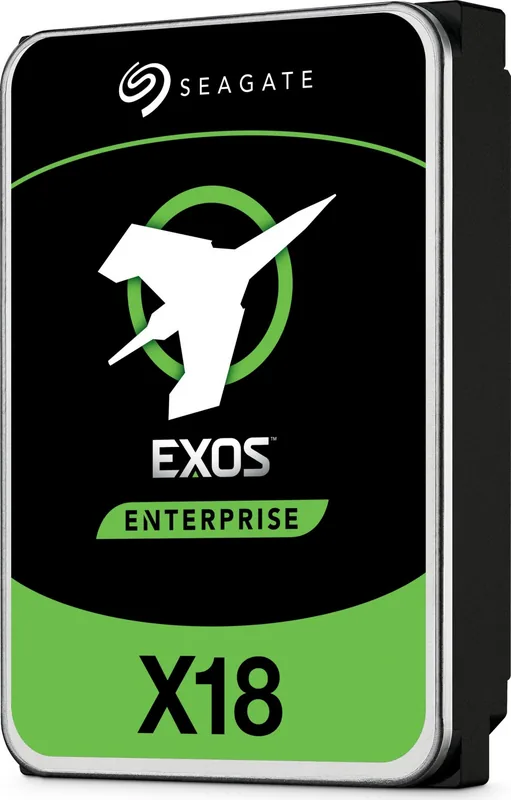
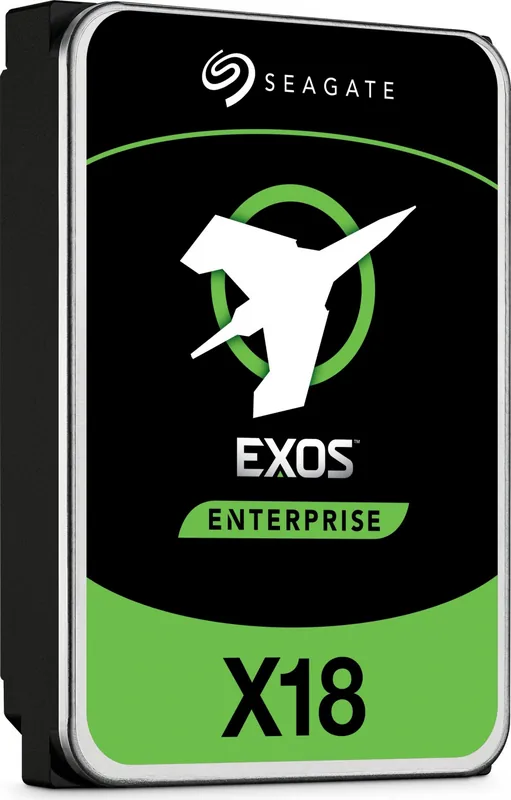
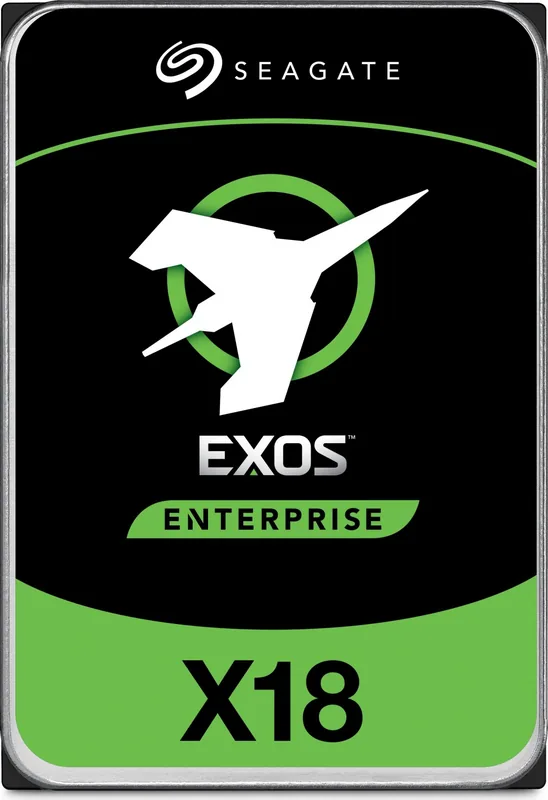
Seagate Exos X18 Manual
PDF manual · 62 Pages
English


Quick check
Incorrect answer, please try again.
Chat with your Seagate Exos X18 manual using AI
Get instant AI answers from your Seagate Exos X18 manual
Ask anything about the Seagate Exos X18. Answers come from this manual, with the pages they are based on.
Ask a Question
Do you recommend Exos X18?
Yes NoFrequently Asked Questions
Exos X18 uses a dual-port Serial Attached SCSI (SAS) interface supporting 3.0, 6.0 and 12.0 Gb/s per port, providing up to 1200 MB/s instantaneous transfer rate per port (dual-port aggregate available).
Is this answer helpful?
Yes. Select Exos X18 SKUs are TCG-compliant self-encrypting drives using AES-256 XTS. SED features include per-band encryption keys, Admin and Locking security providers, cryptographic erase (Sanitize), authenticated firmware download, and PSID-based RevertSP.
Is this answer helpful?
The drives include S.M.A.R.T. monitoring, Drive Self Test (DST) short/extended, Idle Read After Write (IRAW), Deferred Auto-Reallocation (DAR), configurable error recovery parameters, an AFR of 0.35% and an MTBF of 2,500,000 hours, plus a five-year warranty.
Is this answer helpful?
Yes. Drives ship default as 512E and support 4K native models; T10 Fast Format enables conversion between supported sector-size configurations when conditions allow, with format times and procedures specified in the drive documentation.
Is this answer helpful?
Operating range is 5°C to 60°C with non-condensing humidity; power and current profiles vary by capacity and mode. PowerChoice modes provide multiple idle/standby states. Review the drive’s DC power tables and thermal/airflow recommendations for data-center deployments.
Is this answer helpful?
Cryptographic erase replaces the data encryption key for a band with a new key generated by the drive, rendering previously encrypted data irrecoverable instantly; this operation is invoked via the SCSI Sanitize CRYPTOGRAPHIC ERASE service action.
Is this answer helpful?
Exos X18 conforms to SFF 3.5 mechanical dimensions; mounting hole patterns and torque limits are specified. Follow the mechanical and airflow guidelines to ensure proper cooling and reliability in multi-drive enclosures.
Is this answer helpful?
Advantages and Disadvantages
Advantages

- High capacity (up to 18TB) with enterprise-grade helium-sealed HDA for lower power and improved reliability.
- Robust SAS interface (dual-port, 12Gb/s) with 256MB cache and up to 1200 MB/s instantaneous transfer per port.
- Comprehensive reliability features: 2.5M hours MTBF, S.M.A.R.T., DST, IRAW, DAR and 5-year warranty.
- Flexible formatting: supports 512E and 4K native sector sizes plus T10 Fast Format for field conversions.
- SED models provide AES-256 XTS encryption, per-band keys, cryptographic erase, and authenticated firmware.
Disadvantages

- Enterprise-focused power and thermal requirements may necessitate data-center grade cooling and power provisioning.
- Higher initial cost compared to consumer drives due to enterprise features and SED options.
- Capacity and LBA reporting vary by sector size — requires planning to ensure expected usable capacity.
- Complex feature set (mode pages, SCSI commands) can require advanced host/HBA integration and validation.
- Non-user serviceable sealed HDA; opening voids warranty and prevents onsite repairs.
Product Specification
Form factor
3.5" (Width)
Interface
SAS 12Gb/s
Rotational speed
7200/min
Cache
256MB
Recording method
Conventional Magnetic Recording (CMR)
Reliability prediction
2.5 million hours (MTBF)
Warranty
60 months
Warning/Note/Trivia
Note: Unmarked OEM/System Builder hard drives are in circulation. Reduced warranty performance is possible. Manufacturer's warranty can be checked via the serial number. Important: For use within a RAID array, hard drives with different recording methods (CMR, SMR) should not be combined. When using SMR hard drives in a RAID array, ensure that the RAID controller (or the NAS system) is compatible with SMR hard drives, so that the partially blocked recording behavior of SMR is not falsely interpreted as a 'hardware defect'.
Product Description
Seagate Exos X X18 HDD SAS Manual — Overview
Seagate Exos X X18 is a high-capacity enterprise SAS hard drive family designed for demanding data center, server, and high-performance storage applications. Built on a 3.5" form factor with helium-sealed heads and a 7200 RPM spindle, Exos X18 drives deliver a blend of high sustained throughput, advanced reliability features, and storage security options across capacities up to 18TB. These drives support dual-port SAS connectivity at 3.0/6.0/12.0 Gb/s, making them suitable for multi-initiator environments and systems requiring redundant paths.
Key product highlights
Exos X18 drives emphasize enterprise-class endurance and performance. They offer up to 1200 MB/s instantaneous transfer rates per port, large 256 MB cache buffers, and advanced caching/prefetch algorithms to optimize read/write efficiency. Internal design features such as embedded servo, a low-inertia actuator, and factory-sealed helium HDA improve power efficiency and long-term reliability. The drives support multiple logical block sizes (512E and 4K native) and allow T10 Fast Format conversions in the field to adapt sector sizes quickly.
Reliability and service features
Seagate rates Exos X18 with an MTBF of 2.5 million hours and an AFR of 0.35% under specified enterprise conditions. Built-in diagnostics include Drive Self Test (DST), S.M.A.R.T. monitoring, thermal warnings, and Idle Read After Write (IRAW) verification. Error recovery is configurable via SCSI mode pages (AWRE/ARRE, read/write retry counts), and Deferred Auto-Reallocation (DAR) simplifies reallocation on subsequent writes. These drives are offered with a five-year warranty and require no preventive maintenance.
Power, environmental and mechanical details
PowerChoice power management provides multiple idle/standby states (Idle_A/B/C and Standby_Y/Z) to balance performance and energy savings. DC power profiles, acoustic levels, shock/vibration tolerances, and environmental operating ranges are tuned for data center use: 5°C–60°C operating, non-condensing humidity, and specified altitude limits. Mechanical dimensions conform to SFF 3.5 standards and weights range around 650–670 g depending on capacity.
Self-Encrypting Drive (SED) capabilities
Certain Exos X18 SKUs implement TCG-compliant self-encryption (AES-256 XTS). SED features include hardware RNG, per-band encryption keys (up to 32 data bands), controlled Admin and Locking Security Providers, cryptographic erase (Sanitize/CRYPTO ERASE), authenticated firmware download, and PSID-based RevertSP. SED models add minimal power overhead while providing strong protection for data at rest.
Notes
- Default factory format is 512E; 4K native options available. Fast Format (T10) enables sector-size transitions under supported conditions.
- Capacity and LBA counts vary by sector size and model; plan capacity using Seagate’s guaranteed capacity points.
- Validate compatibility with chosen HBA/RAID controller to ensure full capacity and feature support.
Search for 67,706 Manuals online


Type-in Brand or Model