
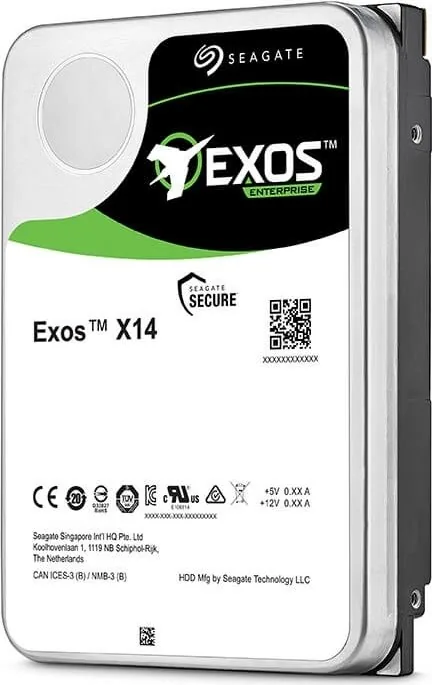
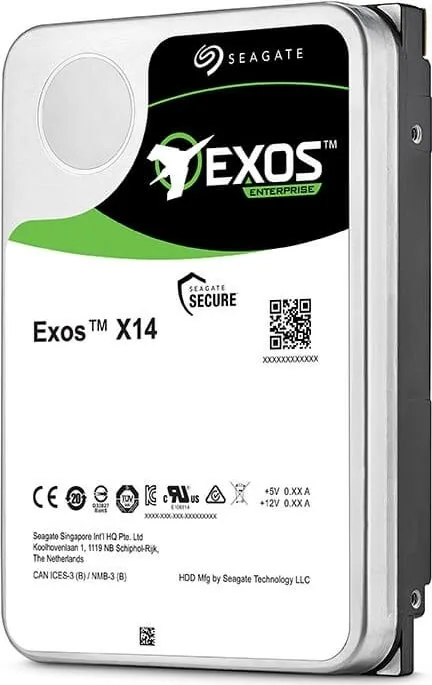
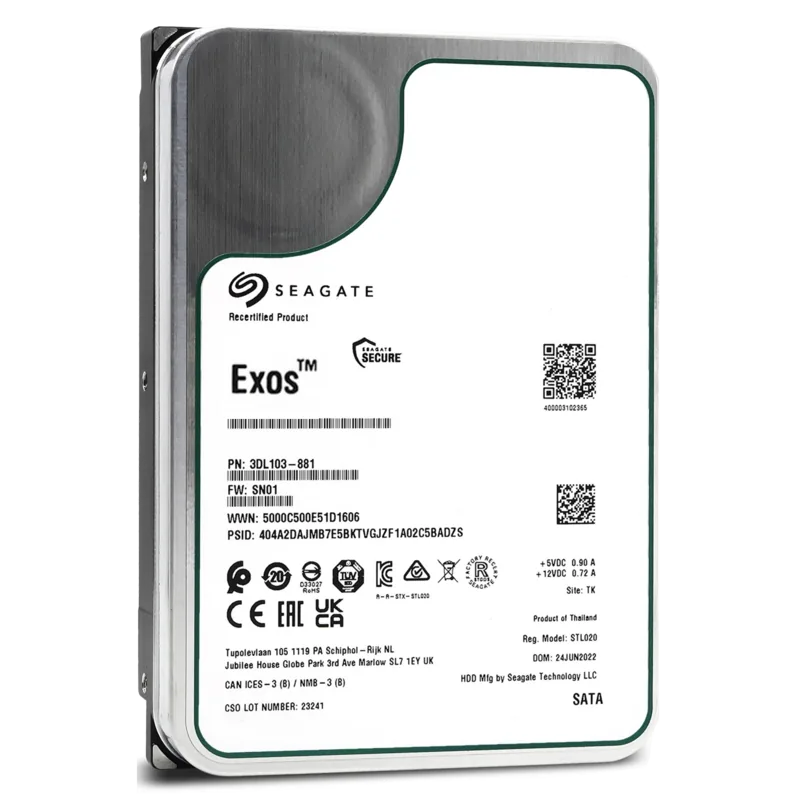
Seagate Exos X14 Manual
PDF manual · 68 Pages
English


Quick check
Incorrect answer, please try again.
Chat with your Seagate Exos X14 manual using AI
Get instant AI answers from your Seagate Exos X14 manual
Ask anything about the Seagate Exos X14. Answers come from this manual, with the pages they are based on.
Ask a Question
Do you recommend Exos X14?
Yes NoFrequently Asked Questions
It is designed for enterprise workloads that need high capacity, steady throughput, and 24/7 reliability. Common uses include servers, storage arrays, virtualization, and large data environments where predictable SAS performance matters.
Is this answer helpful?
It uses Serial Attached SCSI, or SAS, with support for 3.0, 6.0, and 12.0 Gb/s signaling. The dual-port design helps improve connectivity and resilience in enterprise storage systems.
Is this answer helpful?
Yes, self-encrypting variants are available. They support automatic data encryption and decryption, controlled access, drive locking, authenticated firmware download, and cryptographic erase for secure repurposing or disposal.
Is this answer helpful?
The family includes 10TB, 12TB, and 14TB models. Usable capacity varies based on sector size, protection information, and formatting choices, so final capacity depends on the selected configuration.
Is this answer helpful?
The drive includes SMART monitoring, thermal warnings, drive self-test, defect management, and enterprise-grade reliability targets. It is specified for a 0.35% AFR and 2.5 million hour MTBF under defined conditions.
Is this answer helpful?
Proper cooling, secure mounting, grounding, and compatible host hardware are important. The drive is intended for enclosed enterprise systems, and performance can drop if airflow or power conditions are outside spec.
Is this answer helpful?
Advantages and Disadvantages
Advantages

- High-capacity enterprise storage with 10TB, 12TB, and 14TB options.
- Dual-port SAS and 12Gb/s support for strong server and array connectivity.
- Self-encrypting models add automatic encryption and cryptographic erase.
- Built-in monitoring, self-test, and defect management improve reliability.
Disadvantages

- Requires proper cooling and enclosure design to meet rated performance.
- Sector size, formatting, and controller compatibility can be complex to plan.
- Enterprise focus makes it less suited to simple consumer or external use.
- Full capacity and compliance depend on the host system and configuration.
Product Specification
Form Factor
3.5" (Width), 1.03" (Thickness/Height)
Interface
SAS 12Gb/s
Rotational Speed
7200 rpm
Cache
256MB
Power Consumption
10.2W (Operation), 5W (Idle)
Recording Method
Conventional Magnetic Recording (CMR)
Sectors
4KB with emulation (512e)/4KB native (4Kn)
Reliability Prediction
2.5 million hours (MTBF)
Warranty
60 months
Warning/Note/Trivia
Note: Unmarked OEM/System Builder hard drives in circulation. Reduced warranty performance possible. Manufacturer's warranty verifiable via serial number.Important: For use within a RAID array, hard drives with different recording methods (CMR, SMR) should not be combined. When using hard drives with SMR in a RAID array, ensure that the RAID controller (or the NAS system) is compatible with SMR hard drives, so as not to misinterpret the partially blocked recording behavior of SMR as a "hardware defect".
Product Description
Seagate Exos X14 SAS: Enterprise Storage Built for Speed and Resilience
The Seagate Exos X14 SAS line is designed for environments that need dense storage, consistent performance, and dependable 24/7 operation. Built around a 12Gb/s SAS interface and a 7200 RPM platform, it targets servers, workstations, mainframes, and high-scale storage systems where throughput and reliability matter as much as capacity. With models spanning 10TB, 12TB, and 14TB, it gives administrators flexible options for balancing space, performance, and provisioning strategies.
At its core, the drive combines a large cache, dual-port SAS support, and enterprise-oriented queue depth to keep workloads moving smoothly under pressure. The Exos X14 also supports advanced features such as fast format, PowerChoice energy management, RAID rebuild assistance, and SMART monitoring. These capabilities make it a practical fit for mixed read/write workloads, virtualization, and storage arrays that must stay responsive during busy cycles.
Security-minded deployments can look to the self-encrypting variants, which add automatic encryption, controlled access, drive locking, and cryptographic erase support. Those models are aimed at organizations that need data-at-rest protection without adding complexity to the host stack. The platform also includes options for 512E and 4Kn-style sector configurations, letting integrators tune the drive for compatibility or modern storage planning.
Reliability is a major theme throughout the Exos X14 design. The drive is specified for a five-year warranty, a 0.35% annualized failure rate, and a 2.5 million hour MTBF target under defined enterprise conditions. It also includes thermal monitoring, self-test routines, and defect management features that help detect issues early and reduce operational risk. For long-term deployments, those details matter as much as raw capacity.
From an installation standpoint, the drive is built for standard 3.5-inch enterprise mounting and expects proper cooling, grounding, and enclosure design. Temperature, vibration, shock, and power conditions are clearly defined so system builders can keep the drive operating within its intended envelope. That makes the Exos X14 SAS a strong choice for data centers that value predictable behavior, scalable storage density, and enterprise-grade safeguards.
Notes
- Best suited for rack systems and storage arrays with stable airflow.
- SED models add encryption benefits with minimal performance difference.
- Check controller compatibility before planning full-capacity deployments.
- Sector-size and formatting choices can affect usable capacity.
Search for 67,706 Manuals online


Type-in Brand or Model