
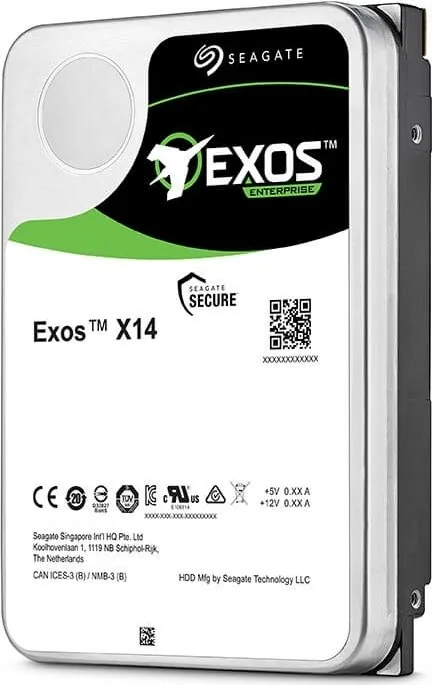
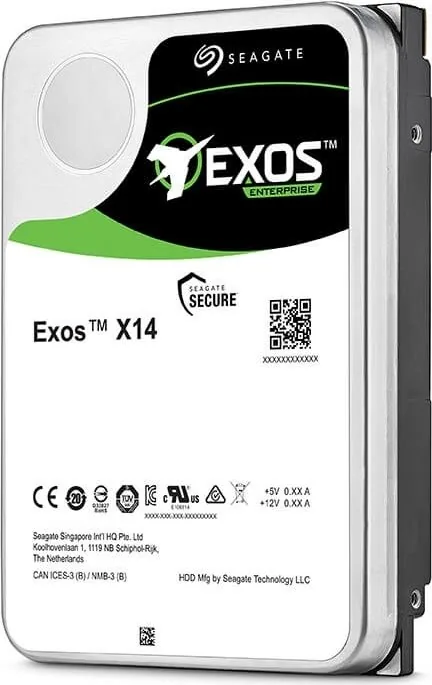
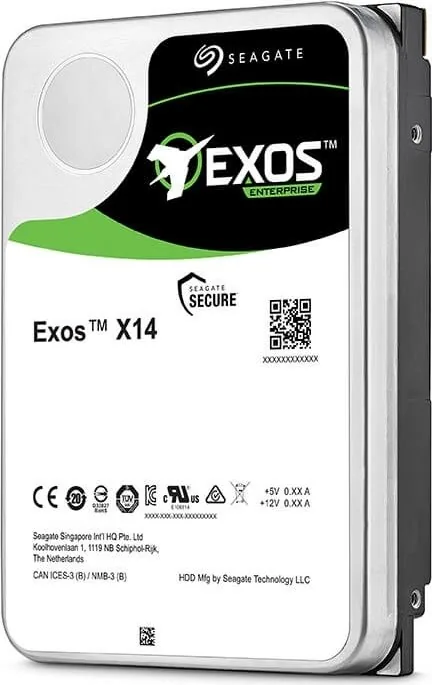
Seagate Exos X14 Manual
PDF manual · 58 Pages
English



Quick check
Incorrect answer, please try again.
Chat with your Seagate Exos X14 manual using AI
Get instant AI answers from your Seagate Exos X14 manual
Ask anything about the Seagate Exos X14. Answers come from this manual, with the pages they are based on.
Ask a Question
Do you recommend Exos X14?
Yes NoFrequently Asked Questions
It is designed for enterprise storage environments that need high capacity, dependable uptime, and SATA compatibility. Common uses include servers, storage arrays, and data-heavy infrastructure where large, reliable HDDs are preferred.
Is this answer helpful?
The series includes 10TB, 12TB, and 14TB models. These capacities are aimed at large-scale storage deployments where maximizing density matters more than low-latency flash performance.
Is this answer helpful?
Yes. The drive supports 512E and 4KN logical sector sizes. It also supports fast format conversion, which makes switching between sector layouts faster and easier during setup or migration.
Is this answer helpful?
Yes. Self-encrypting drive variants use AES-256 encryption and TCG enterprise features. They support controlled access, cryptographic erase, and authenticated firmware handling for stronger data-at-rest protection.
Is this answer helpful?
It includes PowerChoice, which offers selectable power states such as Idle_a, Idle_b, Idle_c, and Standby_z. These modes help reduce power use when the drive is not actively serving requests.
Is this answer helpful?
Use the correct SATA cabling, follow static-discharge precautions, and leave enough clearance for cooling. The drive should also be mounted with approved screws and torque limits to ensure safe operation.
Is this answer helpful?
Advantages and Disadvantages
Advantages

- High-capacity enterprise HDD options: 10TB, 12TB, and 14TB in a proven 3.5-inch SATA format.
- 7200 RPM, 256MB cache, and up to 600 MB/s interface speed support solid bulk-storage performance.
- 512E and 4KN sector support helps with compatibility and deployment flexibility.
- SED models add AES-256 encryption, controlled access, and secure erase features for data protection.
Disadvantages

- Not a performance SSD; latency and random I/O are more suited to archival and enterprise bulk storage.
- Power, acoustics, and reliability vary with workload and temperature, so proper cooling is important.
- Full capacity and sector-mode support may depend on the host adapter or RAID controller.
- Enterprise mounting and handling rules must be followed carefully to avoid damage or warranty issues.
Product Specification
Form factor
3.5" (Width), 1.03" (Thickness/Height)
Interface
SATA 6Gb/s
Rotational speed
7200 rpm
Cache
256MB
Recording method
Conventional Magnetic Recording (CMR)
Reliability forecast
2.5 million hours (MTBF)
Warranty
60 months
Warning/Note/Trivia
Note: Unmarked OEM/System Builder hard drives are in circulation. Reduced warranty performance is possible. Manufacturer's warranty can be verified via the serial number.Important: For use within a RAID array, hard drives with different recording methods (CMR, SMR) should not be combined. When using SMR hard drives in a RAID array, it is important to ensure that the RAID controller (or the NAS system) is compatible with SMR hard drives, in order not to falsely interpret the partially blocked recording behavior of SMR as a "hardware defect".
Product Description
Seagate Exos X14 SATA: Enterprise Storage for Demanding Workloads
The Seagate Exos X14 HDD SATA family is built for data centers, server arrays, and storage platforms that need large capacity, steady throughput, and dependable operation. The line includes 10TB, 12TB, and 14TB models, all designed around a 7200 RPM platform with a 256MB cache and sustained performance that fits high-density storage environments. With SATA 6Gb/s connectivity and support for hot-plug operation, these drives are a practical choice for systems that prioritize capacity and compatibility.
One of the strongest aspects of the Exos X14 line is its balance of speed and scale. The drive supports burst transfer rates up to 600 MB/s, while its enterprise-focused feature set includes Native Command Queuing, S.M.A.R.T. monitoring, and advanced power management through PowerChoice. That makes it easier to tune the drive for either stronger responsiveness or lower power draw depending on the application.
The Seagate Exos X X14 HDD SATA Manual also highlights flexible sector formatting, including 512E and 4KN logical sector sizes. This is especially useful in enterprise deployments where compatibility with controllers, RAID systems, and storage workflows matters. The drive’s fast format capability helps switch sector layouts quickly, reducing setup friction during deployment or migration.
Security is another major theme. Self-encrypting drive models use AES-256 encryption with TCG Enterprise Storage support, controlled access features, and secure erase options such as cryptographic erase and sanitize commands. For organizations handling sensitive workloads, this adds a serious layer of protection without changing the day-to-day storage experience.
Reliability and environmental resilience are clearly part of the design. The drives are rated for broad operating temperatures, shock, vibration, and altitude ranges, and they are intended for controlled enterprise environments. Seagate also specifies workload and temperature guidelines to help preserve MTBF and long-term consistency.
Physically, the drive follows a standard 3.5-inch form factor and can be mounted in multiple orientations using standard screws. Combined with SATA cabling, latching connectors, and broad interoperability, it is easy to integrate into existing storage infrastructure.
Notes
- Best suited for enterprise servers, NAS platforms, and capacity-focused storage arrays.
- Performance and reliability are strongest when installed with proper cooling and workload limits.
- SED models are ideal where data-at-rest protection is required.
- Check controller and RAID compatibility before enabling full-capacity or 4KN configurations.
Search for 67,706 Manuals online


Type-in Brand or Model