

Seagate Cheetah 15K.4 Manual
PDF manual · 94 Pages
English



Quick check
Incorrect answer, please try again.
Chat with your Seagate Cheetah 15K.4 manual using AI
Get instant AI answers from your Seagate Cheetah 15K.4 manual
Ask anything about the Seagate Cheetah 15K.4. Answers come from this manual, with the pages they are based on.
Ask a Question
Do you recommend Cheetah 15K.4?
Yes NoFrequently Asked Questions
The drive uses a dual-port Serial Attached SCSI (SAS) interface supporting 3.0 Gbit/s and 1.5 Gbit/s link rates. Each port provides up to 300 MB/s instantaneous transfer per port; dual-port operation allows concurrent transfers and redundancy.
Is this answer helpful?
It implements S.M.A.R.T. for predictive monitoring, Drive Self Test (DST) short and extended diagnostics, factory defect P-list and field-grown G-list reallocation, configurable error recovery parameters, and a rated Annualized Failure Rate (AFR) of approximately 0.62% under specified conditions.
Is this answer helpful?
Cache segmentation, prefetch (read look-ahead/ARLA), Performance Mode (server vs desktop), write caching (WCE), and logical block size are host-configurable via Mode Select/Mode Sense pages to optimize for sequential server throughput or small random desktop-style I/O.
Is this answer helpful?
Operate within specified ambient temperatures (5°C–55°C recommended), humidity (5%–95% non-condensing), altitude, and shock/vibration limits. Ensure proper airflow/cooling, follow Seagate mounting guidelines (bottom or side mounting), and provide appropriate grounding to meet performance and AFR specifications.
Is this answer helpful?
Yes. The Cheetah 15K.4 supports hot-plug operation with self-test on power-up and dual-port SAS allows redundant connections. Systems integrators must ensure proper power, backplane support, and ESD precautions during hot-swap operations.
Is this answer helpful?
The drive provides DST (short/extended) with self-test result logging, configurable read/write retry counts and recovery time limits, automatic reallocations (ARRE/AWRE), and reporting via SCSI sense codes and log pages to help identify and recover from errors.
Is this answer helpful?
The SAS electrical interface and connectors are mechanically and electrically compatible with certain Serial ATA (SATA) components at the connector level, but full compatibility depends on backplane and controller support; SAS hosts typically support both SAS and SATA devices when designed for that purpose.
Is this answer helpful?
Advantages and Disadvantages
Advantages

- High spindle speed (15,000 RPM) and low average latency (2.0 ms) for fast random I/O.
- Dual-port SAS with concurrent transfers and 3.0/1.5 Gbit/s link speeds for redundancy and scalability.
- Advanced caching (8,192 KB buffer), adaptive prefetch (ARLA) and configurable segmentation for workload tuning.
- Enterprise reliability features: S.M.A.R.T., DST diagnostics, dedicated landing zone and 5-year warranty.
- Comprehensive environmental, power and mechanical specifications simplify integration into server enclosures.
Disadvantages

- Relatively low capacity (147GB) by modern standards compared to contemporary high-capacity drives.
- Higher power consumption and heat output versus lower-RPM or flash-based storage solutions.
- Mechanical HDD design is more vulnerable to shock and vibration than solid-state alternatives in some deployments.
- Requires careful cooling and system-level EMI/grounding practices to meet specified AFR and compliance.
- SAS cabling/backplane requirements increase system complexity and cost compared to SATA consumer units.
Product Specification
Capacity
147GB (corresponds to approx. 136.9GiB, further information here)
Form factor
3.5" (Width)
Interface
SAS
Rotational speed
15000/min
Cache
8MB
Power consumption
14.34W (Idle)
Recording method
Conventional Magnetic Recording (CMR)
Attention/Note/Trivia
Note: Unmarked OEM/System Builder hard drives in circulation. Reduced warranty performance possible. Manufacturer's warranty verifiable via the serial number.Important: For use within a RAID array, hard drives with different recording methods (CMR, SMR) should not be combined. When using SMR hard drives in a RAID array, ensure that the RAID controller (or the NAS system) is compatible with SMR hard drives, so that the partially blocked recording behavior of SMR is not falsely interpreted as a "hardware defect".
Product Description
Seagate Cheetah 15K.4 147GB, 3.5" / SAS Manual
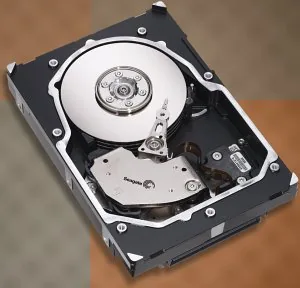
The Seagate Cheetah 15K.4 147GB, 3.5" SAS drive is a high-performance enterprise-class hard disk engineered for demanding server, workstation, and storage-array applications. Spinning at 15,000 RPM, this drive blends proven mechanical design with advanced electronics—GMR heads, PRML read channel, embedded servo and a dual-port Serial Attached SCSI (SAS) interface—to deliver low latency, high I/O throughput and robust reliability for data-center workloads.
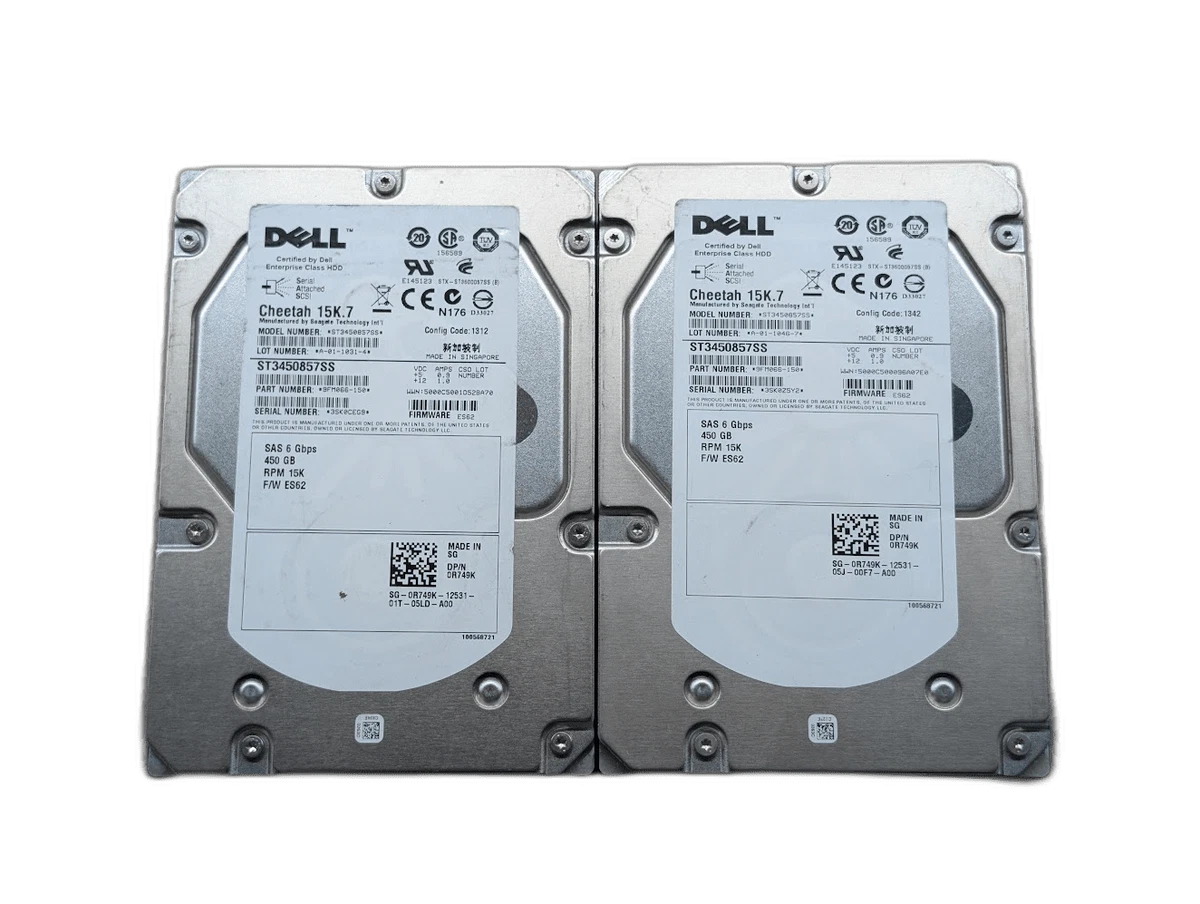
Cheetah 15K.4 models include multi-capacity SKUs (notably the 147GB ST3146854SS) and support both 3.0 Gbit/s and 1.5 Gbit/s SAS link rates. Dual-port SAS enables redundant connections and concurrent transfers for high-availability systems. The drive’s architecture supports a large 8,192 KB buffer (approximately 7,077 KB usable for caching) with configurable multi-segmentation, adaptive prefetch (ARLA), and selectable performance modes to tune behavior for server or desktop-like workloads.
Designed for enterprise environments, the drive offers features that reduce risk and simplify integration: dedicated inner landing zone to protect media during power-off, automatic shipping lock to protect heads during transit, embedded S.M.A.R.T. monitoring, Drive Self Test (DST) short/extended diagnostics, and firmware-download capability via SAS. It supports zone bit recording, ECC correction with substantial burst correction length, and programmable logical block sizes for compatibility with various systems.
Performance highlights include sustained high internal data rates (variable with zone, up to over 1 Gbit/sec internal), average rotational latency of 2.0 ms, rapid access times (typical average read ~3.5 ms), and up to 300 MB/s instantaneous SAS transfer per port. Power and thermal characteristics are tightly specified for integration: idle and active power curves, current profiles, and case/HDA temperature guidelines to meet the specified annualized failure rate (AFR) and five-year service expectations.
Reliability and serviceability are emphasized with an AFR around 0.62% under proper operating conditions, no routine preventive maintenance, and a five-year warranty policy. The drive includes robust error recovery controls (configurable retry counts and recovery time limits), defect reallocation schemes (factory P-list and growth G-list), and comprehensive environmental and mechanical specs (shock, vibration, humidity, altitude, acoustics) for rack or enclosure deployment.
Notes
- Dual-port SAS supports concurrent transfers and full-duplex behavior for high-availability topologies.
- Cache and prefetch parameters are host-configurable via Mode Select/Mode Sense pages to optimize server or desktop I/O patterns.
- Follow Seagate mounting, cooling and grounding recommendations to meet rated AFR and thermal limits.
Search for 67,706 Manuals online


Type-in Brand or Model