
PreSonus R80 V2 Manual
PDF manual · 17 Pages
English



Quick check
Incorrect answer, please try again.
Chat with your PreSonus R80 V2 manual using AI
Get instant AI answers from your PreSonus R80 V2 manual
Ask anything about the PreSonus R80 V2. Answers come from this manual, with the pages they are based on.
Ask a Question
Do you recommend R80 V2?
Yes NoFrequently Asked Questions
The R80 V2 uses an AMT (Air Motion Transformer) tweeter with a 6.8 in² diaphragm that provides faster transient response and extended, airy high-frequency detail compared with conventional dome tweeters, improving clarity and spatial cues in mixes.
Is this answer helpful?
The monitor offers balanced XLR, balanced 1/4" TRS, and unbalanced RCA inputs. Balanced connections are recommended to reduce noise and interference; do not connect multiple sources simultaneously.
Is this answer helpful?
Use the Acoustic Space switch: set -4 dB if speakers are in corners, -2 dB if near the rear wall, and 0 dB if positioned away from boundaries. This attenuates frequencies below 800 Hz to counteract boundary bass boost.
Is this answer helpful?
Play full-band pink noise and set each speaker to 82 dB SPL individually so combined playback equals ~85 dB at the mix position. If 85 dB is too loud for your room, use a 79 dB reference instead. Measure at ear height from the listening position.
Is this answer helpful?
Yes. Use the monitor’s low-cut switch (Flat/80/100 Hz) to align with your subwoofer’s low-pass filter. If the sub lacks an adjustable LPF, set the R80 V2 low-cut to the appropriate frequency to create a smooth 2.1 crossover.
Is this answer helpful?
The R80 V2 includes RF interference filtering, output-current limiting, over-temperature protection, turn-on/off transient suppression, a subsonic filter, and an external mains fuse to protect drivers and electronics.
Is this answer helpful?
Yes—the models share identical voicing and many specifications, differing mainly in driver size, cabinet dimensions, low-frequency extension, crossover frequency, and maximum SPL, allowing consistent tonal character across the series.
Is this answer helpful?
Advantages and Disadvantages
Advantages

- AMT tweeter provides exceptional high-frequency detail and fast transient response.
- Comprehensive rear-panel tuning: HF shelf, mid control, low-cut, and Acoustic Space.
- Multiple input options (XLR, TRS, RCA) for flexible integration with studio gear.
- High SPL capability and Class A/B amplification for clear, powerful performance.
- Waveguide design reduces early desk reflections and improves horizontal coverage.
Disadvantages

- Requires proper placement (vertical only) to achieve intended dispersion and imaging.
- Mid control can alter flat response; inappropriate use may skew mix translation.
- Boundary bass boost near walls/corners may demand acoustic tuning or Acoustic Space use.
- Larger footprint and weight than smaller near-field monitors; may need sturdy stands.
- Integration with subwoofers requires manual crossover/low-cut adjustment if sub lacks LPF.
Product Specification
Principle
2-way
Tweeter
1x Ribbon
Woofer
1x 8"
Frequency Range
40Hz-22kHz
Power
65W/75W RMS (HF/LF)
Max. SPL
107dB
Dimensions
9.49x14.92x12.17in (WxHxD)
Weight
19.84lb
Product Description
PreSonus R80 V2, Stück Manual — Active AMT Studio Monitor
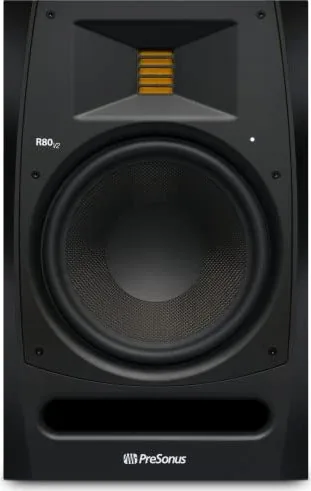
The PreSonus R80 V2 is a self-powered near-field studio monitor built for accurate, detailed monitoring. Featuring a large woven-composite 8" low-frequency driver paired with a 6.8 in² AMT (Air Motion Transformer) tweeter, the R80 V2 delivers extended low-end, airy high frequencies, and fast transient response for critical mixing and mastering work. The AMT tweeter reproduces subtle harmonics and spatial detail that conventional dome tweeters often miss, helping you hear nuanced imaging and clarity across complex mixes.
This monitor offers multiple balanced and unbalanced inputs—XLR, 1/4" TRS, and RCA—so it integrates easily with interfaces, mixers, and controllers. User controls on the rear panel include input gain, a high-shelf (±6 dB @ 10 kHz), a mid-band control (±6 dB @ 1 kHz), selectable low-cut (Flat / 80 Hz / 100 Hz), and an Acoustic Space switch (Flat / -2 dB / -4 dB) to compensate for boundary bass when speakers sit close to walls or corners. A dedicated power inlet with region-specific fuse and an energy-conserving standby mode round out the practical features for studio use.
The R80 V2 differs from the R65 V2 primarily in driver and cabinet size, lower frequency extension (R80 V2 reaches to ~40 Hz vs R65 V2 ~45 Hz), crossover point, and higher peak SPL capability (R80 V2 ~107 dB). Both models use the same amplifier topology (Class A/B) and HF AMT design, ensuring coherent voicing and reliable performance across the R-Series V2 line.
Placement and calibration guidance helps you set up an accurate mix environment: position monitors vertically with tweeters at ear height, toe-in to form an equilateral triangle with your listening position, and keep speakers 8–12 inches from walls when possible. Use the Acoustic Space and Low Cut switches when space is constrained or when integrating a subwoofer. For consistent monitoring levels, PreSonus recommends calibrating to an 85 dB SPL reference (82 dB per speaker measured individually using pink noise) or a lower 79 dB reference for smaller rooms.
Technical highlights include balanced 20 kΩ and unbalanced 10 kΩ inputs, Class A/B LF and HF amplification (75 W LF / 65 W HF), frequency response to 22 kHz, and protection circuitry for RF interference, output-current limiting, over-temperature, and turn-on transients. The R80 V2’s compact vinyl-laminated MDF cabinet and waveguide deliver wide horizontal coverage with controlled vertical dispersion to reduce desk reflections.
Notes:
- Use balanced connections where possible to minimize noise and interference.
- Set Acoustic Space and Low Cut appropriately for wall proximity or subwoofer integration.
- Calibrate left and right monitors independently to ensure matched SPL at the mix position.
Search for 67,706 Manuals online


Type-in Brand or Model