
PowerWalker VFI 3000 TGS Manual
PDF manual · 126 Pages
English



Quick check
Incorrect answer, please try again.
Chat with your PowerWalker VFI 3000 TGS manual using AI
Get instant AI answers from your PowerWalker VFI 3000 TGS manual
Ask anything about the PowerWalker VFI 3000 TGS. Answers come from this manual, with the pages they are based on.
VFI 3000 TGS Maintenance Schedule
In locations subject to high temperatures, shorten recharging intervals to every two months.
If stored in temperate climatic zones, recharge batteries every three months for 1 to 2 hours.
Free maintenance reminders
Timed to your purchase date. Always free, unsubscribe anytime.
Ask a Question
Do you recommend VFI 3000 TGS?
Yes NoFrequently Asked Questions
The VFI 3000 TGS uses an online double-conversion topology: AC is rectified to DC to charge batteries and feed the inverter, which continuously generates a pure sinewave AC output, isolating loads from mains disturbances.
Is this answer helpful?
The long-backup 3000 TGS uses a 72V battery system (typically six 12V batteries) via the standard rear-panel battery connector; external battery capacity can be configured in the LCD settings to match runtime needs.
Is this answer helpful?
The UPS offers a standard USB HID interface for native OS power management with no driver needed. Optional RS-232, AS400, CMC (Modbus RS485) and NMC (Network Management Card) provide additional integration and remote management via WinPower or SNMP/Modbus.
Is this answer helpful?
Modes include Line (normal), Battery, Bypass, ECO (high-efficiency mains-through with <10ms transfer — use when loads tolerate brief transfers) and CVCF (constant voltage/frequency converter mode — useful for frequency-sensitive equipment but with ~60% power derating).
Is this answer helpful?
Front-panel buttons mute audible alarms (short or long presses depending on mode). Pressing the On button for >1s during Line, ECO or CVCF invokes a battery test; periodic automatic tests can also be configured.
Is this answer helpful?
Ensure proper earth grounding, use a protected socket or breaker, maintain ventilation clearances (recommended ≥25cm each side), install a DC breaker when using custom EBMs, and have qualified electricians perform wiring and battery changes to avoid shock or damage.
Is this answer helpful?
The unit complies with IEC/EN 62040-1 safety and IEC/EN 62040-2 EMI/EMS requirements and related IEC/EN immunity standards (ESD, RS, EFT, Surge, etc.) as specified in the technical section.
Is this answer helpful?
Advantages and Disadvantages
Advantages

- Double-conversion (online) topology provides continuous pure sinewave output and full protection from mains disturbances.
- Long-backup model supports external battery packs (72V) for extended runtimes and configurable external battery Ah up to high capacities.
- USB HID support enables native OS recognition and automatic safe shutdown without extra drivers; optional network cards add remote management.
- Front-panel LCD and buttons allow on-site monitoring and configuration of voltage, frequency, ECO/CVCF modes, charger current and battery parameters.
- Multiple operating modes (Line, Battery, Bypass, ECO, CVCF) and clear fault/warning codes simplify operation and troubleshooting.
Disadvantages

- Requires careful ventilation clearance and ambient control; performance and safety depend on proper airflow and placement.
- External battery installation and DC breaker requirements demand qualified electricians and careful adherence to procedure.
- ECO and CVCF modes have trade-offs: ECO may not suit very sensitive loads; CVCF reduces rated output to ~60%.
- Weight and dimensions for the full system (with EBMs) can be significant; planning for rack/tower space and transport packaging is needed.
- Some advanced monitoring/options (RS-232, AS400, CMC, NMC) are optional and may increase total system cost and configuration complexity.
Product Specification
Type
Tower
Classification
VFI (On-Line)
Apparent Power
3,000VA
Active Power
2,700W
Voltage
220V, 230V, 240V
Input
C20
Outputs
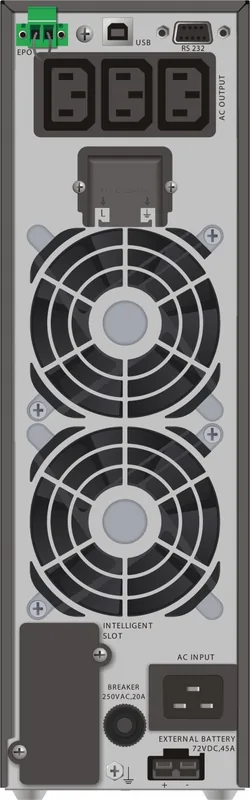
3x C13
Interfaces
USB, serial
Data Line Protection
N/A
Weight
13.67lb
Dimensions (WxHxD)
4.02x12.91x15.35in
Special Features
LCD
Product Description
BlueWalker PowerWalker VFI 3000 TGS, USB/serial Manual
The BlueWalker PowerWalker VFI 3000 TGS is a tower-format online double-conversion UPS engineered for demanding single-phase environments where clean, continuous power is critical. Built on a double-converter topology, it converts incoming AC to DC to charge batteries and feed an inverter that continuously produces a pure sinewave AC output. That design eliminates mains disturbances and ensures seamless protection for servers, storage systems, network devices and sensitive electronics.
This 3kVA (2.7kW) long-backup model supports extended runtimes via external battery packs (72V nominal for the 3000 TGS), and offers versatile output sockets and a terminal block option for heavier loads. The unit includes onboard communications: a USB HID interface for native OS power-management support and optional RS-232 and network/management cards (CMC/NMC/AS400) for remote monitoring and integration with WinPower or other management tools.
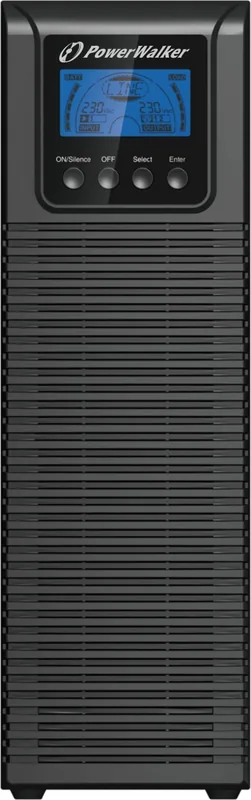
On the front panel an informative LCD and intuitive buttons provide immediate status feedback and configuration: input/output voltage and frequency, load and battery bars, operating mode (Line, Battery, Bypass, ECO, CVCF) and fault/warning codes. The LCD lets you adjust output voltage (220/230/240V), frequency (50/60Hz), auto-bypass, charger current and external battery Ah settings. Audible alarms and a mute/silence function are supported, and EPO (Emergency Power Off) provides rapid remote shutdown if needed.
Operational modes include: Line (normal double-conversion), Battery (on AC loss), Bypass (utility directly to load when enabled), ECO (high-efficiency mode with fast transfer), and CVCF (constant voltage/constant frequency converter mode). The UPS also exposes comprehensive warning and fault codes on the LCD to aid diagnostics, and supports scheduled or manual battery testing. Typical backup times depend on load and battery configuration; for the TGS long-backup variants, runtimes expand significantly when external EBMs are installed.
Mechanically the VFI 3000 TGS is built for rack/tower environments with careful ventilation requirements and thermal protections; ambient limits, altitude derating rules, and routine battery maintenance guidance are provided. Safety and EMC follow IEC/EN standards for UPS equipment.
Notes:
- Designed for critical single-phase loads needing clean sinewave power and long runtime capability.
- USB HID simplifies native OS shutdown/monitoring without extra drivers; optional cards enable SNMP/Modbus or dry-contact signaling.
- Follow ventilation, battery installation and safety cautions closely to avoid hazards and ensure warranty compliance.
Search for 67,706 Manuals online


Type-in Brand or Model