
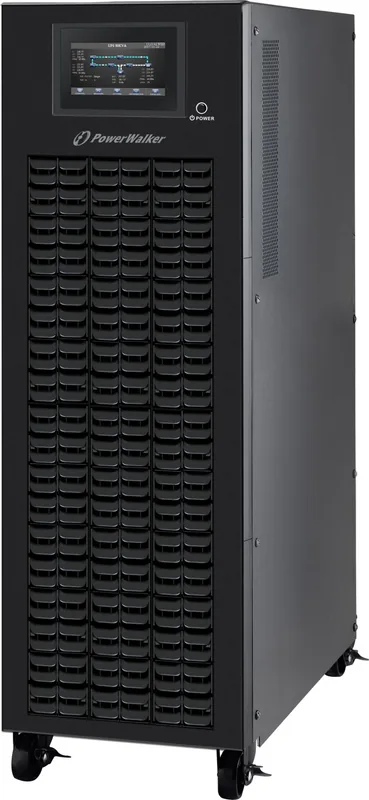
PowerWalker VFI 10K CPG PF1 3/3 BI Manual
PDF manual · 49 Pages
English



Quick check
Incorrect answer, please try again.
Chat with your PowerWalker VFI 10K CPG PF1 3/3 BI manual using AI
Get instant AI answers from your PowerWalker VFI 10K CPG PF1 3/3 BI manual
Ask anything about the PowerWalker VFI 10K CPG PF1 3/3 BI. Answers come from this manual, with the pages they are based on.
VFI 10K CPG PF1 3/3 BI Maintenance Schedule
If stored between 40C and 45C, recharge the battery every 2 months for 1-2 hours.
Store UPS in cool dry location and recharge every 3 months for 1-2 hours if stored between -25C and 40C.
Free maintenance reminders
Timed to your purchase date. Always free, unsubscribe anytime.
Ask a Question
Do you recommend VFI 10K CPG PF1 3/3 BI?
Yes NoFrequently Asked Questions
The unit supports USB and RS-232 communication ports for local monitoring and shutdown. It also supports optional SNMP for network management and is compatible with Windows, Linux, Unix and macOS via supplied monitoring software.
Is this answer helpful?
Yes. Parallel-capable models provide dedicated parallel and share-current ports, with specific wiring and startup procedures detailed in the manual. All units must be parallel models with matching configuration and calibrated inverter voltages within 1V before synchronizing.
Is this answer helpful?
The series comes in BI (internal battery) and BX (external battery) variants. Long-run models accept external battery packs with configurable number of batteries, adjustable charging currents, float voltage settings, scheduled self-tests and battery shutdown thresholds to protect battery health.
Is this answer helpful?
Installation must follow local electrical codes and be performed by qualified personnel. Grounding/TN system is required, backfeed protection (external contactor) is recommended per IEC/EN safety standards, and EPO, proper breaker selection, and correct battery polarity and voltage are essential.
Is this answer helpful?
The UPS provides audible alarms with distinct patterns (e.g., continuous for fault, periodic for battery mode), an LCD data-log with timestamped fault/warning codes and descriptions, and remote notifications via monitoring software when connected.
Is this answer helpful?
ECO mode can improve efficiency but is not recommended in parallel systems. ECO and CVCF settings should be applied with consideration of load tolerance and site-specific power quality requirements.
Is this answer helpful?
Charge batteries before storage and periodically recharge during storage per temperature guidelines. Perform battery self-tests, follow recommended charging durations, replace batteries with identical type/quantity, and use qualified technicians for service due to hazardous voltages.
Is this answer helpful?
Advantages and Disadvantages
Advantages

- Three-phase, double-conversion topology with tight voltage regulation and rapid transfer times.
- Scalable: parallel-capable for redundancy and higher capacity with dedicated share-current and parallel ports.
- Comprehensive local control via touchscreen plus USB/Serial communications and optional SNMP for remote management.
- Flexible battery support: internal (BI) or external long-run configurations with adjustable charging parameters.
- Extensive safety and diagnostic features: EPO, maintenance bypass, fault/warning codes and detailed data log.
Disadvantages

- Requires qualified personnel for installation and maintenance due to hazardous voltages and complex procedures.
- ECO mode is not recommended for parallel systems, reducing energy-saving options when scaled.
- Physical size and weight are substantial, especially for higher-power or long-run models, demanding dedicated space.
- Battery management and configuration complexity may require trained technicians for correct setup and calibration.
- Some safety protections like backfeed contactors need external implementation to fully meet standards.
Product Specification
Type
Tower
Classification
VFI (On-Line)
Apparent Power
10,000 VA
Active Power
10,000 W
Voltage
208V/220V/230V/240V
Input
Dry Contact
Outputs
Dry Contact
Interfaces
USB, serial
Data Line Protection
N/A
Charging Time
9h (90%)
Weight
273.22 lb
Dimensions (WxHxD)
9.84x32.56x24.68in
Features
LCD
Product Description
BlueWalker PowerWalker VFI 10K CPG PF1 3/3 BI, USB/Serial Manual
The BlueWalker PowerWalker VFI 10K CPG PF1 3/3 BI is a three-phase, industrial-grade uninterruptible power supply (UPS) designed for critical commercial and data-center environments. Available in multiple power ratings (10kW up to 80kW) and in internal (BI) or external battery (BX) configurations, this model provides robust AC-to-AC double-conversion protection, flexible installation options, and advanced monitoring via USB/Serial communications.
This UPS emphasizes safety, reliability and configurability. It supports TN earthing, backfeed protection recommendations, and strict wiring requirements to meet IEC/EN standards for safety and electromagnetic compatibility. The unit features clearly labeled terminals, maintenance bypass options, emergency power-off (EPO) connectors, and provisions for parallel operation for scalable redundancy and capacity.
Operationally, the PowerWalker VFI series delivers tight voltage regulation, selectable output frequencies, ECO and CVCF modes, and fast seamless transfer times. Its LCD touchscreen shows control, measure, setting, information and data-log menus — enabling on-device control for startup, battery tests, muting alarms, charger control and detailed parameter calibration (voltage/current/battery). Advanced menus provide maintainer-level calibration, system initialization, self-test routines and parallel system setup, while user-level settings cover date/time, language, contact info and alarm preferences.
Battery management supports both internal and long-run external packs, adjustable charging currents, configurable float and shutdown voltages, and scheduled self-tests. The manual details recommended wiring gauges by model, input/output breaker placement, and safe battery handling procedures — including storage and periodic recharge guidance. Maintenance notes stress that only qualified personnel should service the UPS because of hazardous voltages and battery risks.
Parallel-capable units include share-current and parallel communication ports and specific startup, addition and removal procedures to ensure safe synchronization. The UPS provides extensive fault and warning codes with audible alarm patterns and a data log for troubleshooting. Built-in communications (USB/RS-232) and optional SNMP enable graceful shutdown and remote management across major OS platforms.
In short, the BlueWalker PowerWalker VFI 10K CPG PF1 3/3 BI combines heavy-duty three-phase protection, flexible battery options, advanced local and remote management, and parallel scalability, making it suitable for demanding industrial, IT and infrastructure applications.
Notes
- Follow local electrical codes and grounding practices; EPO and backfeed protection are critical.
- Use qualified technicians for installation, maintenance, battery replacement and parallel configuration.
- Charge new or stored batteries before putting into service; observe manufacturer storage/charge intervals.
- Avoid enabling ECO mode in parallel systems.
Search for 67,706 Manuals online


Type-in Brand or Model