
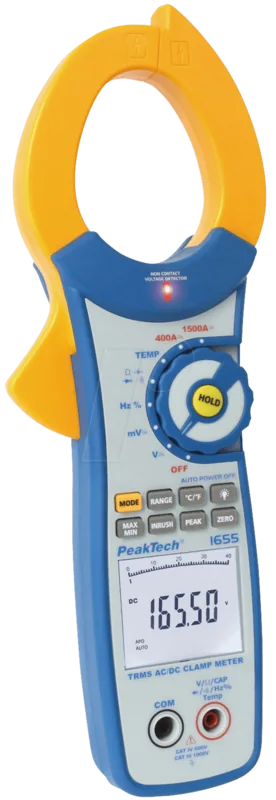
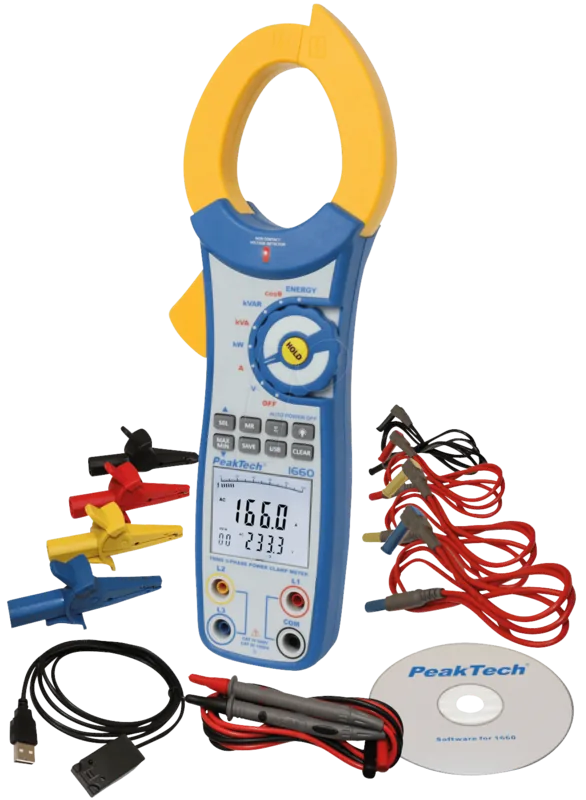
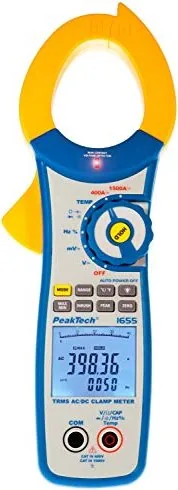
PeakTech 1655 Manual
PDF manual · 96 Pages
English



Quick check
Incorrect answer, please try again.
Chat with your PeakTech 1655 manual using AI
Get instant AI answers from your PeakTech 1655 manual
Ask anything about the PeakTech 1655. Answers come from this manual, with the pages they are based on.
1655 Maintenance Schedule
Repeat calibration after one year to ensure accuracy.
Replace the battery immediately when the BAT symbol appears on the display.
Free maintenance reminders
Timed to your purchase date. Always free, unsubscribe anytime.
Ask a Question
Do you recommend 1655?
Yes NoFrequently Asked Questions
The meter measures AC and DC currents up to 1500 A (ranges 400 A and 1500 A) and voltages up to 1000 V AC/DC. Observe the specified limits and do not exceed the maximum input ratings to avoid damage or injury.
Is this answer helpful?
Yes — it provides True RMS readings for accurate measurement of non-sinusoidal waveforms within its specified AC bandwidth (50–400 Hz for current; AC voltage specified up to 1000 Hz) and crest factor limits. Accuracy depends on percent-of-range and crest factor conditions.
Is this answer helpful?
INRUSH captures short-duration startup currents (typically 110–120 ms) during motor start; PEAK records maximum and minimum peaks of AC waveforms. Use INRUSH for motor inrush diagnostics and PEAK to find transient peak values.
Is this answer helpful?
Follow safety guidance: inspect leads, discharge capacitors before resistance/capacitance tests, remove test leads before clamping, do not exceed 1000 V or CAT III limits, wear insulating PPE, and avoid measurements in wet conditions. Only qualified personnel should open or service the device.
Is this answer helpful?
Temperature is measured using the supplied Type-K thermocouple connected via the V/Ω input and COM. Select °C/°F with MODE, ensure correct polarity on the adapter, and note probe accuracy is additional to meter accuracy.
Is this answer helpful?
Maintenance is minimal: replace the 9 V battery when the BAT icon appears, clean the housing with a damp cloth and mild detergent (no solvents), inspect leads for damage, and have repairs performed by qualified service personnel. Store battery separately for long-term storage.
Is this answer helpful?
The NCV detector is useful for quick checks and will light the LED on presence of AC voltage, but it is highly sensitive and can be triggered by static or nearby sources. Always confirm with proper voltage measurements and test on a known live source before relying on NCV alone.
Is this answer helpful?
Advantages and Disadvantages
Advantages

- True RMS measurement for accurate readings on non-sinusoidal waveforms
- High current capacity: AC/DC up to 1500 A with 52 mm jaw opening
- Wide function set: voltage, resistance, capacitance, frequency, temperature (Type-K), diode, continuity
- Safety-oriented design: CAT III 1000 V rating, finger guard, overload protection
- Handy features: MAX/MIN, PEAK, INRUSH capture, DCA zero, auto/manual range and backlit display
Disadvantages

- Requires removal of test leads before clamp use — extra step in workflow
- 9V battery operation may require frequent replacements under heavy use
- True RMS accuracy limited by specified crest factor and bandwidth constraints
- NCV detector can produce false positives from static or nearby energy sources
- Not suitable for direct use in CAT IV or extremely high-energy industrial circuits
Product Specification
Measurement Range
max. 1500A, max. 1000V, max. 40MΩ
Scope of delivery
Bag, Test leads
Product Description
PeakTech 1655 True RMS current clamp multimeter Manual
The PeakTech 1655 True RMS current clamp multimeter is a robust, feature-rich handheld instrument built for electricians, service technicians, and lab users who need accurate current and electrical diagnostics. Combining a 52 mm jaw opening with True RMS measurement, this clamp meter handles AC and DC currents up to 1500 A and voltages up to 1000 V, while offering protection for use in CAT III environments. Its rugged, fire-retardant housing, finger guard and comprehensive overload protection make it suitable for demanding field and workshop use.
Equipped with a large backlit 4 3/4-digit LCD and bargraph, the PeakTech 1655 provides clear readings for current, voltage, resistance, capacitance, frequency, duty cycle and temperature (Type-K). The meter includes automatic and manual ranging, MAX/MIN and PEAK capture, an inrush capture mode for motor start measurements, and a DCA zero function to remove offsets for precise DC current readings. A non-contact voltage (NCV) detector with LED indicator adds a quick safety check, while the dedicated function and mode buttons give fast access to diode test, continuity buzzer and capacitance ranges.
True RMS capability ensures accurate AC measurements on non-sinusoidal waveforms across a specified bandwidth; crest factor performance is optimized across ranges. Frequency and duty-cycle are measured with good sensitivity; temperature readings via the supplied Type-K thermocouple extend the meter’s versatility. The instrument runs on a 9 V battery, has auto power-off, and a clear low-battery indicator. Input jacks accept the supplied test leads and thermocouple for bench tests, while current is measured using the clamp jaws — test leads must be removed before clamping for safety.
Safety and usability are central: the device meets relevant EU directives for EMC and low-voltage equipment, specifies CAT III 1000 V overvoltage category, and contains multiple warnings and procedures to avoid shocks and damage. The manual emphasizes inspecting leads, discharging capacitors before resistance or capacitance checks, observing polarity for polarized capacitors, and following safe practices for voltage and current ranges. Regular maintenance is simple — clean with a damp cloth and replace the 9 V battery when indicated.
Whether diagnosing complex motor start currents, measuring in noisy electrical environments, or performing routine maintenance, the PeakTech 1655 combines accuracy, safety features and practical measurement functions for professionals and advanced hobbyists.
Notes
- True RMS suited for non-sinusoidal AC measurements; observe specified bandwidth and crest factor limits.
- NCV is high-sensitivity; false triggers (static) can occur — verify on known live sources.
- Always discharge capacitors and remove test leads before clamp usage.
- Replace battery promptly when low-battery icon appears; remove battery for long-term storage.
Search for 67,706 Manuals online


Type-in Brand or Model