

PeakTech 1610 Manual
PDF manual · 128 Pages
English



Quick check
Incorrect answer, please try again.
Chat with your PeakTech 1610 manual using AI
Get instant AI answers from your PeakTech 1610 manual
Ask anything about the PeakTech 1610. Answers come from this manual, with the pages they are based on.
1610 Maintenance Schedule
It is recommended to repeat the factory calibration after one year.
Replace the 9V battery immediately when the BAT symbol appears on the display to ensure accurate measurements.
Wipe the casing with a soft dry cloth or a damp cloth with mild detergent; do not use solvents or abrasives.
Free maintenance reminders
Timed to your purchase date. Always free, unsubscribe anytime.
Ask a Question
Do you recommend 1610?
Yes NoFrequently Asked Questions
Voltage inputs are rated to 600 V AC/DC (overload protection 600 V). Current capability depends on model: P1615 and P1625 measure up to 1000 A (with appropriate ranges and overload protection). Always stay within the specified limits and CAT III 600 V rating.
Is this answer helpful?
Choose the P1625: it offers true-RMS AC measurement and a 42-segment analog bargraph, improving accuracy and visualization for distorted or non-sinusoidal waveforms compared with peak-reading meters.
Is this answer helpful?
Always power down the circuit and discharge capacitors before resistance or capacitance tests. For capacitors, safely discharge using a ~100 kΩ resistor across terminals. Never measure resistance on live circuits to avoid damage and injury.
Is this answer helpful?
These meters are rated Overvoltage Category III (600 V) and Pollution Degree 2. CAT III indicates suitability for distribution-level installations and fixed wiring; it limits exposure to transient overvoltages and guides safe application areas.
Is this answer helpful?
Replace the 9 V (NEDA 1604) battery when the BAT icon appears. Power off, remove test leads, open the battery cover with a screwdriver, replace the battery, and secure the cover. Dispose of used batteries per local regulations.
Is this answer helpful?
Yes—P1615 and P1625 measure DC current. Align the conductor centrally in the jaw and observe the ‘+’ flow marking for correct polarity. Ensure only one conductor is inside the clamp and remove test leads before clamping.
Is this answer helpful?
Factory calibration is provided; the manual recommends recalibration after one year to maintain accuracy, particularly for professional or safety-critical applications.
Is this answer helpful?
Advantages and Disadvantages
Advantages

- Combines clamp current measurement with standard multimeter functions (V, Ω, C, Hz, temp).
- Models include true-RMS (P1625) and analog bargraph for better AC and transient readings.
- Compact 35 mm jaw and handheld design ideal for field and shop use.
- Clear safety ratings (CAT III 600V) and built-in overload protections.
- Useful features: manual/auto range, data-hold, peak/zero functions and backlight.
Disadvantages

- Limited to indoor use and requires care around high-energy industrial circuits.
- Accuracy varies by model and function; less precise than bench instruments for high-end lab work.
- Requires 9 V battery; battery life influences measurement reliability and must be monitored.
- Jaw-based current measurement less accurate if conductor not centered or multiple conductors enclosed.
- Some advanced specs (large capacitance ranges, high-frequency sensitivity) differ between models, needing careful model selection.
Product Specification
Measurement range
max. 1000A, max. 600V, max. 40MΩ
Scope of delivery
Bag, Test leads
Product Description
PeakTech 1610 Current Clamp Multimeter Manual — Overview
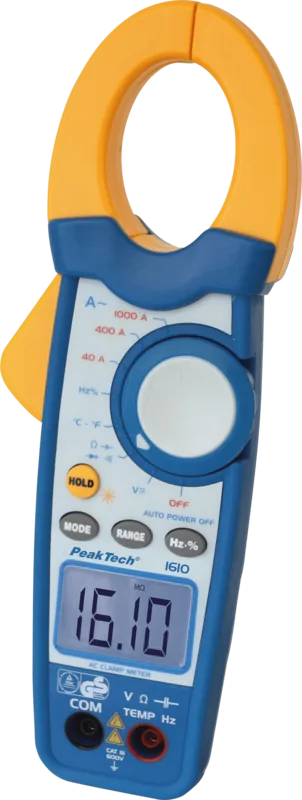
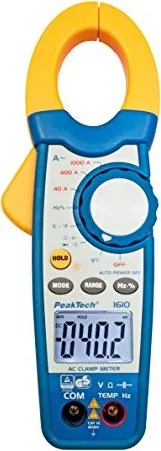
The PeakTech 1610 Current Clamp Multimeter is a compact, versatile clamp meter designed for electricians, technicians, and hobbyists who need a reliable handheld tool for electrical diagnostics. With a 35 mm jaw opening, 3 3/4-digit LCD, and a broad set of measurement functions, it covers AC/DC voltage up to 600 V, current measurements (with P1615/P1625 variants up to 1000 A), resistance, capacitance, frequency, temperature (with K-type probe), continuity and diode testing. The meter family includes models P1610, P1615 and P1625; the P1625 adds a 42-segment analog bargraph and true-RMS capability for more accurate AC readings.
Key features and usage
The unit offers auto and manual ranging, data-hold, backlight, zero/relative measurement, and a peak-hold function (on P1625) for capturing transient peaks. Safety is emphasized: the meter meets EU directives (CE), is rated Overvoltage Category III (600 V), and includes overload protections (600 V for voltage, up to 1000 A for current on applicable models). Practical design touches include a 9 V battery power supply, auto power-off, clear function symbols, and separate COM and V/Ω inputs for standard probe measurements.
Measurement guidance stresses safe practices: always start on the highest range for unknown values, remove test leads before using the clamp, discharge capacitors before resistance or capacitance tests, and never measure voltages or currents beyond the specified limits. The manual details procedures for voltage, current, resistance, continuity, diode, capacitance, frequency and temperature measurements, plus battery replacement and basic maintenance.
Performance and specifications
Accuracy and resolution vary by function and model; DC/AC voltage ranges up to 600 V with percent-level accuracies, current ranges to 1000 A with a few percent accuracy, resistance ranges to 40 MΩ, capacitance up to tens of millifarads on P1625, and temperature ranges to 1000 °C depending on model. The P1625’s true-RMS measurement improves accuracy on non-sinusoidal AC signals. Operating environment: -10…50 °C, up to 3000 m altitude. The device is intended for indoor use and should be handled per safety guidance.
Practical takeaways
This clamp meter line balances portability and measurement breadth for field troubleshooting and bench tasks. It’s well-suited for electricians checking loads and currents, maintenance technicians diagnosing motors and panels, and electronics technicians needing multimeter functions plus a clamp for current measurements.
Notes
- Observe CAT III 600 V rating and do not exceed specified input limits.
- Discharge capacitors before resistance/capacitance tests to prevent damage.
- Replace the 9 V battery when the BAT icon appears; remove battery for long storage.
- Calibration is recommended annually for sustained accuracy.
Search for 67,706 Manuals online


Type-in Brand or Model