

Moog Subsequent Manual
PDF manual · 63 Pages
English



Quick check
Incorrect answer, please try again.
Chat with your Moog Subsequent manual using AI
Get instant AI answers from your Moog Subsequent manual
Ask anything about the Moog Subsequent. Answers come from this manual, with the pages they are based on.
Ask a Question
Do you recommend Subsequent?
Yes NoFrequently Asked Questions
Mono Mode plays one note at a time with both oscillators tracking the same pitch. Duo Mode allows Oscillator 1 and Oscillator 2 to track different pitches simultaneously, enabling 2-note paraphony where each oscillator can play independent notes.
Is this answer helpful?
Press the ACTIVATE PANEL button, set Filter Cutoff to max, EG Amount to center, and other knobs down. Set Envelope Sustain to max, others down. Set Octaves to 16', ensure Hard Sync and Pitch Amt buttons are off, set LFO Rate to 8, and turn all Mixer knobs down.
Is this answer helpful?
Yes, it connects via USB for MIDI data transmission and reception. You can also use the free plug-in editor to store unlimited presets and visualize your sound programming on a Mac or PC.
Is this answer helpful?
MultiDrive is a variable multistage drive circuit located between the filter and amplifier. It provides distortion and overdrive effects ranging from asymmetrical tube-like warmth to aggressive hard clipping depending on the knob setting.
Is this answer helpful?
Engage Shift mode by holding BANK 4 and pressing ACTIVATE PANEL. Use the Bank and Patch buttons to select a parameter, then press a key on the keyboard to change its value.
Is this answer helpful?
No, it does not have built-in speakers. It has a headphone jack and a 1/4 inch Audio Out jack that must be connected to an amplifier, mixing console, or powered speakers.
Is this answer helpful?
Do not use near water, ensure proper ventilation, avoid heat sources, and never open the chassis as there are no user-serviceable parts inside. Always ground the unit properly to prevent electric shock.
Is this answer helpful?
Advantages and Disadvantages
Advantages

- Features a true 100% analog signal path with classic Moog ladder filter
- Includes versatile MultiDrive circuit for rich distortion and overdrive effects
- Offers 2-note paraphonic capability via Duo Mode for richer chords
- Provides extensive hidden parameter access through Shift mode for deep sound design
- Built with a durable steel chassis and includes velocity-sensitive keys
Disadvantages

- Limited to only 16 user-writable presets without computer expansion
- Audio output is unbalanced which may require direct connection to high-quality interfaces
- Requires warm-up time for oscillator tuning stability in cold environments
- External audio input requires key press to gate the signal unless using footswitch
- No polyphonic aftertouch support on the 25-key keyboard
Product Specification
Type
Synthesizer
Sound Generation
Analog
Polyphony
2-voice
Controller
Pitch Bend, Modulation, Knob
Sound Presets
256
Speaker
No
Display
128x64 pixels, LCD
Audio Connections
Line In (0.25 inch jack), Line Out (0.25 inch jack), 1x Headphone (0.25 inch jack)
Features
Sequencer, Arpeggiator
Product Description
Discover the Moog Subsequent 25: A Modern Analog Powerhouse
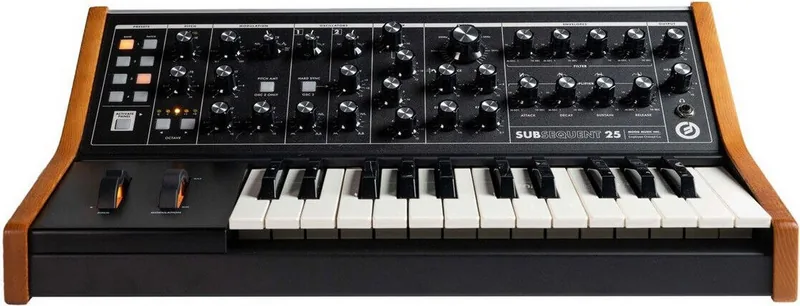
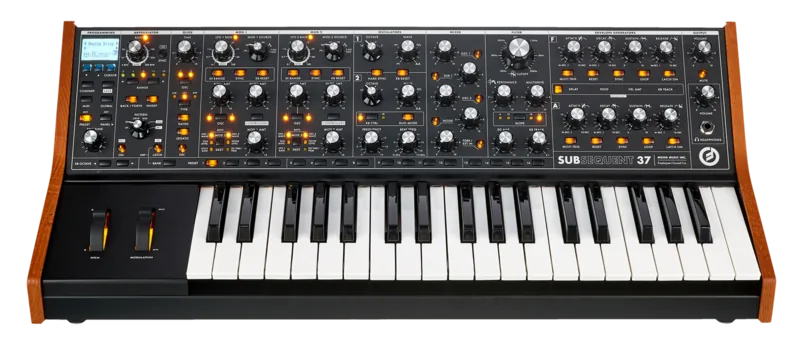
The Moog Subsequent 25 is a compact yet formidable 2-note paraphonic analog synthesizer that bridges the gap between vintage warmth and modern functionality. Designed for both live performance and intricate sound design, this instrument captures the legendary hands-on control of classic Moog gear while introducing a dynamic new sound engine. Housed in a rugged black steel chassis with aluminum extrusion and classic wood sidepieces, it features a velocity-sensitive 25-key keyboard that offers an expressive playing experience right out of the box.
At the heart of the Subsequent 25 lies a 100% analog audio signal path. It boasts two exceptionally stable voltage-controlled oscillators capable of continuously variable waveforms ranging from triangle to sawtooth to square and narrow pulse. A dedicated sub-oscillator adds a solid foundation, while a noise generator provides essential textures for percussion. The iconic Moog Ladder Filter, known for its smooth lowpass response and ability to self-oscillate, shapes the sound with four selectable slopes. A unique MultiDrive circuit allows users to dial in everything from subtle tube-like warmth to aggressive hard clipping, giving every patch a distinct tonal edge.
Beyond its core sound generation, the Subsequent 25 excels in connectivity and versatility. It supports MIDI I/O over USB and DIN jacks, allowing seamless integration into digital audio workstations or external hardware setups. The front panel is packed with dedicated knobs for every function, ensuring intuitive manipulation of parameters like filter cutoff, resonance, envelope stages, and modulation depth. Users can access hidden parameters through Shift mode, unlocking advanced features like envelope delays, hold stages, and velocity sensitivity controls. Whether you are crafting deep bass lines, soaring leads, or complex rhythmic textures, the Subsequent 25 delivers the gritty, organic character that defines the Moog legacy.
Search for 67,706 Manuals online


Type-in Brand or Model