
Moog One Manual
PDF manual · 143 Pages
English



Quick check
Incorrect answer, please try again.
Chat with your Moog One manual using AI
Get instant AI answers from your Moog One manual
Ask anything about the Moog One. Answers come from this manual, with the pages they are based on.
Ask a Question
Do you recommend One?
Yes NoFrequently Asked Questions
Moog One combines a classic analog signal path with modern multitimbral architecture, deep modulation, performance sets, and extensive connectivity. It is designed to be both a playable instrument and a serious sound-design platform.
Is this answer helpful?
A preset can contain up to three synth parts. These can be split across the keyboard, layered on the same keys, or arranged in multitimbral combinations, depending on how you build the sound.
Is this answer helpful?
Yes. Performance Sets, snapshots, dedicated controls, and fast preset browsing make it suitable for stage use. Its tactile panel also helps performers shape sounds in real time without menu-heavy navigation.
Is this answer helpful?
Yes. It includes CV inputs and outputs, plus pedal connections that can also be configured for control voltage. That makes it easy to integrate with modular and Eurorack systems.
Is this answer helpful?
Its core audio path is analog, which gives it the classic Moog character. It also includes digital features such as effects, browser functions, and system management to expand flexibility.
Is this answer helpful?
The instrument is heavy, so two people are recommended for unpacking. It uses an external power supply and balanced outputs, and it may need several minutes to warm up for stable tuning.
Is this answer helpful?
Advantages and Disadvantages
Advantages

- Rich analog sound with three VCOs, dual filters, and flexible routing for deep tonal shaping.
- Three-synth architecture per preset supports layering, splits, and multitimbral performance.
- Hands-on controls, OLED feedback, and a central display make sound design fast and tactile.
- Strong connectivity with MIDI, USB, Ethernet, CV, and pedal inputs for studio or modular setups.
Disadvantages

- Heavy 45 lb chassis makes transport and setup less convenient for one person.
- Complex feature set can feel overwhelming for users seeking a simple synth workflow.
- Analog tuning may need warm-up time before reaching full stability.
- Large size and external power supply require careful placement and cable management.
Product Specification
Type
Synthesizer
Keys
61, Aftertouch
Sound Generation
analog
Controllers
Pitch-Bend, Modulation, X/Y-Touchpad, Rotary encoder
Speakers
no
Display
LCD
Audio Connections
4x Insert Send/Return (0.25in jack), Line In (0.25in jack), Mic/Line In (XLR/0.25in Combo), Stereo Line Out (0.25in jack), 1x Headphone (0.25in jack)
Other Connections
USB-A (USB to Device), USB-B (USB to Host), LAN, MIDI In/Out/Thru, CV In/Out, Volume pedal, Expression pedal, Sustain pedal
Special Features
Sequencer, Arpeggiator
Dimensions
42.13x7.09x20.08in (WxHxD)
Weight
44.95lb
Product Description
Moog One: A Deep Analog Synth for Serious Sound Design
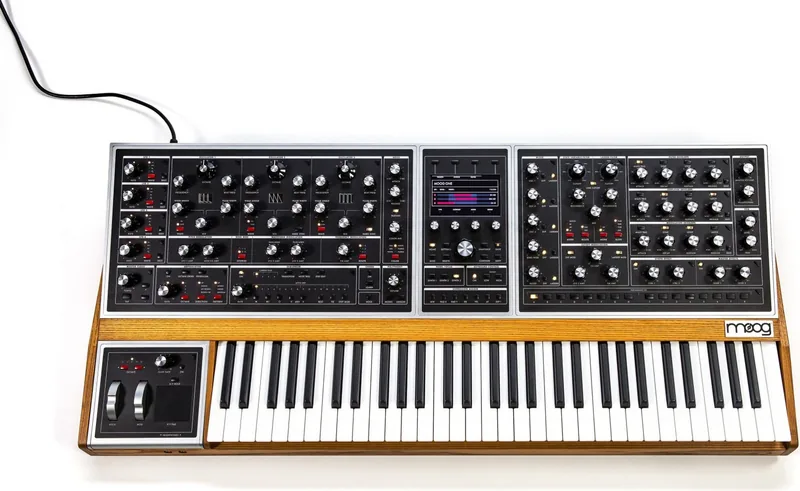
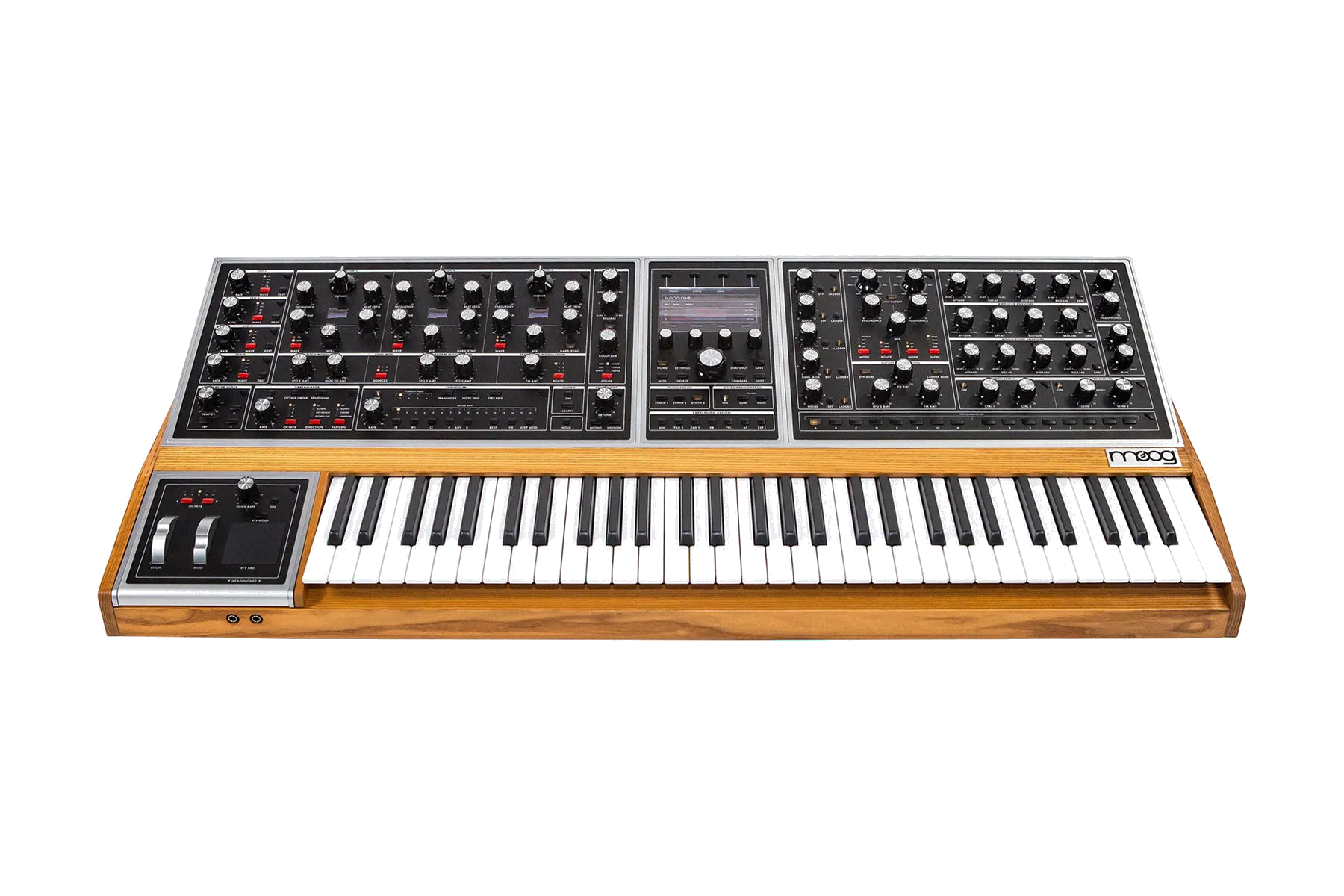
Moog One stands out as a flagship instrument built for players who want the warmth of classic analog synthesis with the flexibility of a modern performance center. It combines a hands-on front panel, a wide range of sound-shaping tools, and a layout that encourages fast, intuitive editing. For musicians, producers, and sound designers, it feels less like a preset box and more like a creative workstation built around touch, timing, and expression.
At its core, Moog One offers three independent synth engines inside a single preset, making it possible to build split, layered, or multitimbral sounds with impressive depth. Its analog oscillators, dual filter structure, envelopes, and LFOs give it a wide sonic range, from classic basses and leads to evolving pads and experimental textures. The browser, performance sets, snapshots, and autosave functions make it practical for both studio work and live use.
What makes Moog One especially compelling is the balance between old-school character and modern control. The angled panel, dedicated knobs, OLED feedback, and center display keep the workflow tactile, while modulation routing, sequencer options, arpeggiation, and effects expand the instrument far beyond traditional subtractive synthesis. It also supports MIDI, USB, Ethernet, and CV I/O, so it can fit into both digital and modular setups.
The Moog One Manual reflects this depth by showing how much attention has been given to real-world playing and sound design. From oscillator sync and frequency modulation to filter routing and performance set organization, the instrument rewards exploration. It is large, complex, and highly expressive, but that complexity is part of its appeal: every section invites detailed shaping rather than quick compromise.
For anyone seeking an analog synth that feels luxurious, powerful, and deeply musical, Moog One delivers a rare combination of character and control.
Notes
- Weighs about 45 lbs, so setup is best handled carefully.
- The analog oscillators may need a short warm-up for stable tuning.
- Great for players who want hands-on control and advanced modulation.
- Strong choice for studio design, live performance, and hybrid synth rigs.
Search for 67,706 Manuals online


Type-in Brand or Model