

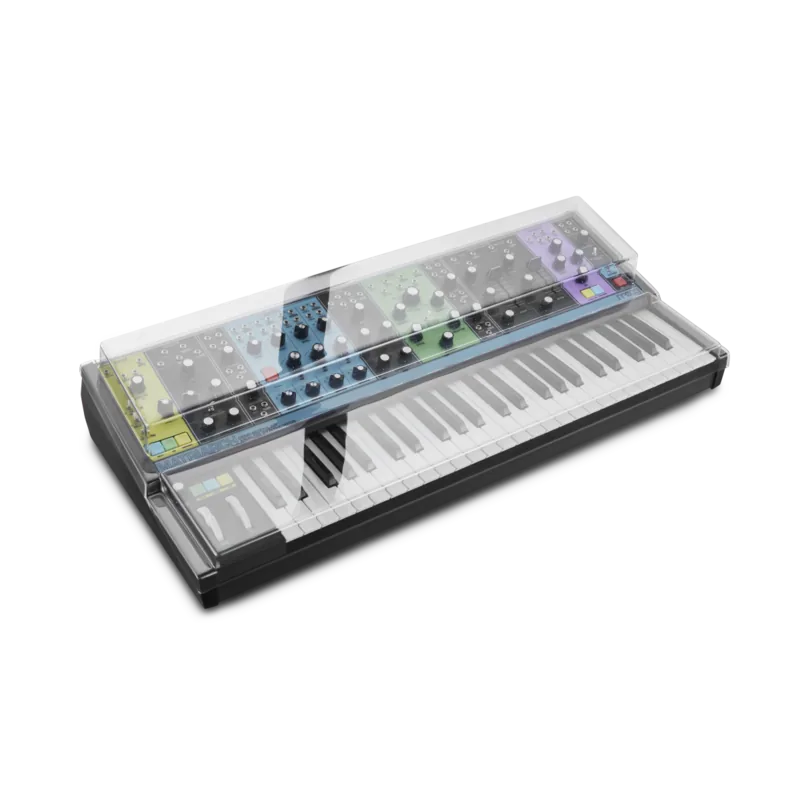

Moog Matriarch Manual
PDF manual · 92 Pages
English



Quick check
Incorrect answer, please try again.
Chat with your Moog Matriarch manual using AI
Get instant AI answers from your Moog Matriarch manual
Ask anything about the Moog Matriarch. Answers come from this manual, with the pages they are based on.
Ask a Question
Do you recommend Matriarch?
Yes NoFrequently Asked Questions
As described, allow about 10-15 minutes warm-up for stable tuning. If the instrument was left in a cold car overnight, tuning may take as long as 25 minutes to stabilize.
Is this answer helpful?
Yes. Use the MAIN OUT LEFT (MONO) jack for mono monitoring. For stereo, connect to MAIN OUT LEFT and MAIN OUT RIGHT. The manual also notes these jacks work with TS and TRS 1/4-inch cables.
Is this answer helpful?
No. The headphone output has its own dedicated HEADPHONE VOLUME knob, and it is not affected by the front-panel MAIN VOLUME control on the Output module.
Is this answer helpful?
When synced, the sync oscillator's cycle is forced to reset to match the previous oscillator. This creates more complex waveform content while keeping the synced oscillator's pitch locked, often producing sharp metallic or flanger-like character.
Is this answer helpful?
The FILTER MODE switch determines whether VCF 1 is high-pass and VCF 2 is low-pass in series, both act as low-pass in stereo, or both receive the same signal and are combined for a notch-capable parallel behavior. CUTOFF is linked, with SPACING offsetting VCF 1.
Is this answer helpful?
Matriarch provides 12 sequence locations across three Banks. Each sequence can hold up to 256 steps, and each step can include up to four notes plus additions like tie or ratchets.
Is this answer helpful?
A global FINE TUNE knob provides overall tuning for all Matriarch oscillators within about plus or minus one semitone, keeping the instrument coherent while you adjust to other gear.
Is this answer helpful?
Advantages and Disadvantages
Advantages

- 90 modular patch points plus a semi-modular front panel for quick and deep sound design
- Four analog VCOs with hard sync, detune, and waveform selection for versatile timbres
- Stereo-capable Ladder Filters with series, parallel, and stereo configurations
- Arpeggiator and multi-bank sequencer with 12 locations and up to 256 notes per sequence
- Stereo analog delay with tap tempo, MIDI sync, ping-pong, and CV control options
Disadvantages

- Requires analog warm-up time (10-15 minutes, potentially up to 25 minutes when cold)
- Many patch points and routing choices can overwhelm beginners
- High resonance settings can self-oscillate, which may be undesirable for some sounds
- Long delay times can become noisy or lo-fi depending on use
- No user serviceable parts; internal servicing must be done by qualified personnel
Product Specification
Type
Synthesizer (semi-modular)
Keys
49, Aftertouch
Sound Generation
analog
Polyphony
4-voice
Controller
Pitch-Bend, Modulation, Rotary Knob
Speakers
no
Display
no
Audio Connections
Line In (6.35mm Jack), 2x Line Out (6.35mm Jack), 1x Headphones (6.35mm Jack)
Other Connections
USB-B (USB to Host), MIDI In/Out/Thru, CV In/Out, Expression Pedal, Sustain Pedal
Special Features
Sequencer, Arpeggiator
Dimensions
32.01x5.51x14.25in (WxHxD)
Weight
24.01lb
Product Description
Moog Matriarch Manual Guide: Semi-Modular Analog Power for Sound and Performance
The Moog Matriarch is a semi-modular analog synthesizer designed for fast inspiration and deep exploration. Inspired by classic Moog circuitry, it pairs a hands-on, performance-ready layout with 90 accessible patch points, letting you stay mostly knob-based while still going modular when you want to. The result is a wide range of tones, from overdriven bass to gently evolving plucks that can spiral into long, characterful delay trails.
At the core are four analog VCOs with hard sync and FM-friendly capabilities. You can stack them in unison for a massive mono voice, or run paraphonic modes for more than one note at once. A responsive 49-key Fatar keyboard brings velocity and channel aftertouch, plus glide and expressive pitch and mod wheels, so your performance feels musical rather than mechanical.
Sound shaping starts with stereo-capable Ladder Filters. Depending on the selected filter mode, Matriarch can run filters in series, parallel, or stereo configurations, with resonance that can even push into self-oscillation. Envelope Generators (ADSR) provide both amplitude control and filter motion, and their patch points make it easy to trigger them from sources beyond the keyboard.
Rhythm and recall are handled by Arp/Seq tools that record and play back 12 sequences with up to 256 notes each. You can also arpeggiate held notes with adjustable direction, random behavior, ties, rests, and ratchets. Tempo control supports direct tapping, and deeper integration is possible with clock syncing and MIDI.
Space and motion come from the built-in stereo analog delay, a two-stage BBD design with feedback from single repeats to near-infinite washes. It supports tap tempo, MIDI sync, ping-pong stereo movement, and flexible timing control, including CV inputs for more expressive delay sculpting.
Key results (what this setup makes easy)
- 4 analog VCOs with sync and FM-style modulation options for classic and modern timbres
- Dual Ladder Filters with series, parallel, and stereo signal paths for decisive tone shaping
- 12-sequence Arp/Seq engine (up to 256 notes) for repeatable patterns that still feel alive
- Stereo analog delay with ping-pong and sync for wide, time-based effects
- Semi-modular patching (90 patch points) for quick experiments and deeper system building
Pros and cons (based on the Moog Matriarch Manual)
Pros
- Extensive patch access (90 modular patch points) without losing the immediacy of a semi-modular panel
- Expressive keyboard with velocity, aftertouch, glide, and performance wheels
- Flexible filter modes (series, parallel, stereo) with resonance and keyboard tracking
- Sequencer and arpeggiator support recording features and tempo control
- Stereo analog delay with sync, tap tempo, and ping-pong behavior
Cons
- Analog warm-up time is required (10-15 minutes typically, longer if very cold)
- Sound design can become complex quickly due to many patch and routing options
- Long delay times can produce noisy, lo-fi trails depending on settings
- Resonance settings can self-oscillate if pushed high
- Service and internal repair should be left to qualified personnel
Notes
- Main outputs can be monitored in mono (left jack) or stereo (left and right). Headphones use a separate headphone volume control.
- Global Settings persist after power off, including behavior like delay sync CV bending.
Search for 67,706 Manuals online


Type-in Brand or Model