
Moog Grandmother Manual
PDF manual · 56 Pages
English



Quick check
Incorrect answer, please try again.
Chat with your Moog Grandmother manual using AI
Get instant AI answers from your Moog Grandmother manual
Ask anything about the Moog Grandmother. Answers come from this manual, with the pages they are based on.
Ask a Question
Do you recommend Grandmother?
Yes NoFrequently Asked Questions
It is a semi-modular analog synthesizer designed for hands-on sound design, performance, and modular-style experimentation. It combines an easy-to-play keyboard with extensive patching options and classic Moog circuitry.
Is this answer helpful?
No. Grandmother can make full sounds without any patch cables. The patch bay is there to expand the signal path, reroute functions, and create more advanced or unusual tones when you want them.
Is this answer helpful?
It is known for warm bass, expressive leads, metallic sync textures, experimental modulation, and vintage-style analog tones. The spring reverb and filter make it especially good for rich, characterful sounds.
Is this answer helpful?
Yes. It includes MIDI, clock sync, audio input, and CV patch points. That means it can integrate with DAWs, modular systems, drum machines, and other synths with ease.
Is this answer helpful?
Yes. The 256-step sequencer and arpeggiator make it useful for building riffs, repeating motifs, and evolving patterns. You can also store multiple sequences and sync them to external clocks.
Is this answer helpful?
The classic Moog ladder low-pass filter is a major highlight. It offers smooth cutoff control, strong resonance, and self-oscillation, which helps shape sounds from mellow to intense with ease.
Is this answer helpful?
Advantages and Disadvantages
Advantages

- Pure analog signal path delivers warm, expressive tone and classic Moog character.
- Semi-modular design works immediately, yet offers deep patching for advanced users.
- Built-in arpeggiator, sequencer, and MIDI make it versatile for performance and studio use.
- Spring reverb, oscillator sync, and FM expand the sound palette beyond traditional subtractive synthesis.
Disadvantages

- Monophonic design limits chord playing and layered polyphonic arrangements.
- Analog oscillators need warm-up time and can drift more than digital instruments.
- Spring reverb can pick up vibration or electromagnetic interference in some environments.
- Learning the patch bay and global settings may feel overwhelming at first for newcomers.
Product Specification
Type
Synthesizer (semi-modular)
Keys
32
Sound Generation
analog
Polyphony
monophonic
Controllers
Pitch-Bend, Modulation, Rotary controls
Speakers
no
Display
no
Audio Connections
Instrument In (0.25 in Jack), Line Out (0.25 in Jack), 1x Headphone (0.25 in Jack)
Other Connections
USB-B (USB to Host), MIDI In/Out/Thru, CV In/Out
Features
Sequencer, Arpeggiator
Product Description
Moog Grandmother: An Analog Playground for Sound Discovery
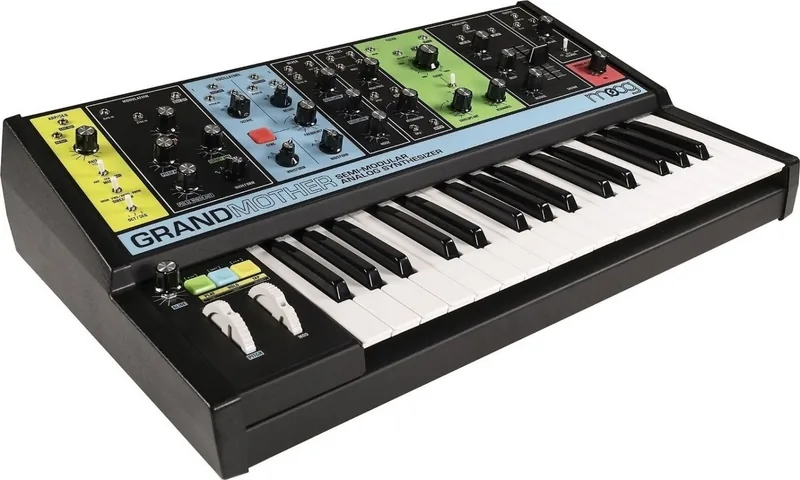
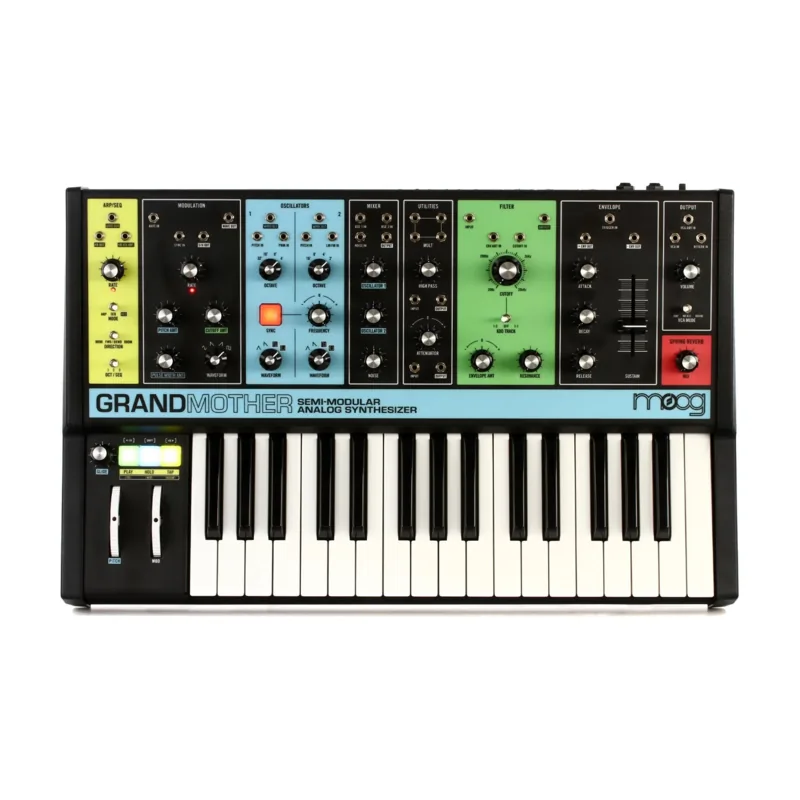
Moog Grandmother brings classic synthesizer character into a hands-on, semi-modular format that invites both immediate play and deep experimentation. With two analog oscillators, a Moog ladder low-pass filter, spring reverb, and a 32-note velocity-sensitive keyboard, it feels like an instrument designed for curiosity as much as performance. If you have been exploring the Moog Grandmother Manual, you already know how much can happen before you even patch a single cable.
What makes Grandmother special is its balance between simplicity and freedom. It works right away with no patching required, so players can start shaping tones with oscillator waves, mixer levels, filter cutoff, resonance, envelope settings, glide, and modulation. At the same time, the 41 patch points open the door to modular-style sound design, letting you reroute signals, add external audio, and build custom control paths. That makes it a strong fit for beginners who want to learn synthesis and for experienced musicians who want a compact analog system with real depth.
The sound engine is entirely analog, which gives Grandmother a warm, lively response that feels organic under the fingers. Oscillator sync, linear FM, pulse width modulation, sample-and-hold modulation, and the onboard reverb all help create everything from soft, flute-like textures to aggressive metallic leads and thick bass tones. The built-in arpeggiator and 256-step sequencer add another layer of creativity, making it easy to sketch rhythmic ideas, build evolving patterns, or sync the synth with larger setups through MIDI and clock connections.
Grandmother also shines as a utility instrument. It can process external audio, serve as a keyboard front end for Eurorack systems, and provide useful CV sources like gate, keyboard pitch, and velocity outputs. The rear-panel connections, global settings, and MIDI implementation make it flexible enough for modern studios while preserving the tactile feel of a classic analog machine. In practice, it is the kind of synth that rewards time spent turning knobs, listening closely, and discovering happy accidents.
Notes
- Let the instrument warm up before tuning for best stability.
- Use the patch bay to unlock its most expressive and experimental sounds.
- The spring reverb adds character, but can react to vibration and interference.
- Great for solo sound design, live performance, and modular integration.
Search for 67,706 Manuals online


Type-in Brand or Model