
MDT Temperature Controller Manual
PDF manual · 2 Pages
English



Quick check
Incorrect answer, please try again.
Chat with your MDT Temperature Controller manual using AI
Get instant AI answers from your MDT Temperature Controller manual
Ask anything about the MDT Temperature Controller. Answers come from this manual, with the pages they are based on.
Ask a Question
Do you recommend Temperature Controller?
Yes NoFrequently Asked Questions
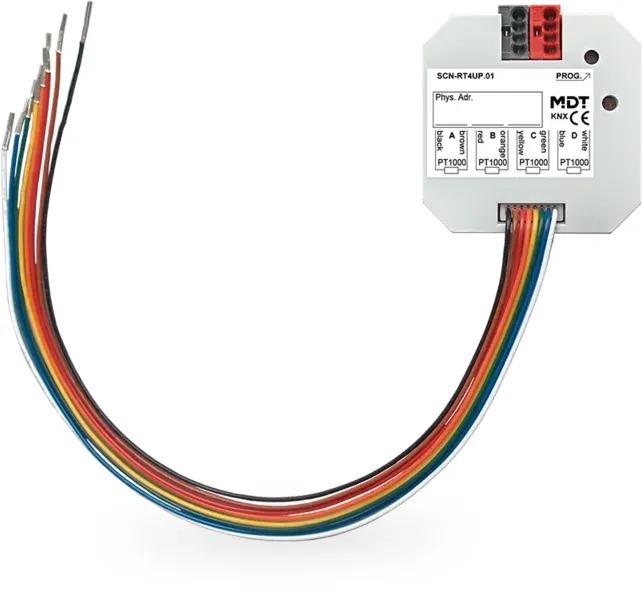
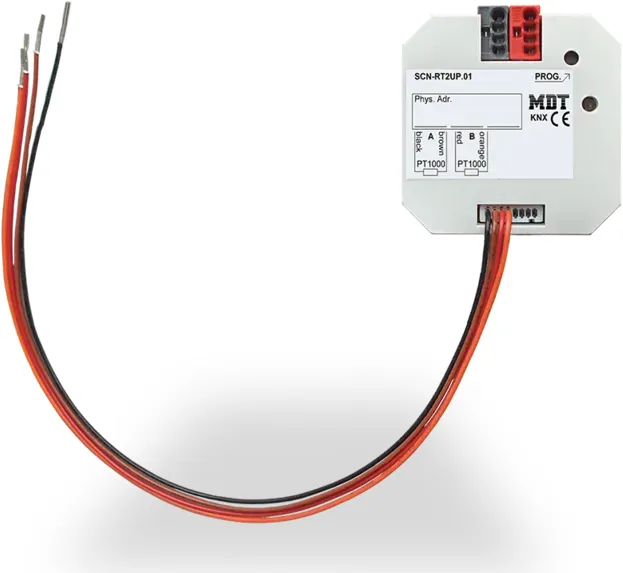
PT1000 inputs are supported on SCN-RT6AP.01, SCN-RT2UP.01 and SCN-RT4UP.01 models. Other variants receive temperature via KNX bus objects only.
Is this answer helpful?
The controller supports two-position, PI and PWM control characteristics. These are configured in the ETS application software when setting up the device.
Is this answer helpful?
Connect the device to the KNX bus, assign a physical address in ETS, create and configure the application program, upload parameters to the device and press the programming key when prompted. The red LED indicates programming status.
Is this answer helpful?
Install only in dry indoor environments (IP20). Keep PT1000 sensor cables under 12 m and avoid routing them parallel to 230VAC mains. Maintain required separations from mains wiring and never place device together with 230V cables in flush-mounted boxes.
Is this answer helpful?
Yes. The device stores minimum and maximum temperatures and can send alarm telegrams if temperature thresholds or frost-protection limits are exceeded; these thresholds are parameterizable in ETS.
Is this answer helpful?
The device is powered via the KNX bus (KNX Bus supply). Typical power consumption is below 0.3 W on the bus.
Is this answer helpful?
Application software and product databases are available for download from MDT’s website under the Downloads section; ensure you use the correct ETS version compatible with the device.
Is this answer helpful?
Advantages and Disadvantages
Advantages

- Flexible control modes (two-point, PI, PWM) adaptable to many HVAC systems.
- Full KNX TP-256 compatibility with ETS application software for integration.
- Available as DIN-rail (REG) and surface-mounted (AP/UP) devices to fit installations.
- Direct PT1000 sensor inputs on select models for accurate local temperature measurement.
- Temperature min/max logging and alarm telegrams enhance safety and monitoring.
Disadvantages

- PT1000 sensor cable length limited to 12 meters, restricting placement.
- IP20 enclosure requires dry indoor installation only.
- Requires professional electrician and ETS familiarity for commissioning.
- Not approved for use in USA or Canada; CE-marked for EU only.
- Sensor cables must not run parallel to 230VAC mains, complicating routing.
Product Specification
Type
Sensor
Standard
KNX
Function
Temperature
Topology
Bus
Features
IP20
Product Description
MDT Temperaturregler Manual — Intelligent KNX Temperature Control
The MDT Temperaturregler is a versatile KNX-compatible temperature controller family designed for precise climate management in residential and commercial installations. Available in multiple form factors and channel counts, these controllers support direct PT1000 sensor inputs (on specific models) and bus-based temperature objects via the KNX network. They offer configurable control characteristics—two-point, PI, and PWM—so installers can tailor behavior for radiators, underfloor heating, ventilation or other HVAC actuators.
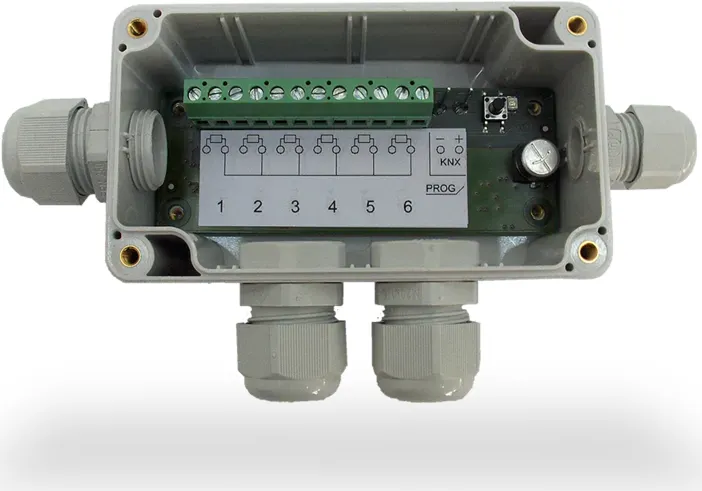
Models include DIN-rail (REG) and surface-mounted (AP/UP) variants with 2, 4, 6 or 8-channel options. PT1000 sensors can be connected where supported, with a recommended maximum cable length of 12 meters to avoid interference and ensure accurate readings. The devices communicate using standard KNX TP-256 interface and are compatible with ETS application software for parameterization and commissioning.
Setup and operation are straightforward: connect to the KNX bus, assign a physical address in ETS, upload the application program, and press the programming key when prompted. A red programming LED indicates programming status. The controller transmits actuating values to the KNX bus as 1-bit or 1-byte variables depending on settings, and it can log minimum and maximum temperatures and send alarm telegrams when thresholds or frost-protection limits are exceeded.
Safety and installation guidance emphasize professional installation by authorized electricians, adherence to relevant standards, and separation from 230 VAC mains wiring to minimize interference. The enclosure rating is IP20 and units are intended for dry indoor environments only. Power is supplied by the KNX bus, keeping wiring requirements minimal for integration into automated building systems.
Notes:
- Choose the model based on required channel count and whether PT1000 inputs are needed (SCN-RT6AP.01, SCN-RT2UP.01, SCN-RT4UP.01 support PT1000).
- Maximum PT1000 cable length: 12 m. Avoid routing sensor cables parallel to 230 VAC mains.
- Control modes and alarm thresholds are configured in ETS; visual setpoint control can be provided via MDT VisuControl or MDT pushbuttons.
Pros and Cons (summary):
Pros:
- Flexible control modes (2-point, PI, PWM) for varied HVAC needs.
- KNX compatibility with ETS databases for easy integration.
- Multiple form factors: DIN-rail and surface-mounted options.
- Direct PT1000 sensor support on selected models.
- Alarm and min/max temperature logging for safety and diagnostics.
Cons:
- PT1000 cable length limited to 12 m, restricting sensor placement.
- IP20 rating limits usage to dry indoor environments.
- Installation requires authorized electricians and ETS knowledge.
- Not certified for use outside the EU (e.g., USA/Canada).
- Sensor cables must not run parallel to 230 VAC, complicating wiring.
Search for 67,732 Manuals online


Type-in Brand or Model