
MDT EZ Manual
PDF manual · 60 Pages
English



Quick check
Incorrect answer, please try again.
Chat with your MDT EZ manual using AI
Get instant AI answers from your MDT EZ manual
Ask anything about the MDT EZ. Answers come from this manual, with the pages they are based on.
Ask a Question
Do you recommend EZ?
Yes NoFrequently Asked Questions
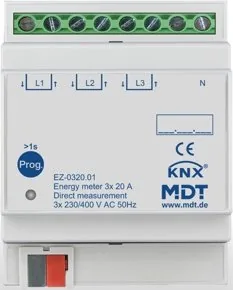
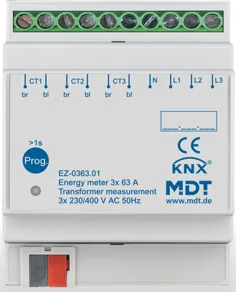
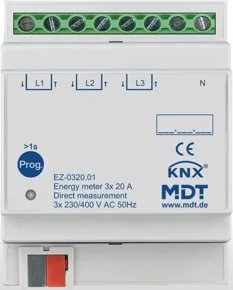
The EZ-0320.01 supports direct measurement up to 20 Amperes, while the EZ-0363.01 uses transformer measurement for currents up to 63 Amperes. Both are three-phase bidirectional meters suitable for different load requirements.
Is this answer helpful?
Yes, the meter is designed as a bidirectional counter. It can separately measure energy consumption from the grid and energy generated and fed back into the grid, making it ideal for photovoltaic systems.
Is this answer helpful?
You can configure the meter to calculate costs using fixed daily and night tariffs entered in the ETS, or by receiving variable tariff values via communication objects. It then calculates total costs for consumption and generation.
Is this answer helpful?
When a configured threshold for load, current, or voltage is exceeded, the meter can send a specific status bit, trigger an event, or reset counters depending on your ETS parameter settings.
Is this answer helpful?
Yes, you need a KNX USB interface or similar gateway connected to the KNX bus to download the physical address and application parameters using the ETS software.
Is this answer helpful?
Absolutely. The meter provides detailed communication objects for each phase (L1, L2, L3) including power, current, voltage, and energy values for granular analysis.
Is this answer helpful?
Advantages and Disadvantages
Advantages

- Supports both direct measurement up to 20A and transformer measurement up to 63A
- Separately tracks energy consumption and injection for accurate billing
- Configurable event triggers based on time, value, or cost thresholds
- Calculates real-time costs and yields using fixed or variable tariffs
- Long frame support significantly reduces programming time in ETS
Disadvantages

- Requires ETS software knowledge for full configuration and setup
- Complex parameter structure may overwhelm beginners during initial setup
- Voltage error object is permanently active which consumes one communication object
- Limited to specific DIN rail mounting formats (4TE)
- Transformer version requires external current transformers for installation
Product Specification
Type
Sensor
Standard
KNX
Function
Current measurement function
Topology
Bus
Features
IP20
Product Description
Mastering Energy Efficiency with the MDT KNX Energy Meter EZ
The MDT KNX Energy Meter EZ series represents a significant leap forward in smart building energy management. Designed for industrial-grade precision, these devices offer comprehensive monitoring capabilities for both consumption and generation within a KNX network. Whether you are managing a small commercial space or a large industrial facility, the EZ-0320.01 and EZ-0363.01 models provide the flexibility needed to track every watt of electricity flowing through your system.
These meters support both direct measurement up to 20 Amperes and transformer-based measurement up to 63 Amperes. They function as three-phase bidirectional counters, allowing users to separately record energy consumption and injected energy. This dual capability is essential for modern setups involving photovoltaic systems where tracking feed-in tariffs is just as important as monitoring usage. The hardware is compact, fitting into standard 4TE DIN rail enclosures, making installation seamless in existing distribution boards.
Beyond simple counting, the device offers advanced features like power factor calculation, reactive power monitoring, and apparent power tracking. Users can set specific thresholds for current, voltage, and load deviations. When these limits are breached, the meter can trigger events, send alarms, or reset counters automatically. The integration with ETS software allows for deep customization of communication objects, ensuring that only relevant data is transmitted over the bus. Support for long frames further optimizes programming time by reducing the number of telegrams required for complex configurations.
The ability to calculate costs and yields based on fixed or variable tariffs adds another layer of utility. By inputting day and night rates, the meter can generate detailed financial reports on energy usage. Events can be configured to activate at specific times, intervals, or when cost thresholds are reached, enabling automated responses to changing energy conditions. This makes the MDT KNX Energy Meter EZ not just a measuring tool, but a central component of an intelligent energy strategy.
Key Takeaways
- Supports both direct and transformer measurement for versatile applications.
- Enables separate tracking of consumption and generation for accurate billing.
- Configurable events allow for automated control and alarm systems.
- Long frame support streamlines ETS programming and reduces bus load.
- Flexible tariff settings facilitate precise cost and yield calculations.
Search for 67,732 Manuals online


Type-in Brand or Model