


Lyngdorf SDA-2400 Manual
PDF manual · 20 Pages
English



Quick check
Incorrect answer, please try again.
Chat with your Lyngdorf SDA-2400 manual using AI
Get instant AI answers from your Lyngdorf SDA-2400 manual
Ask anything about the Lyngdorf SDA-2400. Answers come from this manual, with the pages they are based on.
Ask a Question
Do you recommend SDA-2400?
Yes NoFrequently Asked Questions
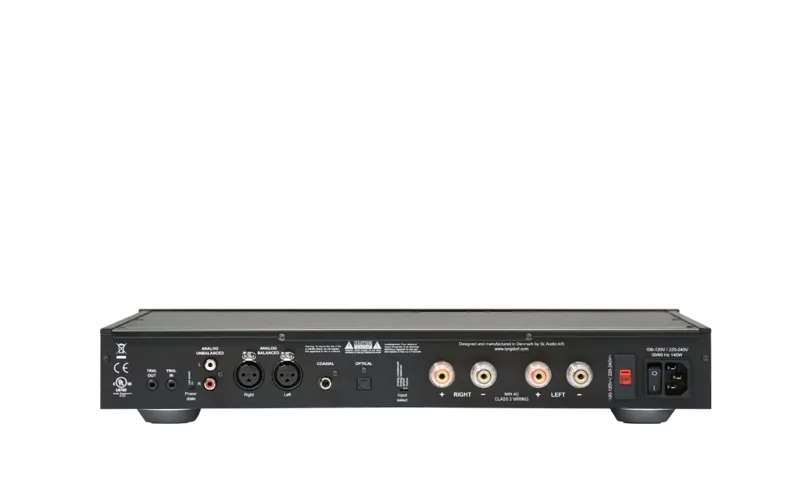
The amplifier uses automatic power control instead of a front power switch. In Low power mode, it turns on when it detects a signal on the selected input, then returns to standby if no signal is detected for about 30 minutes. You can also keep it permanently on by using the On state, or control it externally with Trigger In.
Is this answer helpful?
Trigger In accepts either 5-24 V DC or 4-17 Vrms at 50 Hz AC. If Trigger In has no applied voltage, the amplifier remains in standby. Applying the specified DC or AC voltage switches it into Operate mode.
Is this answer helpful?
No. The inputs are internally connected in parallel, so you must choose one type. Use either the XLR balanced inputs OR the phono unbalanced inputs. Never connect both at the same time.
Is this answer helpful?
It provides optical (Toslink) and coaxial SPDIF digital inputs. The supported maximum formats shown are optical up to 96 kHz / 24-bit, and coaxial up to 192 kHz / 24-bit.
Is this answer helpful?
Connect Left and Right speakers to the corresponding loudspeaker connectors and observe polarity (+ to +, - to -). The manual warns never to run the SDA-2400 in bridge mode by bridging the speaker output terminals, as this can damage the amplifier.
Is this answer helpful?
No regular maintenance is required besides keeping the exterior clean. Wipe the unit with a clean, soft cloth. If needed, use a small amount of non-abrasive cleaner applied to the cloth to remove dirt or fingerprints. Avoid abrasive cleaners and cleaners containing liquid solvents.
Is this answer helpful?
Yes. The voltage selector must be positioned correctly for your local mains supply. After setting it correctly, insert the mains cord firmly into the connector and use the mains switch to power the amplifier.
Is this answer helpful?
Advantages and Disadvantages
Advantages

- Very low standby power consumption (<0.4 W) and automatic power control based on signal detection
- Trigger In and Trigger Out (3.5 mm) for reliable integration with preamps and daisy-chained amps
- Multiple input options: analog balanced, analog unbalanced, optical, and coaxial SPDIF
- High output capability with excellent distortion performance (rated THD+N values as low as 0.004% at 1 W/8 ohms)
- Maintenance-friendly: no regular maintenance required beyond basic exterior cleaning
Disadvantages

- No supported bridged mono use; bridging speaker terminals can damage the amplifier
- Analog inputs must be used correctly: use either XLR OR phono, never both at the same time
- Automatic standby can turn the amplifier off after about 30 minutes without signal (unless set to On)
- Digital input limitations apply: optical is rated up to 96 kHz / 24-bit, coaxial up to 192 kHz / 24-bit
- Requires correct mains voltage selector positioning for safe operation
Product Specification
Channels
2
Power per Channel
200W (8Ω), 400W (4Ω)
Audio Connections
Digital Audio In (coaxial), Digital Audio In (optical), Stereo Line In (RCA), Stereo Line In (XLR)
D/A Converter
32bit/384kHz
Color
black
Dimensions
17.72x2.87x14.17in (WxHxD)
Weight
14.33lb
Product Description
Lyngdorf SDA-2400 Black Amplifier
The Lyngdorf SDA-2400 black Manual highlights a modern, integration-friendly stereo power amplifier built for clean, controlled sound. This compact unit is designed to deliver high headroom with tight distortion performance, while keeping everyday operation simple and power use impressively low.
At a glance, the SDA-2400 black Manual focuses on a power stage that can push serious output depending on load. With analog and digital inputs available, it fits into both traditional and source-rich systems. You can connect analog via balanced XLR or unbalanced phono inputs, or go fully digital with optical (Toslink) or coaxial SPDIF.
A standout feature for real-world setups is trigger control. The amplifier supports Trigger In and Trigger Out using a 3.5 mm mono jack, allowing it to switch operate and standby state from another component. Instead of a front power switch, it uses automatic power control: it wakes when it detects an audio signal on the selected input, and it returns to standby if no signal is detected after about 30 minutes. If you prefer constant operation, you can use an On state.
In the signal chain, connection choices matter. The amplifier requires you to use either the XLR balanced inputs OR the phono unbalanced inputs at the same time, never both. For digital sources, SPDIF and optical inputs are also available through an input selector.
Speaker setup is straightforward but precise. Connect the Left and Right loudspeaker terminals correctly, observing polarity (+ to + and - to -). The manual also cautions against bridging the speaker outputs, as bridged mono use is not supported.
Key takeaways
- Low standby power (<0.4 W) plus automatic wake on signal makes it energy-smart.
- Trigger In/Out enables seamless control with preamps, streamers, and multi-unit setups.
- Flexible connectivity: balanced, unbalanced, optical, and coaxial inputs.
- Strong measured performance, including very low THD+N and high signal-to-noise.
Setup and use notes
- Set the correct mains voltage using the voltage selector before powering on.
- Use the input selector and follow the analog input rule to avoid incorrect parallel use.
- Avoid bridge mode; connect speakers normally to Left and Right.
Care and maintenance
The exterior needs no regular servicing beyond gentle cleaning with a soft cloth. Use only non-abrasive cleaning methods and avoid solvent-based cleaners.
Search for 67,732 Manuals online


Type-in Brand or Model