
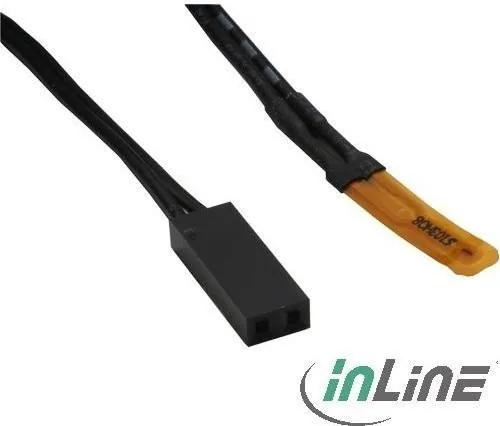
InLine Water Cooling Temperature Sensor Manual
PDF manual · 1 Pages
English


Quick check
Incorrect answer, please try again.
Chat with your InLine Water Cooling Temperature Sensor manual using AI
Get instant AI answers from your InLine Water Cooling Temperature Sensor manual
Ask anything about the InLine Water Cooling Temperature Sensor. Answers come from this manual, with the pages they are based on.
Ask a Question
Do you recommend Water Cooling Temperature Sensor?
Yes NoVideo Manual
IFM TN2511 Temperature Sensor: Setup, Wire, Use with S7 and Logix
Frequently Asked Questions
The sensor is a thin NTC thermistor offering electrical characteristics identical to high-precision thermistors (JT/IT/HT/ET/AT series). High B-values and precise R25 ratings yield predictable resistance-to-temperature behavior for accurate measurements.
Is this answer helpful?
Common options include 103JT (≈10 kΩ at 25°C, B≈3435 K) and 104JT (≈100 kΩ at 25°C, B≈4390 K). Alternate R25 tolerances and values are available; choose based on temperature range and ADC resolution requirements.
Is this answer helpful?
Typical thermal time constant is about 5 seconds in still air for standard variants (time to reach ~63.2% of temperature change). Actual response depends on mounting, airflow, and medium.
Is this answer helpful?
Dissipation factor is around 0.7 mW/°C and rated power at 25°C is in the low milliwatt range (e.g., ~3.5 mW for listed variants). Avoid excess excitation current to prevent self-heating and measurement error.
Is this answer helpful?
Yes. These series share identical electrical characteristics, so you may choose a part based on mechanical configuration without changing electrical performance.
Is this answer helpful?
Variants show operating ranges up to 250°C for some types and up to 125°C for others. Select the specific part number that matches your required maximum and minimum operating temperatures.
Is this answer helpful?
Use the NTC thermistor equation with R25 and B-value: T(K) = B / ln(R/R25) + 273.15 after rearrangement, or use standard lookup tables provided by the part to map resistance values to °C for best accuracy.
Is this answer helpful?
Advantages and Disadvantages
Advantages

- High precision with interchangeable JT/IT/HT/ET/AT electrical characteristics for flexible mechanical selection.
- Thin form factor yields fast thermal coupling and short thermal time constant (~5 s in air).
- Available in common R25 values (10 kΩ, 100 kΩ) and high B-values for accurate resistance-to-temperature mapping.
- Low dissipation factor (~0.7 mW/°C) minimizes self-heating, suitable for low-power designs.
- Wide operating temperature options (examples up to 250°C or 125°C depending on variant).
Disadvantages

- Low rated power (millowatt range) requires care to avoid self-heating in high-current applications.
- Thermal time constant measured in air; actual response varies with mounting and medium.
- Specific tolerance and alternate R25 options may be required for tight-accuracy applications, complicating selection.
- Very high or very low temperature extremes require selecting the correct variant to stay within operating limits.
- Resistance values at extreme temperatures vary widely, requiring proper calibration or conversion formula implementation.
Product Specification
Type
Temperature sensor
Product Description
InLine Temperatur Sensor Manual: Reliable Thin NTC Thermistor
The InLine Temperatur Sensor is a compact, high-precision NTC thermistor designed for accurate temperature measurement across a wide range of applications. Built on the same electrical characteristics as established high-precision thermistors, this inline sensor combines thin-profile packaging with reliable thermal response, making it ideal for embedded systems, HVAC monitoring, and consumer electronics.
Product overview
This inline sensor family includes interchangeable types (JT, IT, HT, ET, AT) that share identical electrical behavior, allowing selection based solely on mechanical or mounting preferences without affecting measurement performance. Typical part variants include 103JT (10 kΩ) and 104JT (100 kΩ), offering different resistance ranges and B-values to suit various temperature spans and sensitivity needs.
Thin construction ensures fast thermal coupling and short thermal time constants (around 5 seconds in air for standard variants), enabling responsive readings for control loops and quick temperature changes. Power dissipation is low (approximately 0.7 mW/°C), and rated power at 25°C is in the milliwatt range, so the sensor is suited to low-power designs where self-heating must be minimized.
Key technical highlights
- Resistance options: common R25 values include 10 kΩ (103JT) and 100 kΩ (104JT), with tolerances and alternate resistance ratings available.
- B-value: high B values (e.g., ~3435 K for 103JT, ~4390 K for 104JT) deliver steep, predictable resistance-to-temperature curves for accurate conversions.
- Operating range: devices cover wide ranges (examples show up to 250°C for some variants and up to 125°C for others), allowing use in demanding thermal environments.
- Interchangeability: identical electrical characteristics across JT/IT/HT/ET/AT series simplify design choices and stocking.
Use cases
The InLine Temperatur Sensor fits temperature sensing in small spaces, medical devices, industrial controllers, consumer appliances, and any application requiring precise temperature feedback with minimal self-heating. Its thin form and fast thermal response make it suitable where rapid detection and compact mounting are needed.
Notes
- Choose the R25 and B-value combination that best matches your target temperature range and ADC resolution to minimize conversion error.
- Account for the thermal time constant in control loops; typical values are around 5 s in still air but will vary with mounting and medium.
- Avoid exceeding rated power to prevent self-heating and measurement drift.
Measured example resistances (illustrative)
At 20°C: ~12.11 Ω for 103JT and ~127.7 Ω for 104JT (table shows resistances across temperatures). Use the B-value and R25 to compute precise conversions.
Search for 67,706 Manuals online


Type-in Brand or Model
Lena Wagner
10 months ago
How easy is it to install, and will the adhesive work if I want to mount the temperature sensor on a curved surface?
Manual.ly
10 months ago
Installation is straightforward: you can connect the sensor directly to the motherboard header, then place the probe where you want to measure. The adhesive is intended for even, smooth, flat surfaces and is usually sufficient for such mounting. If you need to mount it on a curved surface, the sensor may not adhere evenly, so we recommend additional fastening such as a suitable tape or a small amount of cyanoacrylate (super glue) to ensure solid contact.