
HiKOKI UV3628DA Manual
PDF manual · 248 Pages
English



Quick check
Incorrect answer, please try again.
Chat with your HiKOKI UV3628DA manual using AI
Get instant AI answers from your HiKOKI UV3628DA manual
Ask anything about the HiKOKI UV3628DA. Answers come from this manual, with the pages they are based on.
UV3628DA Maintenance Schedule
Regularly inspect all mounting screws to ensure they are properly tightened. Retighten immediately if any are loose to prevent hazards.
On occasion, check before, during, and after operation that swarf and dust have not collected on the tool and battery terminals.
Wipe the tool body with a cloth soaked in soap solution to remove concrete. Immediately remove any concrete attached to the flexible assembly.
Ask a Question
Do you recommend UV3628DA?
Yes NoFrequently Asked Questions
It is used to compact fresh concrete for foundations and concrete products. Vibration helps remove trapped air and promotes a more homogeneous concrete mix.
Is this answer helpful?
It has Normal mode at 12,000 vibrations per minute for general compaction and sensitive formwork areas. Power mode reaches 15,200 vibrations per minute for high-viscosity concrete.
Is this answer helpful?
The UV3628DA is designed for HiKOKI Multi Volt batteries, including BSL36A18 and BSL36B18. Existing BSL3660, BSL3620, BSL3626, and BSL18xx batteries are not compatible.
Is this answer helpful?
Insert the rod vertically, avoid contact with steel reinforcement and formwork, and move it between overlapping points. Withdraw it slowly after compaction to prevent holes from forming.
Is this answer helpful?
Release the trigger and check for overload or overheating. Remove the cause of overload, or allow the tool and battery to cool completely before restarting.
Is this answer helpful?
Switch off the tool, remove the battery, and wipe away concrete with a cloth dampened in mild soap solution. Do not wash the tool body with water or use solvents that can damage plastic parts.
Is this answer helpful?
Advantages and Disadvantages
Advantages

- Cordless 36 V design improves mobility around foundations, forms, and concrete product work.
- Two modes deliver 12,000 or 15,200 vibrations per minute for normal and high-viscosity concrete.
- A 28 mm vibrating rod and 280 mm effective compaction area support systematic concrete consolidation.
- Overload and temperature protection, warning lights, and battery indicators support safer operation.
Disadvantages

- Compatible only with designated HiKOKI Multi Volt batteries; older battery series cannot be used.
- The 4.2 kg tool weight may become tiring during extended or overhead work.
- The vibrating rod becomes hot after use and requires careful handling.
- Concrete, dust, and water must be kept out of the tool body and battery terminals.
Product Specification
Vibrations
15,200/min
Weight
9.26 lb
Product Description
HiKOKI UV3628 Cordless Concrete Vibrator - Read, Download & Print Free
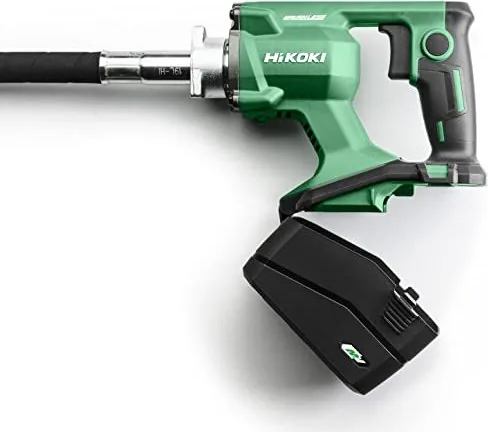
The HiKOKI UV3628 Cordless Concrete Vibrator is designed for efficient concrete compaction during foundation work, slab pours, and the production of concrete components. Its cordless 36 V platform helps users move freely around the work area without managing a mains cable, making it practical for demanding construction tasks and locations with limited access to power.
Built for Controlled Concrete Compaction
This model uses a 28 mm vibrating rod with a 187 mm length and an 825 mm assembly length. The flexible hose supports controlled placement into fresh concrete, helping remove trapped air and encourage a more uniform mix. The effective compaction area is approximately 280 mm in diameter, allowing operators to cover a pour methodically by overlapping insertion points.
Two operating modes provide flexibility for different concrete conditions. Normal mode runs at 12,000 vibrations per minute for regular compaction and areas where formwork may be more vulnerable to deformation. Power mode reaches 15,200 vibrations per minute and is intended for higher-viscosity concrete that needs more vigorous consolidation.
Cordless Performance and Useful Protection Features
The UV3628DA uses HiKOKI Multi Volt batteries, including the BSL36A18 and BSL36B18. The tool automatically manages compatible 36 V battery power, while a battery indicator helps users monitor remaining charge. At 4.2 kg with a BSL36B18 battery, it combines a substantial vibrating assembly with portable cordless operation.
Built-in overload and temperature protection functions help safeguard the motor and battery during intensive work. Warning lights on the switch panel indicate overload or excessive temperature, allowing the user to stop, remove the cause of strain, or let the tool cool before continuing. These features support more reliable use when compacting dense mixes or working continuously.
Practical Operation and Care
For best results, insert the vibrating rod vertically, keep it clear of reinforcement bars and formwork, and withdraw it slowly to avoid leaving holes. Excessive vibration can separate concrete ingredients, so controlled, evenly spaced placement is important. When working on slopes, begin at the lower end to use the weight of later concrete pours effectively.
After use, remove concrete residue promptly with a well-wrung cloth and mild soap solution. Keep ventilation areas, switches, battery terminals, and the flexible assembly clean. Avoid water entering the tool body, do not bend or stand on the flexible hose, and allow the vibrating rod to cool before touching it.
Notes
- Use only designated genuine HiKOKI Multi Volt batteries.
- Wear eye, face, and hearing protection during concrete work.
- Turn the tool off and wait for vibration to stop before setting it down.
Search for 67,732 Manuals online


Type-in Brand or Model