
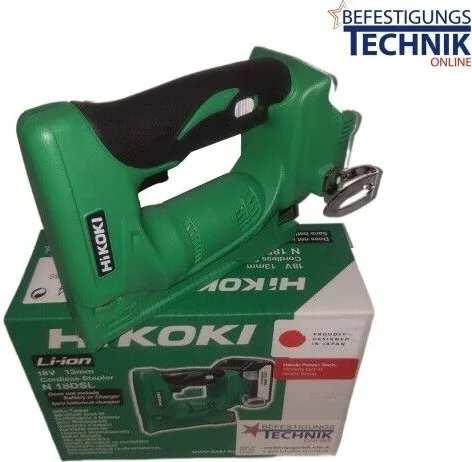
HiKOKI N18DSLW4Z Manual
PDF manual · 96 Pages
English



Quick check
Incorrect answer, please try again.
Chat with your HiKOKI N18DSLW4Z manual using AI
Get instant AI answers from your HiKOKI N18DSLW4Z manual
Ask anything about the HiKOKI N18DSLW4Z. Answers come from this manual, with the pages they are based on.
N18DSLW4Z Maintenance Schedule
Check all mounting screws to ensure they are properly tightened. Retighten immediately if any are loose.
Slide the magazine open and remove adhesive residue, fragments, and splinters that have collected inside.
Ensure the push lever slides smoothly. Clean the sliding area if it does not operate correctly.
If stored for 3 months or more, ensure the battery is fully charged before use to prevent charging issues.
Ask a Question
Do you recommend N18DSLW4Z?
Yes NoFrequently Asked Questions
It is a cordless stapler. It is designed to drive compatible HiKOKI staples into wood and similar materials, rather than conventional nails.
Is this answer helpful?
Use genuine HiKOKI BF1206, BF1210, and BF1213 staples. The supported staple lengths are 6 mm, 10 mm, and 13 mm. Using other staples may increase the risk of jams and driver-blade damage.
Is this answer helpful?
The N18DSL model uses 18 V lithium-ion battery packs, including BSL1820 and BSL1840. Check compatibility with your existing HiKOKI battery platform before purchase.
Is this answer helpful?
The solo designation generally means the tool is supplied without a battery and charger. This format is useful for users who already have compatible HiKOKI 18 V batteries and charging equipment.
Is this answer helpful?
The magazine holds up to 150 staples in a bonded strip. The anti-blank-firing feature stops operation when the staple count becomes low, helping prevent empty firing.
Is this answer helpful?
Yes. The adjuster changes the driving depth by up to 2 mm. Test on spare material first, then adjust for a shallower or deeper staple position as needed.
Is this answer helpful?
Advantages and Disadvantages
Advantages

- Cordless 18 V design supports mobile fastening without a mains cable.
- 150-staple magazine helps reduce reloading during repetitive jobs.
- Single-shot and continual-shot modes suit accurate or faster repeated fastening.
- Adjustable drive depth helps tailor staple seating to the material.
- Trigger lock, contact lever, and anti-blank firing improve operating control.
Disadvantages

- Designed for staples rather than conventional nails.
- Compatible only with specified genuine HiKOKI BF1206, BF1210, and BF1213 staples.
- Solo configuration may require a separately owned compatible battery and charger.
- Hard or thin materials can cause incomplete driving, bending, or material damage.
- Magazine and blade-guide areas require regular cleaning to prevent jams.
Product Specification
Battery
18 V, lithium-ion
Magazine type
Staples (0.24-0.51 in, 0.47 in wide)
Magazine capacity
150 staples
Features
Belt clip, soft grip, belt clip
Weight
2.65 lb
Included
Without charger and battery
Product Description
HiKOKI N18DSLW4Z Cordless Nailer solo - Read, Download & Print Free
The HiKOKI N18DSLW4Z Cordless Nailer solo is a practical 18 V fastening tool designed for quick, controlled staple work without the restriction of a power cord. Although often searched as a cordless nailer, this model is a cordless stapler built for driving compatible HiKOKI staples into wood and similar materials. It is well suited to securing breathable waterproof membranes, insulation materials, and other light-duty construction layers.
Its cordless design supports flexible work around the home, workshop, or jobsite. The N18DSL uses an 18 V lithium-ion battery platform and accepts BSL1820 or BSL1840 battery packs. As a solo version, it is intended for users who already own compatible batteries and a charger. The tool's operating weight varies with the battery selected, helping users choose between a lighter setup or longer runtime.
Controlled fastening features
A magazine holds up to 150 staples, reducing interruptions during repetitive work. The stapler is designed for genuine HiKOKI BF1206, BF1210, and BF1213 staples, covering lengths from 6 mm to 13 mm. Using the specified staples helps reduce the risk of jams and protects the driver blade from unnecessary wear.
For better control, the tool offers single-shot and continual-shot operation. Single-shot firing is useful when exact placement matters, while continual-shot operation helps speed up repeated fastening. A contact push lever and trigger work together as a safety system, so the stapler will not fire from trigger action alone. The trigger lock adds further protection while carrying, loading, storing, or taking a break.
Depth adjustment and everyday convenience
An adjustable depth control lets users fine-tune how deeply staples are driven, with an adjustment range of up to 2 mm. This is helpful when working with different material thicknesses or when a neat finish is important. An anti-blank-firing mechanism stops operation when the staple supply becomes low, helping avoid dry firing and unnecessary wear.
The integrated hook provides a convenient way to hang the tool from a belt during work. Routine care is straightforward: keep the magazine and blade-guide area free of adhesive residue, staple fragments, and dust. Always lock the trigger, remove the battery, and empty remaining staples before maintenance or clearing a jam.
Notes
- Wear eye protection, and use hearing protection where required.
- Do not use the tool near flammable liquids, gases, or dust.
- Test staple depth on a spare piece of material before starting the main job.
- Disconnect the battery before loading staples, clearing jams, or cleaning the tool.
Search for 67,732 Manuals online


Type-in Brand or Model