Manual.ly Logo

HiKOKI C3606DB Manual

0.0 · 0 Ratings

PDF manual · 276 Pages

English

M: QW-35-FL
page

/ 276

Loading...
f2b009825f100ed03fde76268639a5d50ac9 page c
12
English
e) Do not use dull or damaged blades.
Unsharpened or improperly set blades produce narrow
kerf causing excessive friction, blade binding and
kickback.
f) Blade depth and bevel adjusting locking levers
must be tight and secure before making the cut.
If blade adjustment shifts while cutting, it may cause
binding and kickback.
g) Use extra caution when sawing into existing walls
or other blind areas.
The protruding blade may cut objects that can cause
kickback.
Lower guard function
a) Check the lower guard for proper closing before
each use. Do not operate the saw if the lower guard
does not move freely and close instantly. Never
clamp or tie the lower guard into the open position.
If the saw is accidentally dropped, the lower guard may
be bent. Raise the lower guard with the retracting handle
and make sure it moves freely and does not touch the
blade or any other part, in all angles and depths of cut.
b) Check the operation of the lower guard spring. If
the guard and the spring are not operating properly,
they must be serviced before use.
Lower guard may operate sluggishly due to damaged
parts, gummy deposits, or a build-up of debris.
c) The lower guard may be retracted manually only for
special cuts such as “plunge cuts” and “compound
cuts”. Raise the lower guard by the retracting
handle and as soon as the blade enters the material,
the lower guard must be released.
For all other sawing, the lower guard should operate
automatically.
d) Always observe that the lower guard is covering
the blade before placing the saw down on bench or
fl oor.
An unprotected, coasting blade will cause the saw to
walk backwards, cutting whatever is in its path. Be aware
of the time it takes for the blade to stop after switch is
released.
ADDITIONAL SAFETY WARNINGS
1. Wear earplugs to protect your ears during operation.
2. Use only blade diameter specifi ed on the machine.
3. Do not use any abrasive wheel.
4. Do not use saw blades which are deformed or cracked.
5. Do not use saw blades made of high speed steel.
6. Do not use saw blades which do not comply with the
characteristics specifi ed in these instructions.
7. Do not stop the saw blades by lateral pressure on the
disc.
8. Always keep the saw blades sharp.
9. Ensure that the lower guard moves smoothly and freely.
10. Never use the circular saw with its lower guard fi xed in
the open position.
11. Ensure that the retraction mechanism of the guard
system operates correctly.
12. Never operate the circular saw with the saw blade turned
upward or to the side.
13. Ensure that the material is free of foreign matters such as
nails.
14. The saw blades range should be from 165 mm to
162 mm.
15. Pull out battery before carrying out any adjustment,
servicing or maintenance.
16. Be careful of brake kickback.
This circular saw features an electric brake that functions
when the switch is released. As there is some kickback
when the brake functions, be sure to hold the main body
securely.
17. Ensure that the switch is in the OFF position. If the battery
installed to power tool while the switch is in the ON
position, the power tool will start operating immediately,
which could cause a serious accident.
18. Avoid cutting in the state where the base has fl oated up
from the material.
When blade is binding, or when interrupting a cut for any
reason, release the trigger and hold the saw motionless
in the material until the blade comes to a complete
stop. Never attempt to remove the saw from the work
or pull the saw backward while the blade is in motion or
KICKBACK may occur. Investigate and take corrective
actions to eliminate the cause of blade binding.
19. Support large panels to minimize the risk of blade
pinching and KICKBACK. Large panels tend to sag
under their own weight (Fig. 3). Supports must be
placed under the panel on both sides, near the line of cut
and near the edge of the panel as shown in Fig. 2.
To minimize the risk of blade pinching and kickback.
When cutting operation requires the resting of the saw
on the work piece, the saw shall be rested on the larger
portion and the smaller piece cut off .
20. Use extra caution when making a “Pocket Cut” into
existing walls or other blind areas. The protruding blade
may cut objects that can cause KICKBACK.
NEVER place your hand or fi ngers behind the saw
(Fig. 4). If kickback occurs, the saw could easily jump
backwards over your hand, possibly causing severe
injury.
21. WARNING: It is important to support the work piece
properly and to hold the saw fi rmly to prevent loss
of control which could cause personal injury. Fig. 5
illustrates typical hand support of the saw.
22. Place the wider portion of the saw base on that part
of the work piece which is solidly supported, not on
the section that will fall off when the cut is made. As
examples, Fig. 6 illustrates the RIGHT way to cut off the
end of board, and Fig. 7 the WRONG way. If the work
piece is short or small, clamp is down.
DON’T TRY TO HOLD SHORT PLACES BY HAND!
23. Never attempt to saw with the circular saw held upside
down in a vise. This is extremely dangerous and can
lead to serious accidents (Fig. 8).
24. When using the guide, do not attempt an inclined cut
which would allow the cut material to slip between the
saw blade and guide. Doing so could result in injury.
(Fig. 9, 10)
25. Should lever remain loosened, it will create a very
hazardous situation. Always thoroughly clamp it.
(Fig. 15)
26. It is very hazardous to allow the incline wing bolt and
incline wing nut to remain loosened. Always thoroughly
clamp it. (Fig. 26)
27. Prior to cutting operation, make sure the material you
are going to cut. If the material to be cut is expected to
generate harmful / toxic dusts, make sure the dust bag
or appropriate dust extraction system is connected with
dust outlet tightly.
Wear the dust mask additionally, if available.
○ Before starting to saw, confi rm that the saw blade
has attained full-speed revolution.
○
Should the saw blade stop or make an abnormal
noise while operating, promptly turn OFF the switch.
○ Using the circular saw with the saw blade facing
upwards or sideways is very hazardous. Such
uncommon applications should be avoided.
○ When cutting materials, always wear protective
glasses.
○ When fi nished with a job, pull out the battery.
28. After having attached the saw blade, reconfi rm that the
lock lever is fi rmly secured in the prescribed position.
29. Use a saw blade that is for cutting wood.
00BookC3606DBEU.indb1200BookC3606DBEU.indb12 2022/10/0611:44:412022/10/0611:44:41

Chat with your HiKOKI C3606DB manual using AI

Get instant AI answers from your HiKOKI C3606DB manual

Ask anything about the HiKOKI C3606DB. Answers come from this manual, with the pages they are based on.

C3606DB Maintenance Schedule

Before each use
Check lower guard movement and closing

Ensure the lower guard moves freely and closes instantly. Do not operate if it is bent or sluggish.

Show in the manual (page 12)
Regularly
Inspect mounting screws

Check all mounting screws for proper tightness. Retighten any loose screws immediately to prevent hazards.

Show in the manual (page 18)
Every 50 operating hours
Clean motor ventilation holes

Blow dry air into motor housing vents to remove dust. Avoid contact with cleaning oil or water.

Show in the manual (page 18)
As needed
Sharpen or replace saw blade

Replace or sharpen the blade as soon as abrasion is noted to maintain efficiency and prevent motor issues.

Show in the manual (page 18)
Regularly
Clean inside of saw cover

Remove sawdust and residue from inside the saw cover. Always remove the saw blade before cleaning.

Show in the manual (page 18)
Occasionally
Inspect tool and battery terminals

Check for swarf or dust accumulation on terminals before, during, and after operation. Remove debris to prevent shorts.

Show in the manual (page 18)
As needed
Clean lower guard mechanism

Use an air gun to blow chips and particles from the space between the lower guard and gear cover.

Show in the manual (page 18)
M: qwen/qwen3.8-flash

Ask a Question

0/1000

Do you recommend C3606DB?

Yes No

Frequently Asked Questions

A

The maximum no-load speed is 5600 revolutions per minute when set to High mode.

Is this answer helpful?

A

Yes, the tool supports Multi-volt batteries automatically switching between 18V and 36V capacities.

Is this answer helpful?

A

It cuts up to 66 millimeters deep at a 90-degree angle and 45 millimeters at a 45-degree bevel.

Is this answer helpful?

A

HiKOKI provides a statutory guarantee subject to country-specific regulations covering defects from manufacturing.

Is this answer helpful?

A

Charging should occur between 0°C and 40°C with ideal conditions around 20°C to 25°C for battery health.

Is this answer helpful?

A

Yes, an electric brake engages when the switch is released to stop the blade swiftly.

Is this answer helpful?

A

Saw blades should range from 165 mm to 162 mm and comply with EN847-1 standards for safety.

Is this answer helpful?

M: QW-35-FL

Advantages and Disadvantages

Advantages

  • Multiple speed modes including a silent option for quieter work environments
  • Electric brake stops the blade quickly for enhanced operator safety
  • Multi-volt battery compatibility allows use with various HiKOKI packs
  • LED light illuminates the cutting area for better precision
  • Overload and overheat protection features safeguard the motor
VS

Disadvantages

  • Weight increases significantly with larger 36V batteries attached
  • Requires specific multi-volt battery packs not found in older generations
  • Does not come with a hard protective storage case in the kit
  • Lower guard spring requires regular inspection to ensure free movement
  • Cutting depth limits may be restrictive for thick timber tasks
M: QW-35-FL

Product Specification

Type

Circular Saw

No-load speed

5600 rpm

Blade Diameter

6.50 in

Cutting Capacity

2.60 in (Depth at 0 deg), 1.77 in (Depth at 45 deg bevel)

Bevel Angle

0-45 deg

Arbor Size

0.79 in

Weight

8.16 lbs

M: QW-35-FL

Product Description

Comprehensive Overview of the Hikoki C3606DB

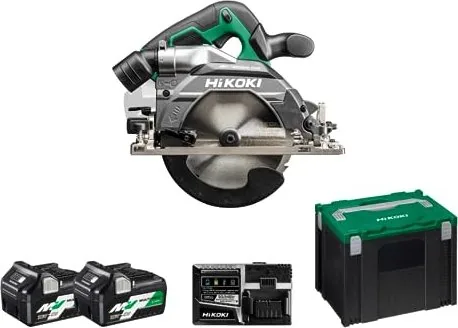
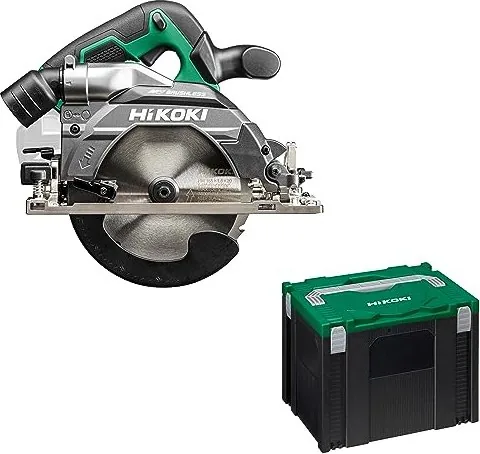
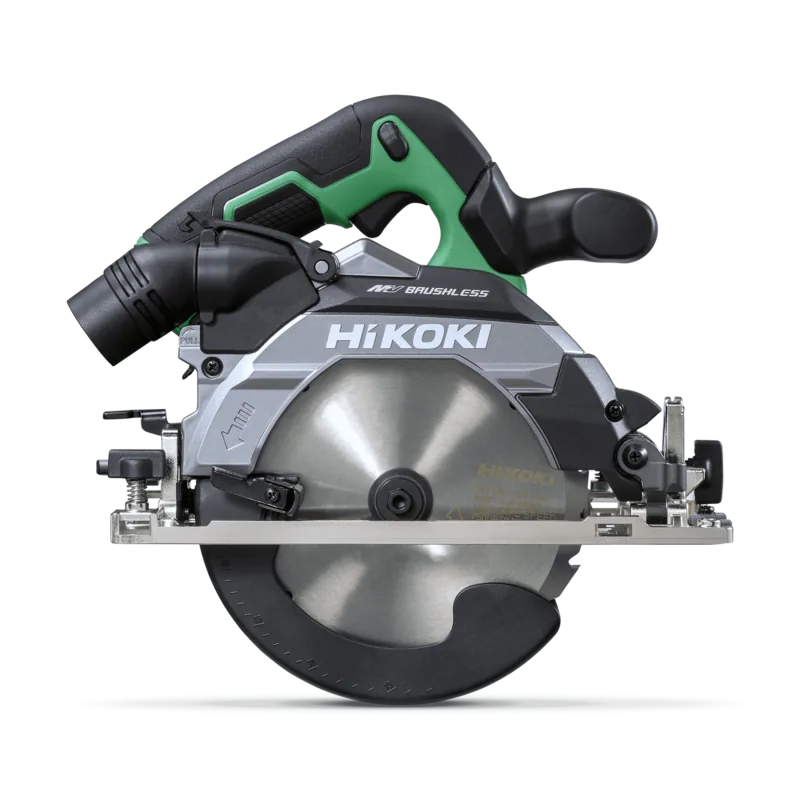
The Hikoki C3606DB Cordless Circular Saw represents a significant advancement in portable power tools for modern workshops. Designed primarily for professional carpenters and DIY enthusiasts, this unit delivers exceptional power while maintaining portability through its cordless architecture. The core appeal lies in its ability to handle diverse cutting applications without tethering the user to a wall outlet. This flexibility allows for efficient workflow on job sites where electrical access might be limited or non-existent. Engineers have focused heavily on user ergonomics to reduce fatigue during long-duration projects involving multiple precise cuts throughout the day.

Performance Specifications and Modes

Technically impressive capabilities define the operational parameters of this machine. The electric motor provides variable speed settings tailored to different material densities. In the High mode, the no-load speed reaches 5600 revolutions per minute ensuring fast progress through hardwoods and engineered panels. Alternatively, the Medium mode operates at 4300 revolutions per minute offering a balance between speed and control. For noise-sensitive environments, the Silent mode drastically reduces output to roughly 2000 revolutions per minute. Maximum cutting depth measures 66 millimeters at a ninety-degree angle which accommodates standard lumber thicknesses effectively.

Safety Protocols and Protection Systems

Operator safety remains the top priority in the design philosophy of this equipment. The lower guard functions automatically retracting when cutting begins and closing instantly upon release of the trigger. An electronic brake engages immediately after the switch is deactivated to stop blade rotation rapidly reducing potential hazards from coasting. Thermal protection sensors monitor internal temperatures shutting down the system if overheating occurs to prevent permanent motor damage. Users must adhere to strict guidelines regarding hand placement near the blade path to avoid serious injury scenarios involving kickback events.

Battery Management and Maintenance

Powering the tool utilizes dedicated Li-ion battery packs capable of storing sufficient energy for extensive sessions. The Multi-volt system recognizes voltage differences and adjusts operation automatically for maximum compatibility with existing tool ecosystems. Routine maintenance is critical for longevity requiring periodic checks of mounting screws and ventilation slots for debris accumulation. Cleaning protocols suggest using dry air to remove dust from internal components rather than liquids which could damage sensitive electronics. Always recharge batteries within the specified temperature range to preserve chemical integrity and ensure consistent discharge rates over the product lifecycle.

Connectivity and Accessory Integration

Modern construction workflows often require charging external devices alongside power tools. This saw features a USB connection port allowing users to charge tablets or phones directly from the battery pack. While convenient, caution dictates removing peripherals after completion to prevent drain on the main battery. Accessories included typically involve a hex key wrench and parallel guide fences enhancing precision for repetitive tasks. Replacement blades must match specific diameter requirements to maintain balance and minimize vibration during high-speed spinning operations. Adhering to these manufacturer recommendations guarantees optimal performance and prevents premature wear on drive mechanisms.

M: QW-35-FL

© Copyright 2026 Manual.ly
