
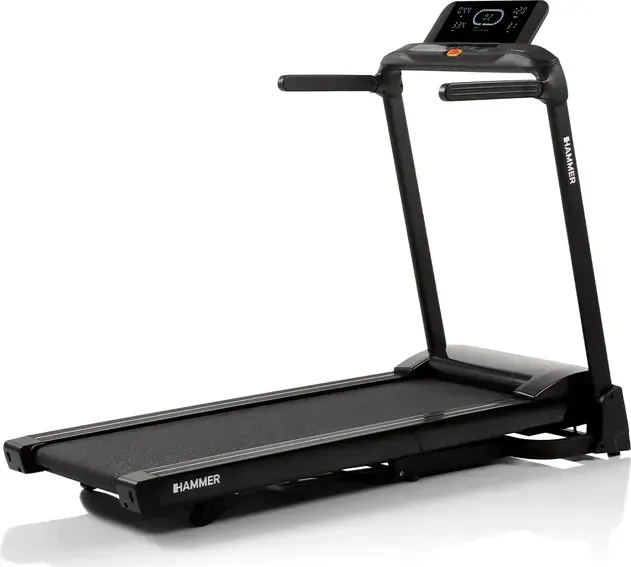
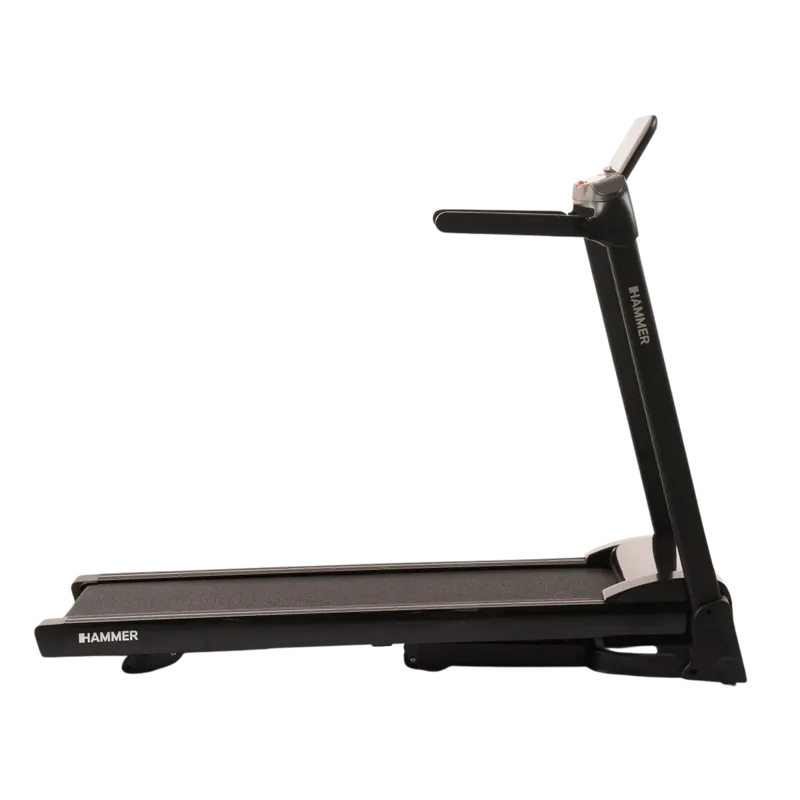
Hammer FlyRun 2.0 Manual
PDF manual · 27 Pages
English


Quick check
Incorrect answer, please try again.
Chat with your Hammer FlyRun 2.0 manual using AI
Get instant AI answers from your Hammer FlyRun 2.0 manual
Ask anything about the Hammer FlyRun 2.0. Answers come from this manual, with the pages they are based on.
FlyRun 2.0 Maintenance Schedule
Apply silicone lubricant to the running deck before first use. Check periodically by feeling for silicon under the belt.
Remove dirt with a vacuum or damp cloth. Do not use cleaning agents. Wipe sweat-contact parts with a damp cloth.
Regularly check that all screws, nuts, handles, and pedals are tightly secured and free of defects.
Regularly inspect parts subject to wear indicated by an asterisk in the parts list to ensure safety.
Ask a Question
Do you recommend FlyRun 2.0?
Yes NoFrequently Asked Questions
The treadmill supports up to 130 kg maximum user weight and is certified to EN ISO20957-1/6 Class HB for home use.
Is this answer helpful?
Yes. Lubricate the running deck before first use with the recommended silicone lubricant. Raise the belt, apply lubricant to the deck, wipe it evenly, and repeat on the other side. Unplug the unit before maintenance.
Is this answer helpful?
The treadmill will not start unless the safety key is inserted and clipped to your clothing. Pulling the key out stops the treadmill immediately. Use the START/STOP button for controlled stopping; if incline is not zero after an emergency stop, reset incline to 0 before restarting.
Is this answer helpful?
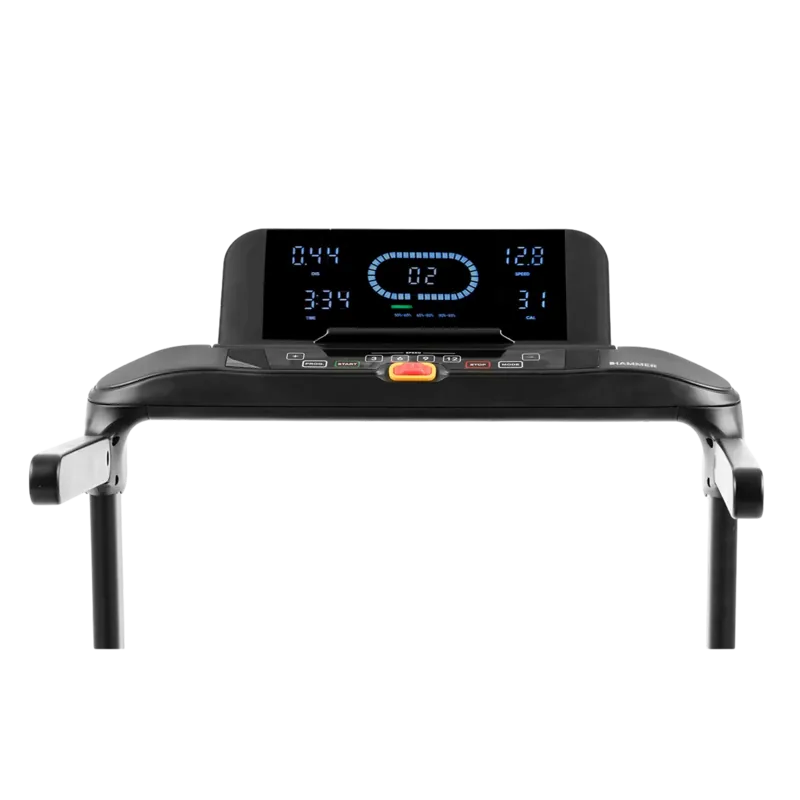
The console supports Quickstart, 15 preset programs, 3 user-program slots (U01–U03), HRC heart-rate control (HP1–HP3), countdown modes (time/distance/calories), and a fat-measurement mode.
Is this answer helpful?
Centering and tensioning are done via two rear hex screws. Perform adjustments in 1/4-turn increments while the belt runs at about 6 km/h with no user. Tighten clockwise to increase tension; center by alternating small turns and testing.
Is this answer helpful?
No. It is intended for private home use only. Using it in commercial settings like gyms, hotels, or rehab centers may void warranty and exceed design specifications.
Is this answer helpful?
A recommended session includes 5–10 minutes warm-up, 15–40 minutes main training at 70–85% of maximum heart rate, and 5–10 minutes cool-down. Beginners should start at lower intensity and build up gradually.
Is this answer helpful?
Advantages and Disadvantages
Advantages

- Comprehensive console: Quickstart, 15 programs, 3 user programs, HRC, countdown modes and body-fat measurement.
- Safety-focused: emergency safety key, clear start/stop procedure and mains safety instructions.
- Space-saving foldable design with air-assist cylinder and three incline settings.
- Maintenance-friendly: clear instructions for lubrication, belt centering and tensioning; wear parts listed.
- Suitable for home use with EN ISO20957-1/6 Class HB certification and 130 kg max user weight.
Disadvantages

- Not intended for commercial or multi-user gym environments; warranty may be voided for non-home use.
- Assembly requires two people and some manual adjustment (screws, centering) which can be fiddly.
- Speed and belt adjustments require manual screw turns; improper adjustment can reduce belt life.
- Heart rate control requires an accurate chest strap and correct setup; loss of signal reduces functionality.
- Electrical safety depends on correct mains voltage and single-outlet use; avoid multi-sockets and overloaded circuits.
Product Specification
Colors
black, white
Motor power
2HP continuous power, 4.5HP maximum power
Speed
0.50-12.43 mph
Incline
0.9-3.3% manually adjustable
Running surface
51.18x16.54in
Max. user weight
286.60lb
Dimensions
62.20x28.74x49.61in
Folded dimensions
36.22x28.74x55.12in
Weight
118.89lb
Features
Transport wheels, hand pulse measurement, chest strap compatible, tablet holder, app support (iOS, Android), foldable
Product Description
Hammer FlyRun 2.0 Treadmill — Practical Guide and Overview
The Hammer FlyRun 2.0 Treadmill is a home-use treadmill built to EN ISO20957-1/6 Class HB standards, designed for users up to 130 kg. It combines a user-friendly console with multiple training modes, safety features, and essential maintenance guidance to deliver a reliable cardio solution for home fitness. The console supports Quickstart, 15 preset programs, three user-program slots, HRC (heart rate control) modes, countdown targets (time, distance, calories), and a body fat measurement function. Speed can be adjusted with dedicated buttons and four quick-speed shortcuts for rapid changes.
Assembly is simplified by partial preassembly; two people are recommended for full setup. The treadmill has a folding mechanism with an air-assist bar for space-saving storage and three incline positions set via a locking pin. The unit requires a stable, level surface with at least 1.5–2 m clearance around it. Electrical safety guidance emphasizes correct mains voltage, avoiding multi-socket overloads, and using the supplied power cord and switch safely.
Safety and start procedures center on the emergency safety key: the treadmill won’t run without it inserted and will stop instantly if removed. Users are instructed to clip the key to clothing and to use the START/STOP button for controlled stopping. The HRC modes (HP1–HP3) automatically adjust speed to keep heart rate near a target value derived from age and intensity; the console displays pulse-related color signals (green/yellow/red) to indicate training zones.
Maintenance and care are clearly detailed: lubricate the deck before first use and periodically thereafter (silicone lubricant supplied), clean the belt with a vacuum or damp cloth (no harsh chemicals), and keep sweat-prone parts wiped. Belt centering and tension adjustments are performed via rear hex screws in small increments (¼ turn max) while the belt runs at ~6 km/h with no user on it. Wear parts like the belt and drive components are listed in the parts section and should be checked regularly.
Training guidance recommends pulse-oriented training, warming up and cooling down, and progressive frequency and intensity—ideally three sessions per week initially, increasing as fitness improves. Target training pulses are calculated from 220 − age, and recommended training intensity is 70–85% of maximum heart rate. Typical session structure: 5–10 min warm-up, 15–40 min training, 5–10 min cool-down.
Notes:
- Maximum user weight: 130 kg.
- Designed for home use only; commercial use voids warranty.
- Lubricate before first use and routinely thereafter.
- Keep safety-key clipped to clothing during use.
Product manual keyword
Hammer FlyRun 2.0 Treadmill Manual
Search for 67,706 Manuals online


Type-in Brand or Model