
Formfutura CarbonFil Manual
PDF manual · 5 Pages
English



Quick check
Incorrect answer, please try again.
Chat with your Formfutura CarbonFil manual using AI
Get instant AI answers from your Formfutura CarbonFil manual
Ask anything about the Formfutura CarbonFil. Answers come from this manual, with the pages they are based on.
Ask a Question
Do you recommend CarbonFil?
Yes NoFrequently Asked Questions
Formfutura CarbonFil Carbon is a PETG-based filament reinforced with short carbon fibres for FFF/FDM 3D printing, designed to offer improved stiffness, dimensional stability and a matte industrial finish compared to standard PETG.
Is this answer helpful?
No, CarbonFil is not classified as hazardous under EU directives, but safe handling practices are required. Heated or molten material can cause burns and excessive overheating may release hazardous fumes, so use ventilation and PPE.
Is this answer helpful?
Store spools in a dry, ambient environment away from direct sunlight and ignition sources. Keep filaments sealed in their packaging with desiccant when not in use to prevent moisture uptake and preserve print quality.
Is this answer helpful?
Standard FFF/FDM printers can print CarbonFil, but because carbon fibres can abrade brass nozzles, using a hardened or wear-resistant nozzle is recommended for prolonged use. Ensure good ventilation and consider local exhaust for multiple printers.
Is this answer helpful?
Print in a well-ventilated area or use local exhaust; avoid inhaling dust or fumes. Use heat-resistant gloves when handling molten material, safety glasses for post-processing, and a particle-filter respirator (P2) if dust or aerosols form.
Is this answer helpful?
Waste should be minimized and recycling checked where available. Filament waste can be incinerated or disposed of per local regulations. Empty, uncontaminated packaging may be recyclable; contaminated packaging should follow local disposal rules.
Is this answer helpful?
Sanding, grinding or cutting can produce fine dust; control dust and avoid ignition sources. Use dust extraction, wear appropriate respiratory protection, and be aware that carbon fibres can blunt cutting tools and increase wear.
Is this answer helpful?
Advantages and Disadvantages
Advantages

- Higher stiffness and dimensional stability than standard PETG, suitable for functional parts.
- Matte, industrial black finish enhances aesthetic and hides layer artifacts.
- Chemically stable and not classified as hazardous under EU regulations when handled properly.
- Printable on standard FFF/FDM machines with appropriate ventilation and temperature control.
- Low water solubility; good shelf life when stored dry with desiccant.
Disadvantages

- Contains carbon fibres which can increase nozzle wear—hardened nozzles recommended.
- Heated or molten material can cause burns; extra care needed during handling.
- Overheating can emit hazardous decomposition products—requires good ventilation.
- Fine dust from sanding or trimming may be combustible and requires dust control.
- May be less flexible than standard PETG, limiting some applications.
Product Specification
Type
Carbon (80% PETG, 20% Carbon fiber)
Suitability
universal
Print temperature
446-509°F
Heatbed recommendation
32-140°F
Impact strength
541.32lbf/ft
Elongation at break
8%
Modulus of elasticity
551.14ksi
Tensile strength
7.61ksi
Dimensional stability
185°F
Density
74.29lb/ft³
Base color
black
Product Description
Formfutura CarbonFil Carbon, 3D printing filament Manual
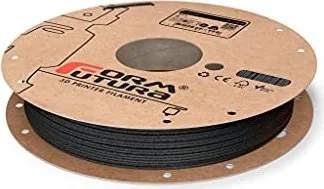
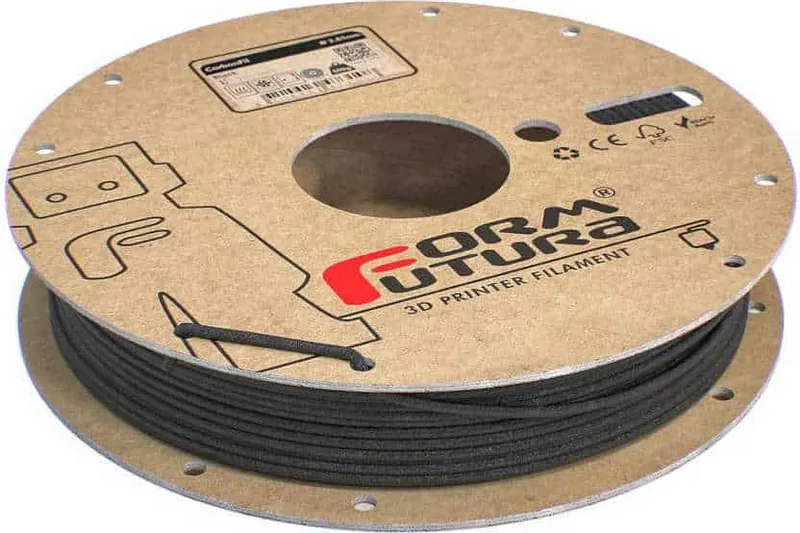
Formfutura CarbonFil Carbon is a carbon-fibre filled PETG-based filament engineered for FFF/FDM 3D printing. Blending PETG polymers with short carbon fibres, CarbonFil delivers improved stiffness, dimensional stability and a matte, industrial look while remaining easy to print under correct conditions. It targets hobbyists and professionals seeking stronger, stiffer parts than standard PETG while keeping reasonable printability.
The filament is supplied as black monofilament granules (spooled filament for printers) with a density around 1.19 g/cc and is essentially insoluble in water. It is chemically stable under normal storage conditions; avoid extreme heat, moisture and direct sunlight. CarbonFil is not classified as hazardous under EU regulations, but heated or molten material can cause burns and decomposition at excessive temperatures can emit hazardous fumes. Good ventilation, local exhaust at busy print farms, and standard PPE are recommended when printing or post-processing.
In use, keep printers in well-ventilated areas and consider local exhaust when running multiple machines. Avoid dust accumulation and ignition sources; fine dust can be combustible. Handle hot extruded material with heat-resistant gloves and use eye protection when post-processing. Store spools in dry conditions with desiccant to prevent moisture uptake and maintain print quality.
CarbonFil is suited for functional prototypes, jigs, fixtures and end-use parts where stiffness and surface appearance matter. It benefits designs that exploit carbon-reinforced PETG’s mechanical gains, while maintaining much of PETG’s ease of printing. As with any composite filament, nozzle wear is possible over time; consider hardened nozzles for extended use.
Notes
- Not classified as dangerous per EU directives, but follow recommended PPE and ventilation.
- Use a hardened nozzle to limit wear from carbon fibres.
- Store sealed with desiccant to preserve filament performance.
Search for 67,706 Manuals online


Type-in Brand or Model