
Fantec PGS-300 Manual
PDF manual · 14 Pages
English



Quick check
Incorrect answer, please try again.
Chat with your Fantec PGS-300 manual using AI
Get instant AI answers from your Fantec PGS-300 manual
Ask anything about the Fantec PGS-300. Answers come from this manual, with the pages they are based on.
PGS-300 Maintenance Schedule
If the power station will not be used for a long time, connect it to a wall outlet to recharge it.
Check the power station before use. Inspect cables for damage and sharp bends; do not use defective cables.
Free maintenance reminders
Timed to your purchase date. Always free, unsubscribe anytime.
Ask a Question
Do you recommend PGS-300?
Yes NoFrequently Asked Questions
The PGS 300 has a 296Wh (14.8V/20Ah) lithium-ion battery and delivers a continuous 300W AC output with a short-term peak of 600W, suitable for small appliances and electronics.
Is this answer helpful?
The unit offers a 220–240V pure sine AC socket, one USB-C PD 45W port, a Quick Charge USB port (QC3.0), two standard USB ports (5V/2.4A) and multiple 12V DC outputs including a cigarette-socket output.
Is this answer helpful?
You can recharge via the supplied 19V/3A 230V charger or connect a compatible PV solar panel to the DC input. Use only the supplied adapter or one matching the specified voltage/current to ensure safe charging.
Is this answer helpful?
The PGS 300 includes protections against short circuit, overload, overheating, overvoltage, overcharge and deep discharge. It also has temperature monitoring with fan control and display warnings to prevent damage.
Is this answer helpful?
No. International air regulations generally prohibit passenger carriage of portable power stations with more than 100Wh battery capacity; the PGS 300 at 296Wh exceeds that limit.
Is this answer helpful?
Yes. The pure sine wave AC output provides stable, clean power suitable for sensitive electronics, but observe wattage limits and avoid connecting devices that exceed the rated power.
Is this answer helpful?
If a temperature warning or fault appears, disconnect loads causing the issue, allow the unit to cool, and restart. For persistent faults or visible damage, stop using the device and contact Fantec support for service.
Is this answer helpful?
Advantages and Disadvantages
Advantages

- Compact, portable 296Wh battery with a 300W continuous (600W peak) pure sine inverter.
- Versatile outputs: AC socket, USB-C PD 45W, QC USB, standard USB and multiple 12V DC ports.
- Multiple safety protections: short-circuit, overload, overheat, over/under-voltage and overcharge protections.
- Built-in LED light with SOS and strobe modes and clear display for battery, temperature and input/output power.
- Supports solar charging (PV panel sold separately) and includes a 19V/3A 230V charger.
Disadvantages

- 296Wh capacity limits runtime for larger appliances — not a replacement for home mains power.
- Weight (~4.1 kg) and size are portable but may be heavy for long hikes or ultralight travel.
- Cannot be carried onto passenger aircraft due to >100Wh battery restriction.
- Charging speed limited to supplied 19V/3A adapter unless using higher compatible solar input solutions.
- No user-serviceable parts; damage from impact or moisture requires professional service.
Product Specification
Type
Solar Generator
Battery
LiFePO4, 296Wh
AC Output
1x Schuko socket (Type-F)
AC Output Power
300W
DC Output
1x Cigarette lighter (12V)
USB Output
1x USB-C (45W), 2x USB-C (18W), 1x USB-C (12W), USB-C
Solar charging current max.
15A
Weight
30.86 lb
Dimensions
1.18 in
Special Features
Transport handles, incl. lamp
Manufacturer's Warranty
2 Years
Note
Prices partly include 0% VAT tax rates for AT and DE
Product Description
Fantec PGS 300 Solargenerator Manual — Overview
The Fantec PGS 300 Solargenerator is a compact 300W portable power station designed for outdoor use, emergency backup and mobile charging. With a 296Wh lithium-ion battery, pure sine wave AC output and multiple DC/USB ports, it balances portability and practical power for small appliances, devices and lighting. The unit supports charging from a 230V adapter or solar panels (PV panels sold separately) and features built-in protections against short circuit, overload, overheating, overvoltage, overcharge and deep discharge.
Key Features and Design
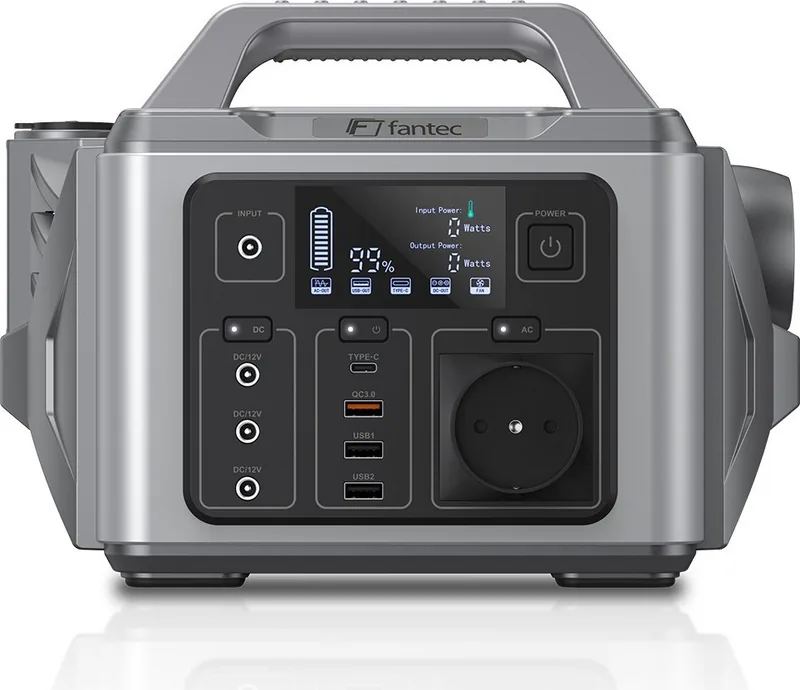
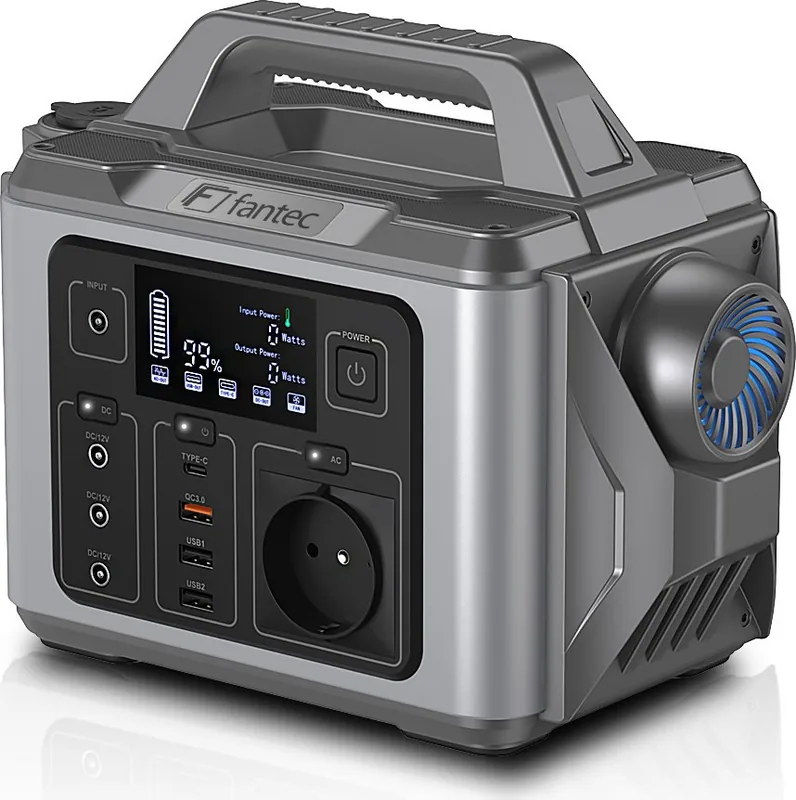
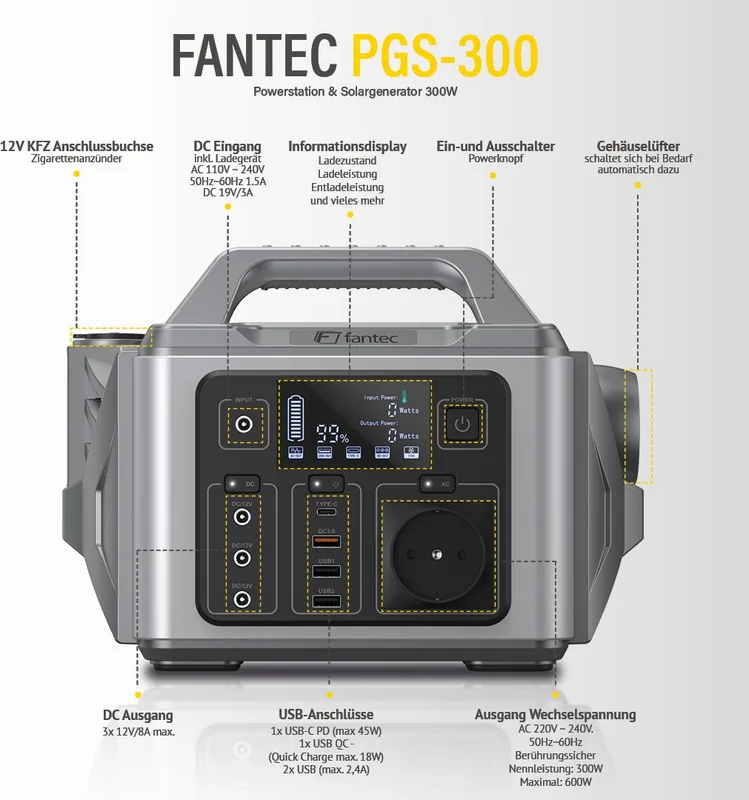
At roughly 4.1 kg and measuring 28.3 x 15.5 x 20.5 cm, the PGS 300 is easy to carry and store. It provides a continuous rated output of 300W with a peak surge of 600W, making it suitable for devices that require short bursts of higher power. Outputs include a 220–240V pure sine AC socket, a 45W USB-C PD port, Quick Charge USB output, two standard USB ports, three 12V DC outputs plus a 12V cigarette-socket output. A 3W LED light with SOS and strobe modes adds utility for camping and emergencies.
The front display shows battery level, active outputs (AC, USB, USB-C, DC), input/output power, fan status and temperature. The unit automatically powers down after inactivity and engages a cooling fan when battery temperature rises; warning colors on the display indicate device temperature and call for shutdown if red.
Usage and Charging
Powering the unit is straightforward: hold the power button to turn the station on or off, then enable specific output groups (AC, USB, DC) via dedicated switches. It charges from the supplied 19V/3A adapter or from compatible solar panels. The manual recommends using only the supplied adapter or one matching the required voltage/current to protect the unit. Charging status is visible on the display.
Safety and Maintenance
Fantec emphasizes regular inspections for damage, safe handling of cables and avoidance of water, extreme heat or impacts. Do not attempt repairs; contact Fantec support for service. Observe load limits — do not connect household mains if the unit is charging — and recharge the unit every six months if stored long-term. Note regulatory constraints: units over 100Wh cannot be carried onto passenger aircraft.
Notes
- Supplied accessories include the PGS 300 unit, a 230V charger and cables plus a 12V car cable. Solar panels are optional and sold separately.
- The station uses a pure sine inverter suitable for sensitive electronics.
- Keep firmware/documentation and disposal guidance in mind: batteries require proper recycling.
Search for 67,706 Manuals online


Type-in Brand or Model