

Facom 306D Manual
PDF manual · 2 Pages
English



Quick check
Incorrect answer, please try again.
Chat with your Facom 306D manual using AI
Get instant AI answers from your Facom 306D manual
Ask anything about the Facom 306D. Answers come from this manual, with the pages they are based on.
306D Maintenance Schedule
Have the wrench checked regularly on a test rig or by the FACOM metrological laboratory about once a year, or more often for intensive use.
If the wrench is dropped, have it verified with a control device or sent to the FACOM service department immediately.
Clean the wrench using only a dry cloth. Do not use any solvent or detergent.
Free maintenance reminders
Timed to your purchase date. Always free, unsubscribe anytime.
Ask a Question
Do you recommend 306D?
Yes NoFrequently Asked Questions
The Facom 306D family includes models with different ranges; the typical small 1/4" drive variants cover low torque ranges suitable for 1–50 N·m or similar depending on the exact model. Check the specific model designation for exact min/max N·m values.
Is this answer helpful?
Pull the ring toward the handle, rotate the handle until the vernier aligns with the desired graduation, then release the ring so it clicks and locks in position. Apply force until you hear the wrench click, which signals the preset torque has been reached.
Is this answer helpful?
Facom recommends periodic checks about once a year, more frequently with intensive use, or immediately after the wrench has been dropped. The Facom metrology lab can provide test reports or full calibration certificates on request.
Is this answer helpful?
No. Clean only with a dry cloth and never use solvents or detergents. The wrench must not be disassembled; doing so can void accuracy and damage the mechanism.
Is this answer helpful?
Yes. The manual notes compliance with ISO 6789 under specified head-angle conditions and references conformity with the European EN60900 standard where applicable, making it suitable for regulated environments.
Is this answer helpful?
Always keep the wrench perpendicular to the tightening axis, hold the handle centrally, apply steady progressive force, stop immediately at the click, avoid exceeding the maximum torque, and set the wrench to its minimum before storage.
Is this answer helpful?
Yes. Facom can issue a dated, numbered test report (checks at 20, 60 and 100% capacity within tolerance) or a formal calibration certificate covering 6–12 points tied to national standards, available upon request for a fee.
Is this answer helpful?
Advantages and Disadvantages
Advantages

- ISO 6789 compliant (when head angle ≤ ±3°) ensuring reliable metrological performance.
- Compact 1/4" drive with 9x12mm interface ideal for tight spaces and small fasteners.
- Simple ring-and-handle adjustment with audible click for repeatable torque application.
- Facom calibration and testing services available for traceable accuracy and documentation.
- Low maintenance: dry-cloth cleaning and straightforward storage recommendations.
Disadvantages

- Limited to 1/4" drive capacity—may not suit heavy-duty torque applications.
- Requires periodic calibration (annually or after drops) to maintain specified accuracy.
- Not intended for loosening fasteners—risk of damage if misused.
- Head angle must be kept within ±3° for ISO compliance, requiring careful handling.
- No solvents or disassembly allowed, limiting user servicing options.
Product Specification
Tool Mount
0.35x0.47 in Square Drive
Torque
0.74-3.69 ft-lb
Handle
Plastic
Overall Length
7.28 in
Special Features
Interchangeable Head
Scope of Delivery
Box (Plastic)
Product Description
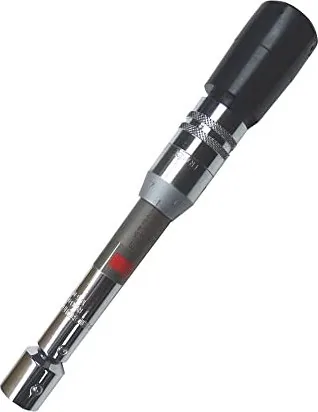
Facom 306D torque wrench 9x12mm Manual
The Facom 306D torque wrench 9x12mm is a precision click-type torque wrench designed for accurate fastening in automotive, mechanical and industrial applications. Built to meet ISO 6789 when the head angle is within ±3°, this compact 1/4" drive tool offers dependable torque control for small to medium fasteners using a 9x12mm head interface. Ergonomically shaped with a ring-and-handle adjustment system, the wrench allows fast, repeatable settings and an audible, tactile click at the target torque to prevent over-tightening.
Setting the torque is straightforward: pull the adjustment ring toward the handle, rotate the handle to the desired graduation on the vernier scale, then release the ring so it locks into place. During tightening, keep the wrench perpendicular to the fastener axis, hold the handle in its center, and apply steady, progressive force until the click indicates the preset torque has been reached.
Facom emphasises safe operation and long-term accuracy. The manual stresses never exceeding the wrench’s maximum torque—especially when loosening or applying torque at an angle—and recommends always storing the tool set to its minimum setting. Regular calibration (about once a year or more often with heavy use or after a drop) is advised to preserve precision. Facom’s metrology laboratory can issue test reports (checks at 20, 60 and 100% capacity within ±4% tolerance) or full calibration certificates (6–12 test points tied to national standards) on request.
Maintenance is simple: wipe with a dry cloth, do not use solvents or detergents, and never disassemble the wrench. Proper cleaning and storage prolong tool life and maintain safety. The product also complies with EN60900 where specified, making it suitable for environments requiring that European standard.
With clear setting steps, robust calibration options, and concise maintenance advice, the Facom 306D torque wrench 9x12mm is positioned as a reliable, accurate tool for technicians who need repeatable torque control in a compact format.
Notes
- Meets ISO 6789 when head angle ≤ ±3°.
- Use only dry cloth for cleaning; do not disassemble.
- Facom offers calibration and test reports for traceable accuracy.
Search for 67,706 Manuals online


Type-in Brand or Model