
Epever Tracer AN Series Manual
PDF manual · 40 Pages
English



Quick check
Incorrect answer, please try again.
Chat with your Epever Tracer AN Series manual using AI
Get instant AI answers from your Epever Tracer AN Series manual
Ask anything about the Epever Tracer AN Series. Answers come from this manual, with the pages they are based on.
Ask a Question
Do you recommend Tracer AN Series?
Yes NoFrequently Asked Questions
The Tracer xx10AN supports sealed lead-acid, gel, flooded lead-acid, LiFePO4, and various Li(NiCoMn)O2 configurations. For custom voltage settings choose the "USER" battery type to modify charge thresholds locally or via PC/APP/MT50.
Is this answer helpful?
The controller continuously compares PV operating points to locate the true maximum power point, even under multi-peak or partial shading. This dynamic tracking reduces MPPT loss time and improves energy capture by roughly 10–30% versus PWM controllers.
Is this answer helpful?
Protections include PV overcurrent and short-circuit protection, PV/battery reverse polarity protection, night reverse charging prevention, battery over-voltage and over-discharge cutoffs, battery/internal temperature protections, load short/overload auto-recovery, and TVS transient protection.
Is this answer helpful?
Yes. The Tracer series supports RS485 Modbus communication and can be monitored/configured via PC software, the cloud app (with optional Wi‑Fi or Bluetooth module), or the MT50 remote meter. Note the RS485 port is not isolated by default.
Is this answer helpful?
Follow the model-specific wire size and fast-acting fuse recommendations (battery-side fuse 1.25–2× rated current, within 150 mm of battery). Use larger conductors for long runs to reduce voltage drop and adhere to local electrical codes.
Is this answer helpful?
When internal temperature reaches ~81°C the controller progressively reduces charging power (increments of 5–40% per °C), and if it exceeds 85°C charging stops. Charging resumes when temperature falls below ~75°C.
Is this answer helpful?
Load modes include manual ON/OFF, dusk-to-dawn (Light ON/OFF), timer-based night or pre-dawn timers (1–15 hours), test mode, and dedicated Timer1/Timer2 configurations. Timer2 is disabled for some modes like manual or test.
Is this answer helpful?
Advantages and Disadvantages
Advantages

- High MPPT efficiency (claimed ≥99.5%) and up to 98% DC/DC conversion for better energy harvest
- Supports multiple battery chemistries with configurable voltage parameters and temperature compensation
- Comprehensive protections: over/under voltage, reverse polarity, thermal throttling, overload and short-circuit auto-recovery
- Multiple load modes (timers, dusk/dawn, manual) and real-time energy statistics with RS485/APP/PC monitoring
- Compact models with clear LCD, recommended wiring/fuse specs, and broad application (RV, home, monitoring)
Disadvantages

- RS485 port has no isolation by default; external isolator recommended in some installations
- Equalization raises explosive gas risk for flooded batteries—requires good ventilation and caution
- Some parameters require the USER mode to modify; default presets cannot be changed for safety
- Max PV open-circuit voltage limits differ by model—careful PV string design needed to avoid overvoltage
- Internal thermal throttling reduces charging power at high temp, which may limit output in hot enclosures
Product Specification
Note
Prices sometimes include 0% VAT tax rates for AT and DE
Type
Charge controller
Product Description
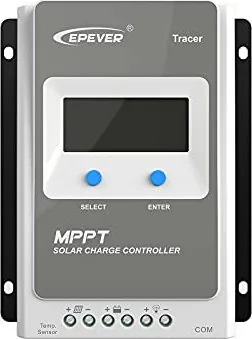
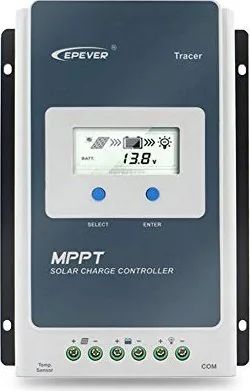
Epever Tracer xx10AN — Reliable MPPT Solar Charge Controller
The Epever Tracer xx10AN series delivers a robust MPPT solar charge controller designed for residential, RV, field monitoring, and light commercial systems. Built around an advanced MPPT algorithm, these controllers maximize energy harvest from PV arrays by tracking the true maximum power point even under partial shading or multi-peak conditions. Compared with PWM controllers, the Tracer series can increase energy capture by roughly 10–30%, with DC/DC conversion efficiencies up to 98% and MPPT tracking efficiencies claimed at 99.5%.
The models in this family support 12V and 24V systems and multiple current ratings (10A, 20A, 30A, 40A). They provide adaptive three-stage charging—bulk, boost/equalize, and float—optimized to prolong battery life and maintain system stability. The unit supports lead-acid and several lithium chemistries (including LiFePO4 and Li(NiCoMn)O2) with configurable battery voltage parameters either locally or remotely via app/PC/MT50. Temperature compensation and an optional external temperature sensor help protect battery health and refine charge profiles.
Practical installation features include a clear LCD, RS485 Modbus communication, common-negative grounding, and a protected RS485 port that supplies 5V/200mA to accessories. Wiring guidance and recommended fuse sizes are specified for each model to ensure safe operation. The controller includes multiple load control modes (timers, dusk-to-dawn, manual, test) to manage lighting or other DC loads efficiently.
Comprehensive protections cover PV overcurrent/short-circuit, reverse polarity for PV and battery, night reverse charging protection, battery over-voltage and over-discharge cutoffs, temperature-based charging reduction and shutdown, load short-circuit and overload auto-recovery, internal over-temperature protection, and transient suppression (TVS). The controller will throttle charging power automatically as internal temperature rises and resume normal operation when cooled.
Maintenance and troubleshooting are straightforward: periodic checks of airflow, terminals, wiring insulation, and surge arresters are recommended. The controller provides clear LCD error icons and procedures for common faults (battery over/under voltage, overheating, load faults). Mechanical dimensions, wiring sizes, and electrical specifications (max PV open-circuit voltages, rated charge/discharge currents, self-consumption) are provided per model to aid correct selection and installation.
Notes:
- Choose wire gauge and fusing per model recommendations and local codes. Keep battery ventilation in mind for equalization cycles.
- Use the "USER" battery type to fine-tune voltage thresholds; lithium setups disable automatic system-voltage auto-identification.
- RS485 port lacks isolation—use an isolator if needed in noisy or grounded systems.
Search for 67,706 Manuals online


Type-in Brand or Model