
Epever Tracer AN Series Manual
PDF manual · 36 Pages
English



Quick check
Incorrect answer, please try again.
Chat with your Epever Tracer AN Series manual using AI
Get instant AI answers from your Epever Tracer AN Series manual
Ask anything about the Epever Tracer AN Series. Answers come from this manual, with the pages they are based on.
Tracer AN Series Maintenance Schedule
Ensure no blockage on airflow around the controller. Clear up any dirt and fragments on the radiator.
Check all naked wires to ensure insulation is not damaged by sun exposure, friction, dryness, insects, or rats.
Confirm that LEDs are consistent with requirements and take corrective action for any error indications.
Confirm terminals have no corrosion, insulation damage, or burnt signs, and tighten screws to suggested torque.
Clear up dirt, nesting insects, and corrosion in time.
Check that the lightning arrester is in good condition and replace it immediately if necessary.
Free maintenance reminders
Timed to your purchase date. Always free, unsubscribe anytime.
Ask a Question
Do you recommend Tracer AN Series?
Yes NoFrequently Asked Questions
Tracer supports lead-acid (sealed, gel, flooded) with local LCD selection. Lithium types (LiFePO4 and Li(NiCoMn)O2) are supported but their parameters must be set via PC software or mobile app for correct BMS coordination.
Is this answer helpful?
Yes—up to six controllers can be paralleled to expand charging capacity. When paralleling, use proper RS485 cascading for communication and ensure PV/battery wiring and fusing meet each model's rated current and cable recommendations.
Is this answer helpful?
An internal temperature sensor triggers automatic charging power reduction once internal temperature reaches defined thresholds (reducing power progressively above ~81°C) and stops charging above ~85°C. It resumes normal operation when temperature falls below the safe limit.
Is this answer helpful?
Optional remote temperature sensor (RTS) and remote battery voltage sensor (RBVS) provide accurate battery temperature and terminal voltage readings to avoid voltage-drop errors and enable precise temperature-compensated charging and improved battery protection.
Is this answer helpful?
Yes. Dry-contact interfaces allow the controller to manage utility/generator start/stop and inverter start-stop signals. Proper configuration of control voltages and ensuring the (Load) dry contact is wired correctly prevents overloads and undesired starts.
Is this answer helpful?
Observe each model's maximum PV open-circuit voltage (e.g., 138V @25°C for many models) and MPPT voltage range. Use recommended wire sizes (specified per model) and ensure PV ISC and total VOC under low temperature do not exceed controller limits.
Is this answer helpful?
On the PV energy interface, long-press ENTER until the value flashes and press ENTER again to reset. In the battery temperature interface, long-press ENTER to switch between °C and °F for displayed temperature units.
Is this answer helpful?
Advantages and Disadvantages
Advantages

- High MPPT tracking efficiency (≥99.5%) and DC/DC conversion efficiency up to ~98.6% for better energy yield.
- Supports 12/24/36/48V auto systems, multiple battery chemistries, temperature-compensated charging and user-configurable profiles.
- Isolated RS485 (Modbus) communication, optional Wi‑Fi/Bluetooth for remote monitoring and up to 6 units parallelable for expansion.
- Comprehensive protections: overcharge/discharge, PV reverse polarity, thermal power reduction/shutdown, and transient suppression.
- Dry-contact outputs for load and generator control enable hybrid system integration and automatic load management.
Disadvantages

- No internal battery reverse protection; incorrect wiring can damage the controller.
- Lithium battery settings cannot be configured via the local LCD—require PC or mobile app.
- IP20 enclosure and indoor mounting preference limit outdoor installations without proper enclosure and ventilation.
- TVS protection handles limited surge energy; external surge arresters recommended in lightning-prone areas.
- Some model voltage/current limits require careful PV string design to avoid exceeding VOC or input current ratings.
Product Specification
Note
Prices partly include 0%-VAT tax rates for AT and DE
Type
Charge controller
Product Description
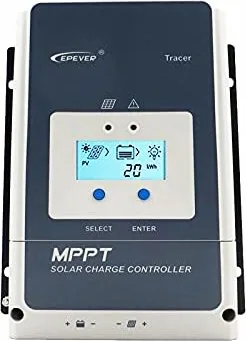
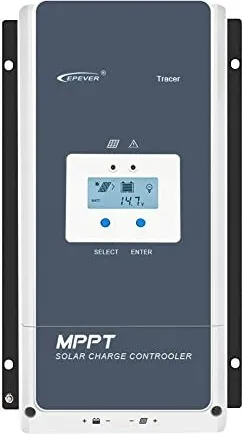
Epever Tracer MPPT Charge Controller — Smart, Efficient Solar Charging
The Epever Tracer MPPT Charge Controller is a high-performance MPPT solar charge solution designed for residential, RV, and off-grid applications. Built on multiphase synchronous rectification technology and an advanced MPPT algorithm, Tracer controllers deliver fast tracking, high conversion efficiency, and robust protection features to maximize energy harvest from PV arrays while safeguarding batteries and system components.
Featuring a dual-core processor and optimized MPPT tracking, the Tracer series reaches MPPT tracking efficiency of at least 99.5% and DC/DC conversion efficiency up to the high 98% range. This translates to more usable energy from the same solar array, especially under changing irradiance or multi-peak conditions. The controllers support a wide battery voltage range (auto 12/24/36/48V), multiple battery chemistries including lead-acid and lithium variants, and temperature-compensated charging to extend battery life.
Design highlights include isolated RS485 communication (Modbus), optional remote temperature and battery voltage sensors for precise monitoring, and support for up to six units in parallel for system expansion. Tracer models offer configurable three-stage charging (bulk/boost/float or user-defined profiles), automatic power reduction at high temperature, and dry-contact outputs for load control or utility/generator coordination—making them suitable for hybrid power setups with inverters or generators.
Safety and durability are central to the product: compliance with IEC62109-1 and EMC standards, TVS protection for transient surges, comprehensive protections for overcharge, over-discharge, reverse polarity, PV short-circuit (non-charging), and thermal shutdown. Mechanical designs emphasize ventilation and clear mounting guidelines, while the LCD interface and buttons offer on-site parameter viewing and adjustments. Remote configuration is possible via PC or mobile app through RS485 and optional Wi‑Fi/Bluetooth modules.
Typical users benefit from detailed PV array sizing guidance, wire sizing charts, dry contact logic for load/generator control, and model-specific specs for current, voltage, and power handling. From small 50A units to 100A models, Tracer controllers accommodate varied PV configurations and battery systems with clear installation and maintenance guidance.
Notes:
- Supports lead-acid (sealed/gel/flooded) and specific lithium chemistries; lithium parameters must be set via PC/APP.
- Remote sensors (RTS, RBVS) improve charging accuracy and compensate for cable voltage drop.
- Maintain ventilation and adhere to wiring safety: use recommended fuses and cable sizes.
Search for 67,706 Manuals online


Type-in Brand or Model