
Epever DuoRacer DR1206N Manual
PDF manual · 34 Pages
English



Quick check
Incorrect answer, please try again.
Chat with your Epever DuoRacer DR1206N manual using AI
Get instant AI answers from your Epever DuoRacer DR1206N manual
Ask anything about the Epever DuoRacer DR1206N. Answers come from this manual, with the pages they are based on.
DuoRacer DR1206N Maintenance Schedule
Ensure the controller is firmly installed in a clean, dry ambient and that airflow is not blocked. Clear dirt and debris from the radiator.
Check exposed wires for insulation damage from sun, wear, dryness, insects, or rats. Repair or replace wires as necessary.
Tighten all terminals and inspect connections for looseness, breakage, or burning.
Confirm LED or LCD indications match requirements. Address any troubleshooting or error indication.
Confirm all system components are grounded tightly and correctly.
Check terminals for corrosion, insulation damage, overheating, or burnt/discolored signs, and tighten screws to the suggested torque.
Check for dirt, nesting insects, and corrosion, and clear them promptly.
Confirm the lightning arrester is in good condition. Replace it promptly if needed to prevent controller or equipment damage.
Free maintenance reminders
Timed to your purchase date. Always free, unsubscribe anytime.
Ask a Question
Do you recommend DuoRacer DR1206N?
Yes NoFrequently Asked Questions
BATT1 supports Sealed, Gel, Flooded lead-acid types and lithium chemistries including LiFePO4 and Li-NiCoMn. Battery type selection sets appropriate charging parameters; custom settings require PC software or mobile app.
Is this answer helpful?
No. BATT1 and BATT2 must be the same system voltage (both 12V or both 24V). The controller relies on identical voltage levels for correct BATT2 detection and charging logic.
Is this answer helpful?
AES provides a control signal for compatible car refrigerators to use surplus solar energy. The port behavior depends on model variants; for DR1206-series models the AES and RS485 may share power constraints. AES turns on when BATT1 reaches boost/equalize for a set duration and turns off after configurable delay checks.
Is this answer helpful?
Protections include PV current/power limiting, PV short-circuit and reverse-polarity tolerance, night reverse charging prevention, battery overcharge/over-discharge cutoffs, over-temperature shutdowns, and internal TVS surge protection. External surge arrestors are recommended in lightning-prone areas.
Is this answer helpful?
Keep PV array power ≤ ~1.5× controller rated power to avoid wasted modules and excessive open-circuit voltages. Observe model-specific maximum PV open-circuit voltages (e.g., ~60V or 100V depending on model and temp). Design arrays for safe Voc at minimum ambient temperatures.
Is this answer helpful?
BATT2 receives a controlled 1A trickle/constant-current charge. Charging starts when BATT1 is in float or when total charging current exceeds thresholds and stops when conditions reverse or when BATT2 reaches its configured full voltage. BATT2 only supports lead-acid chemistry.
Is this answer helpful?
Yes. An optional remote temperature sensor provides battery temperature data for temperature compensation of charging voltages (lead-acid only). Without the sensor, the controller defaults to 25°C charging parameters.
Is this answer helpful?
Advantages and Disadvantages
Advantages

- High-efficiency MPPT algorithm increases energy harvest vs PWM by ~20–30%.
- Dual-battery support (BATT1 configurable; BATT2 auto-detected lead-acid) for RV/boat use.
- AES output and RS485/Modbus enable fridge control and remote monitoring/expansion.
- Comprehensive protections: reverse polarity, overcharge/discharge, PV limiting, temperature cutoffs.
- Selectable displays (basic or standard) plus remote meter and app connectivity options.
Disadvantages

- BATT2 only supports lead-acid chemistry; lithium starter batteries are not supported.
- BATT1 and BATT2 must be the same system voltage; mixed-voltage setups are unsupported.
- PV open-circuit voltage limits require careful array design to avoid controller damage.
- Advanced/custom battery parameters require PC or app and careful adherence to BMS specs.
- IP33 offers limited ingress protection—unit must be installed away from direct water exposure.
Product Specification
Note
Prices partially include 0%-VAT rates for AT and DE
Type
Charge controller
Product Description
Epever DR1206N — Advanced Dual-Battery MPPT Charge Controller
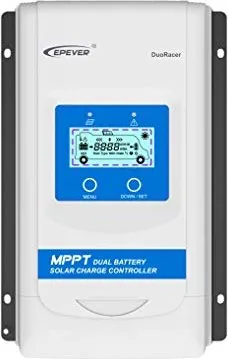
The Epever DR1206N is a versatile MPPT solar charge controller designed for systems that need to charge two batteries simultaneously — a main battery (BATT1) and a starter battery (BATT2). Built for small off-grid installations like RVs, campers and boats, it supports multiple lead-acid battery chemistries (Sealed, Gel, Flooded) and lithium types (LiFePO4, Li-NiCoMn) for the main battery, while the starter battery is supported as a lead-acid type with automatic voltage recognition. The controller leverages an advanced MPPT algorithm to extract maximum energy from PV arrays with fast tracking and high efficiency, typically improving energy utilization by 20–30% compared with PWM controllers.
Key capabilities and operation
The DR1206N actively manages charging with adaptive three-stage charging for BATT1 and a trickle- or regulated-charge strategy for BATT2. BATT2 receives a controlled 1A trickle charge when conditions are met, and charging logic ensures BATT2 only charges when BATT1 reaches specific states or when overall charging current exceeds thresholds. The AES signal output provides power control for compatible car refrigerators, allowing surplus solar power to be used efficiently. Communication options include RS485 (Modbus) for monitoring and optional remote meters, Wi‑Fi/Bluetooth adapters or USB-RS485 converters for mobile/PC monitoring.
Design and protections
The unit offers IP33 protection, a cooling heat sink, and requires ventilation for reliable operation. It includes comprehensive protections: PV overcurrent/power limiting, short-circuit and reverse-polarity tolerance, night reverse protection, battery overcharge and over-discharge prevention, temperature-based cutoffs, internal TVS transient protection, and safe shutdown behavior under over-temperature. Recommended wiring and mounting guidelines minimize voltage drop and ensure safe installation; fusing on the battery side and correct cable sizing are highlighted for safety.
Displays, controls and customization
Two user display options exist: a basic LED/LCD interface (DDB) and a more feature-rich standard display (DDS) that shows battery SOC, PV metrics, temperatures and fault codes. Battery charging profiles are selectable for common chemistries, and an advanced “User” profile allows custom voltage parameter changes via PC or app. The controller supports automatic low-power mode when PV conditions are insufficient and provides temperature compensation when an external sensor is connected.
Practical considerations
Sizing PV arrays to avoid excessive open-circuit voltage at low temperatures and keeping PV array power within recommended multipliers of the controller rating are essential. The manual also emphasizes safe battery handling, grounding requirements, and periodic maintenance (terminals, wiring, airflow, surge arrestor checks).
Notes:
- BATT1 and BATT2 must share the same system voltage (e.g., both 12V).
- BATT2 charging is limited to lead-acid chemistry only.
- Custom voltage settings for batteries require careful adherence to BMS specifications for lithium cells.
Search for 67,706 Manuals online


Type-in Brand or Model