
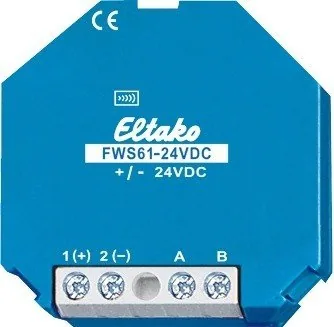
Eltako FWS61-24V DC Manual
PDF manual · 1 Pages
English


Quick check
Incorrect answer, please try again.
Chat with your Eltako FWS61-24V DC manual using AI
Get instant AI answers from your Eltako FWS61-24V DC manual
Ask anything about the Eltako FWS61-24V DC. Answers come from this manual, with the pages they are based on.
Ask a Question
Do you recommend FWS61-24V DC?
Yes NoFrequently Asked Questions
The module requires a stable twenty-four volt direct current power source. It draws power from a switch mode power supply unit designed to handle the load efficiently. Standard batteries are not suitable for continuous operation given the design intent for wired mains power systems.
Is this answer helpful?
Routine data transmission occurs at least every ten minutes in standard status telegrams. Significant events like rapid wind speed changes or rain cessation trigger immediate updates. Alerts regarding connection loss also broadcast immediately to ensure rapid response to system faults.
Is this answer helpful?
A single transmitter handles one multi-sensor unit directly. However, multiple transmitters can theoretically connect to one sensor to create redundancy networks. Careful configuration is needed to avoid signal collisions when scaling beyond basic layouts.
Is this answer helpful?
The device operates on the 868.3 MHz frequency band which is common for industrial wireless protocols in Europe. Transmit power stays below ten milliwatts to minimize interference. This ensures coexistence with other wireless building control devices operating nearby.
Is this answer helpful?
Yes, the module transmits ambient temperature values ranging from minus forty degrees to plus eighty degrees Celsius. These readings update alongside other weather parameters every ten minutes during normal operations. Extreme cold triggers frost warnings internally.
Is this answer helpful?
Qualified electricians must perform installation due to risks of electric shock or fire if wiring is incorrect. High voltage sections of the power supply demand strict adherence to local electrical codes. Attempting self-installation voids warranties and compromises safety compliance.
Is this answer helpful?
If messages stop arriving for five seconds, the module sends alarm telegrams repeated every thirty seconds. Actuators can be taught-in to respond to these alerts automatically. This ensures that loss of visibility is communicated instantly to the central control interface.
Is this answer helpful?
Advantages and Disadvantages
Advantages

- Extremely low standby power consumption protects battery life and grid load effectively during idle states.
- Includes internal antenna design reducing external component clutter and simplifying physical mounting requirements significantly.
- Automated alarm system notifies users immediately upon sensor disconnection preventing blind spots in monitoring coverage.
- Supports comprehensive seven-item weather tracking providing granular data for complex building automation algorithms.
- Wide operating temperature range ensures reliability across different global climates and seasonal extremes consistently.
Disadvantages

- Mandatory connection to specific twenty-four volt switching power supply adds cost and complexity to initial system planning phase.
- Installation strictly limited to qualified electricians which increases labor costs and limits DIY implementation possibilities entirely.
- Limited to single multi-sensor input limiting scalability unless cascading setups are implemented with extra modules involved.
- Radio transmission relies on specific frequency bands that may face congestion in dense urban environments with high activity.
- Requires specific deep wall boxes for combined installation of module and power supply unit to maintain neatness.
Product Specification
Type
Wireless Module
Standard
EnOcean, Wireless Bus (868MHz)
Function
Wireless Module, Temperature, Light, Humidity, Rain, Wind Speed
Topology
Bus
Dimensions
1.77x1.77x0.71in
Product Description
Elevate Building Automation With Accurate Weather Data
Modern infrastructure relies heavily on real-time environmental feedback to optimize energy usage and enhance safety protocols. The Eltako FWS61-24V DC Wireless Weather Data Transmitter Module stands out as a robust solution for integrating outdoor sensor data into indoor control systems. This wireless module bridges the gap between physical weather stations and digital management interfaces, ensuring that decisions are driven by precise measurements rather than assumptions.
Key Capabilities and Specifications
The device processes seven critical weather items sent by the accompanying multi-sensor array. These measurements encompass brightness from three cardinal points, twilight duration, wind velocity, precipitation rates, and ambient air temperature. All data flows through a wireless telegraph system operating on the 868.3 MHz band. The transmitter maintains a very low standby power loss of just 0.3 watts, contributing significantly to overall system efficiency. Physical dimensions measure 45 millimeters in width and depth, allowing it to fit neatly into various enclosures.
Operational Logic and Communication
Upon powering up, the unit automatically sends a teach-in telegram followed by two status telegrams within sixty seconds. Routine updates occur at least every ten minutes unless significant changes trigger immediate transmission. For instance, wind speeds exceeding thresholds send burst signals, while brightness shifts over ten percent activate instant alerts. If communication from the primary sensor stops for five seconds, an alarm telegram broadcasts repeatedly until service resumes. This mechanism ensures operators never miss critical equipment failures or line breaks.
System Requirements and Safety
Successful deployment requires a matching switching power supply unit rated for twenty-four volts direct current. Skilled electricians should handle all electrical work to comply with safety regulations regarding fire and shock risks. The hardware withstands temperatures ranging from minus twenty degrees to plus fifty degrees Celsius during operation. Storage allows slightly wider variance down to negative twenty-five degrees. Full European Union conformity directives apply to this radio equipment type released from production week twenty-six onwards.
The system integrates with specialized visualisation software to interpret incoming signals accurately. Compatible hardware includes wireless multifunction sensor relays and actuators which react to the weather data dynamically. When the supply voltage is applied, specific sequences ensure devices recognize each other within the network topology. This handshake process facilitates seamless data flow without user intervention after initial configuration steps are completed. Evaluation takes place using Wireless Building Visualisation and Control Software. This platform allows technicians to view trends graphically. Users can configure thresholds for triggers that manage blinds or heating units automatically. Compliance with Directive 2014-53-EU guarantees safety standards for radio equipment. Technical support channels exist for troubleshooting firmware or connectivity issues encountered during commissioning phases.
Note: Verify all cable connections match specifications before finalizing installations. Proper mounting prevents moisture ingress which could damage electronics over time. Software integration supports wireless multifunction sensor relays and actuators for complete workflow automation.
Search for 67,706 Manuals online


Type-in Brand or Model