
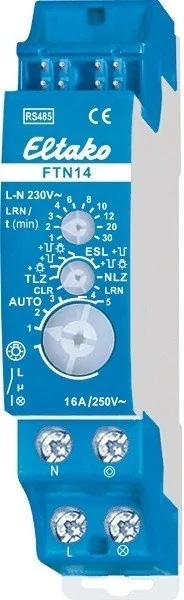
Eltako FTN14 Manual
PDF manual · 2 Pages
English



Quick check
Incorrect answer, please try again.
Chat with your Eltako FTN14 manual using AI
Get instant AI answers from your Eltako FTN14 manual
Ask anything about the Eltako FTN14. Answers come from this manual, with the pages they are based on.
Ask a Question
Do you recommend FTN14?
Yes NoFrequently Asked Questions
The device supports incandescent lamps up to 2000 watts. For energy saving lamps, the limit is 150 watts. Electronic ballast units are also supported within specific VA limits.
Is this answer helpful?
Control is available via RS485 bus for central management. It also supports conventional local switching at 230V. Wireless sensors and pushbuttons can be integrated for remote operation.
Is this answer helpful?
The switching state is maintained during power outages. When the power supply fails, the unit does not reset. Timing restarts at the end of the period when voltage returns.
Is this answer helpful?
Yes, FBH sensors can be taught into the actuator. Master and slave sensors are supported for motion detection. Settings depend on brightness or motion thresholds.
Is this answer helpful?
The active standby loss is only 0.2 watt. This is significantly low compared to standard timers. It helps reduce overall system energy consumption.
Is this answer helpful?
Only skilled electricians must perform the installation. Incorrect wiring poses a risk of fire or electric shock. Follow all safety guidelines and manuals carefully.
Is this answer helpful?
Yes, a switch-off early warning flickers 30 seconds before timeout. This is repeated three times at decreasing intervals. It alerts occupants before the light goes off.
Is this answer helpful?
Advantages and Disadvantages
Advantages

- Low standby power consumption minimizes energy waste effectively.
- RS485 bus integration allows centralized control easily.
- Switch-off warning feature alerts users before lights turn off.
- Compatible with energy saving lamps up to 150 watts.
- Flexible wireless sensor teaching supports various control needs.
Disadvantages

- Installation must be done by skilled electricians only.
- Temperature range limits usage to specific environmental conditions.
- Complex programming might be difficult for non-technical users.
- Maximum parallel capacitance restricts local control lead length.
- Wireless teaching requires mains power for initialization.
Product Specification
Type
Actuator
Standard
EnOcean, RS485
Function
Switching Actuator (on/off)
Topology
Bus
Features
IP20
Product Description
Understanding the Eltako FTN14 Stair Light Delay Switch
Controlling stairway illumination efficiently is crucial for both safety and energy conservation in modern buildings. The Eltako FTN14 Stair Light Delay Switch offers a robust solution for this specific application. It operates as a staircase off-delay timer with a NO contact rated at 16A and 250V AC. This capacity supports incandescent lamps up to 2000 watts. It also manages energy saving lamps effectively up to 150 watts. The module is designed for DIN-EN 60715 TH35 rail mounting. Each module width measures 18mm.
Advanced Control Features
Integration into larger systems is seamless via the Eltako-RS485 bus. Bidirectional communication allows for monitoring and control from a central point. You can also use conventional local switching for simplicity. Wireless operation is available using pushbuttons and motion sensors. The teach-in process is handled through specific rotary switch settings. This flexibility allows for various configurations in different environments.
Safety and Efficiency Focus
Standby power consumption is incredibly low at just 0.2 watt. This minimizes waste during non-operation periods. A unique switch-off early warning feature enhances usage. The light flickers approximately 30 seconds before time-out occurs. This happens three times with decreasing intervals to alert occupants. Permanent light function can be activated with a long button press. This mode auto-switches off after 60 minutes.
Installation and Technical Data
Only skilled electricians should perform installation. Improper handling risks fire or electric shock significantly. Device temperature range is minus 20 to plus 50 degrees Celsius. Storage temperatures tolerate minus 25 to plus 70 degrees Celsius. Humidity must remain below 75 percent annually. Power supply fails logic maintains the switching state during outages. Timing restarts when voltage returns.
The unit supports advanced response delay settings. These range from 1s to 120s based on rotary switch positions. Clearing memory is done via specific switch combinations. You can delete taught-in sensors individually or completely. Factory settings reset easily if needed. Wireless sensors require N and L mains connection for teaching. The LED indicator provides visual feedback during operation. Always consult the housing for complete operating instructions.
Configuration Overview
Configuring the device for specific needs requires attention to detail. The PC tool PCT14 allows behavior adjustments for sensors. It manages wireless pushbutton clicks and sensor addition securely. Always remember to disconnect FAM when using the tool. Teach-in confirmation telegrams are sent to other bus actuators. Address assignment uses the FAM14 module interaction. This ensures the device is unique on the network.
Search for 67,706 Manuals online


Type-in Brand or Model