
DT Swiss F 535 ONE Manual
PDF manual · 39 Pages
English



Quick check
Incorrect answer, please try again.
Chat with your DT Swiss F 535 ONE manual using AI
Get instant AI answers from your DT Swiss F 535 ONE manual
Ask anything about the DT Swiss F 535 ONE. Answers come from this manual, with the pages they are based on.
Ask a Question
Do you recommend F 535 ONE?
Yes NoFrequently Asked Questions
They adjust low-speed compression behavior. OPEN keeps the fork most sensitive and compliant for traction. DRIVE firms the low-speed response to reduce movement from pedaling for efficiency. LOCK blocks the fork in fully extended position for rides where suspension is not needed.
Is this answer helpful?
No. The high-speed compression behavior is pre-set using a shim system that responds once a defined oil pressure threshold is reached. That means riders tune main feel through the low-speed modes rather than turning high-speed compression adjustments.
Is this answer helpful?
Line Air uses a bypass that helps equalize pressure conditions between positive and negative air sides when the fork is compressed. This reduces the breakaway force needed to get moving, creating a smoother first part of travel for comfort and traction.
Is this answer helpful?
APT (Adaptable Progression Tune) changes the air-spring progression by adding or removing volume spacers in the air chamber. More spacers generally increase progression and support near the end of travel, while fewer spacers feel more linear.
Is this answer helpful?
Do not exceed three volume spacers. Installing more than three can prevent full fork compression. The fork is delivered with two spacers, and additional parts are meant for rider-specific adjustment within the allowed maximum.
Is this answer helpful?
Because parts inside the fork are pressurized. The service guidance stresses releasing the air completely before loosening components like the spring unit or air chamber cap, and never pointing pressurized parts toward your face or body during disassembly.
Is this answer helpful?
Advantages and Disadvantages
Advantages

- Three-mode low-speed compression (OPEN, DRIVE, LOCK) helps match traction and pedaling needs.
- Closed damping system with a floating piston supports consistent performance and reduces oil foaming.
- Line Air bypass design promotes smooth breakaway for comfort and traction.
- APT volume spacers allow progression tuning from more linear to more progressive feel.
Disadvantages

- High-speed compression is pre-set and not adjustable, limiting tuning options for fast hits.
- Adjustment and service require careful steps, correct tools, and correct order of operations.
- APT progression tuning has a strict spacer limit to protect full fork travel.
- LOCK mode is intended for situations where suspension is not needed, not for rough terrain.
Product Specification
Type
Suspension Fork
Colors
black
Wheel Size
29"
Travel
5.51"
Suspension Medium
Air
Steerer
tapered 1.5"
Stanchion Diameter
1.38"
Axle System
0.59" Thru-Axle (Boost)
Brake System
Disc Brake
Brake Mount
Postmount
Weight
4.61 lb
Product Description
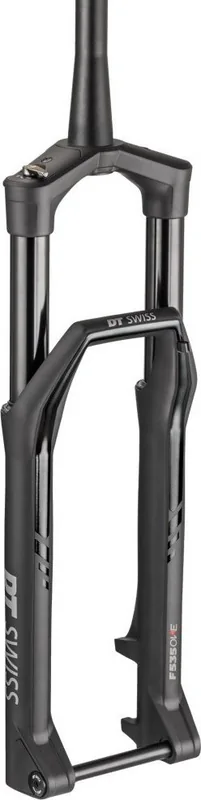
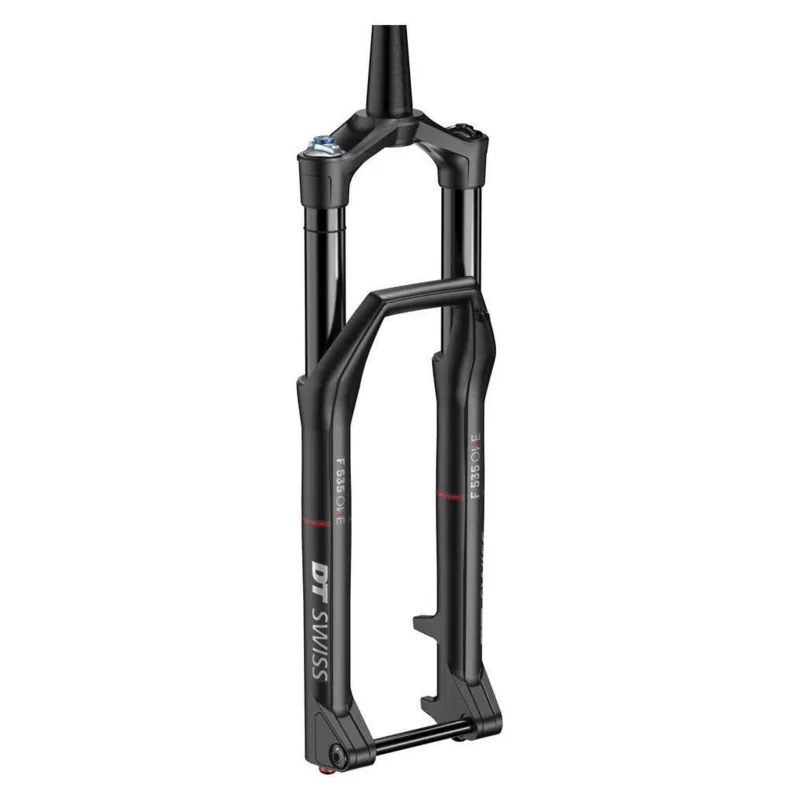
DT Swiss F 535 ONE 29" 140mm Suspension fork
Tuned control for fast, rough, and mixed trails
The DT Swiss F 535 ONE 29" 140mm Suspension fork delivers a precision feel by combining a closed damping system with a two-stage air spring. Based on the DT Swiss F 535 ONE 29" 140mm Suspension fork Manual, its engineering goal is simple: stay responsive on the first part of the stroke, then ramp up support as speeds and forces increase.
Damping that adapts through the stroke
Inside the fork, oil is guided through adjustable low-speed compression paths and shim-based high-speed circuits. As pressure rises during faster hits, more oil is forced through different routes, creating separate behavior for small/medium inputs versus hard impacts. The low-speed compression offers three pre-set modes: OPEN for maximum sensitivity, DRIVE to firm up against pedaling movements, and LOCK for riding when suspension is not needed. High-speed compression is pre-set, using shims that open only beyond a defined pressure threshold.
Line Air spring for smooth breakaway and traction
The Line Air system uses a bypass in the air chamber to equalize pressure conditions, reducing the force needed to start the stroke. The result is a smoother initial response that helps traction on uneven ground. A spring connector also uses a coil spring approach to absorb minor impacts before they reach the air-spring seals, while still transferring force directly during major hits.
Progression tuning with APT volume spacers
Riders can fine-tune the air-spring curve using APT (Adaptable Progression Tune) volume spacers. The fork ships with two spacers, and includes additional adjustment options, letting you shift from more linear comfort toward a more progressive, supportive feel. A safety note matters: do not install more than three volume spacers, or full compression can be compromised.
Service-friendly design and safe adjustment approach
Small-service procedures focus on clean assembly, correct lubrication for seals and O-rings, and careful handling of pressurized components. Before air-related steps, the air must be fully released, and disassembly should never point pressurized parts toward the face or body.
Notes
- Low-speed compression: OPEN, DRIVE, and LOCK are pre-adjusted modes.
- High-speed compression is not user-adjustable; it is controlled by the shim system.
- APT tuning changes progression, but spacer count is capped for safe travel.
Key results (what matters most)
- Multi-stage damping separates traction sensitivity from hard-hit control.
- Closed-system oil control helps maintain consistent performance on rough downhills.
- Line Air improves breakaway and smoothness for better tire contact.
- APT spacers let you tailor progression from linear to very progressive.
- Service guidance emphasizes cleanliness, correct tools, and safe air release.
Search for 67,706 Manuals online


Type-in Brand or Model