
Doepke DFS 4 040 Manual
PDF manual · 2 Pages
English



Quick check
Incorrect answer, please try again.
Chat with your Doepke DFS 4 040 manual using AI
Get instant AI answers from your Doepke DFS 4 040 manual
Ask anything about the Doepke DFS 4 040. Answers come from this manual, with the pages they are based on.
DFS 4 040 Maintenance Schedule
For non-stationary systems, repeat the test every working day according to regulations.
Press test button T at least every six months. If tripping does not occur, replace the device immediately.
Free maintenance reminders
Timed to your purchase date. Always free, unsubscribe anytime.
Ask a Question
Do you recommend DFS 4 040?
Yes NoFrequently Asked Questions
The DFS 4 040 is a four‑pole residual current circuit‑breaker designed to detect AC and DC residual currents and disconnect supply automatically to protect people and equipment in installations where mixed fault currents may occur.
Is this answer helpful?
No. Due to potential danger and the need for correct upstream/downstream RCD coordination and wiring, installation and commissioning must be carried out by a qualified electrical professional.
Is this answer helpful?
Perform a function test using the built‑in test button at least every six months for stationary installations. For non‑stationary or mobile setups, test daily. If the device fails to trip during testing, it must be replaced immediately.
Is this answer helpful?
The green LED signals the presence of the internal operating voltage required for AC/DC (type A and B) sensing. If the LED is off only type A detection is guaranteed; the MI device may lose full all‑current detection capability.
Is this answer helpful?
No. During insulation tests according to DIN EN 61557‑2 the RCCB must be switched off, because the internal auxiliary supply can distort measurements on terminals 1, 3, 5 and 7.
Is this answer helpful?
No. The DFS 4 series are residual current devices without integrated overcurrent protection. Appropriate external overcurrent protective devices (OCPD/SCPD) must be provided as required by the installation.
Is this answer helpful?
Yes. Operation is limited to normal ambient conditions free of corrosive gases (e.g., chlorine, ammonia, sulphur gases). Exposure to such atmospheres can impair long‑term tripping performance.
Is this answer helpful?
Advantages and Disadvantages
Advantages

- All‑current sensitivity (AC and DC) in MI variant allows detection of mixed fault currents.
- DIN‑rail modular design for easy integration in distribution boards (TS 35).
- Accessible test button and LED status indicator simplify routine functional checks.
- Flexible wiring: neutral can be placed left or right; supply recommended on terminals 1,3,5,7.
- Low DC trip threshold in MI variant protects upstream type A devices from DC faults.
Disadvantages

- No built‑in overcurrent protection; requires correct external OCPD selection.
- Installation and servicing must be performed by qualified electricians only.
- Sensitive to corrosive gases — unsuitable for harsh chemical environments.
- Pulsating or smooth DC can lower effective trip thresholds and cause unexpected behavior.
- Must be switched off during insulation tests to avoid distorted measurements.
Product Specification
Type
RCCB
Number of Poles
3 + N
Rated Voltage
400V
Rated Current
40A
Degree of Protection
IP20
Width
2.83 in
Modular Units
4
Product Description
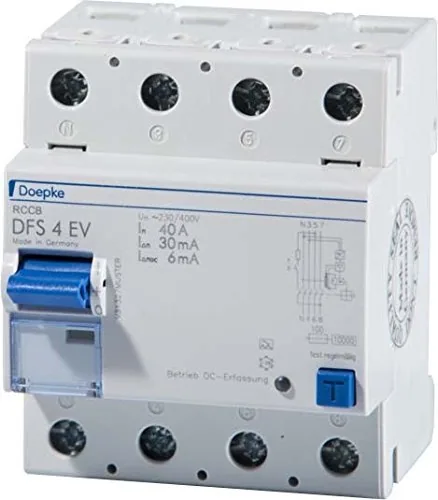
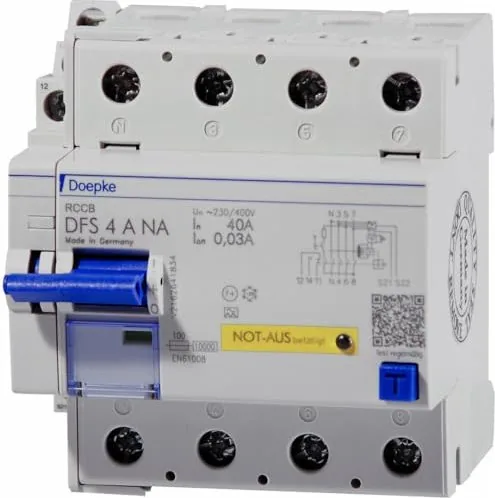
Doepke DFS 4 040 — Reliable all‑current residual current protection
The Doepke DFS 4 040 is a four‑pole residual current circuit‑breaker (RCCB) designed to provide dependable protection in installations where AC and DC fault currents may occur. Built as a DIN‑rail modular device for TS 35, the DFS 4 040 combines sensitive all‑current detection with practical installation and maintenance features. Its MI variant offers particularly low DC tripping thresholds, making it suitable where DC components or downstream equipment can produce DC leakage currents that would otherwise defeat standard type A protection.
Compact yet robust, the DFS 4 040 supports flexible wiring with neutral conductor on either side and recommended supply connections at terminals 1, 3, 5 and 7. It is intended to be used in conjunction with appropriate overcurrent protection devices (it has no built‑in overcurrent protection) and must be installed by qualified electricians due to potential hazards. The unit includes a user‑accessible test button for routine functional checks and an LED status indicator that signals whether the internal power for AC/DC sensing is present.
Key practical points include regular testing (at least every six months for stationary systems and daily for mobile or non‑fixed installations), adherence to environment limits (free of corrosive gases), and clear guidance on downstream/upstream combinations of RCD types to avoid nuisance or missed tripping. When the green LED is lit the device senses both type A and B residual currents; if it is dark, only type A tripping is guaranteed.
Because the DFS 4 040 is sensitive to DC residual currents, special attention must be paid to pulsating DC (type A) and smooth DC faults — these can produce lower effective trip thresholds than rated values. For insulation testing (DIN EN 61557‑2), the device should be switched off or isolated as measurements on the terminals can be distorted by the internal auxiliary supply.
Overall, the Doepke DFS 4 040 is aimed at installations requiring robust detection of mixed AC/DC fault currents, with built‑in features to support safe operation and maintenance when properly installed and tested.
Notes
- Install and service only by qualified personnel. Ensure protection against corrosive atmospheres.
- Perform functional tests regularly using the accessible test button; replace immediately if tests fail.
- For insulation tests, switch the device off to avoid erroneous readings at terminals 1, 3, 5, 7.
- Use correct upstream/downstream RCD combinations as recommended to avoid unwanted interactions.
Search for 67,706 Manuals online


Type-in Brand or Model