
Candy CKBBS 100 Manual
PDF manual · 133 Pages
English



Quick check
Incorrect answer, please try again.
Chat with your Candy CKBBS 100 manual using AI
Get instant AI answers from your Candy CKBBS 100 manual
Ask anything about the Candy CKBBS 100. Answers come from this manual, with the pages they are based on.
CKBBS 100 Maintenance Schedule
Remove frozen food and defrost when frost layer exceeds 3 mm to reduce energy consumption. Do not use sharp objects or open flames.
Keep the drainage pipe in the refrigerator compartment clean to prevent water accumulation. Use a stick if clogged.
Remove dust from the back of the appliance with a vacuum cleaner after unplugging to improve energy efficiency.
Ask a Question
Do you recommend CKBBS 100?
Yes NoFrequently Asked Questions
After installation, wait 2–3 hours to allow the appliance temperature to stabilize before placing fresh or frozen foods inside. After transport, if the fridge was laid down, keep it upright and still for 2–3 hours before powering.
Is this answer helpful?
Level 1 is the warmest and level 4 the coldest. For normal use an intermediate setting (level 2) is recommended. Advanced settings allow sub-level adjustments for finer temperature control.
Is this answer helpful?
If frost exceeds ~3 mm, press the ON/OFF button, unplug the appliance, remove frozen food to a cool place, leave the door open to speed defrosting, collect and dry water, then reconnect and reset temperature. Never use open flames or sharp tools.
Is this answer helpful?
Check doors are fully closed and seals intact, avoid frequent door openings, ensure ambient temperature is within the appliance climate class range, defrost if necessary, and remove dust from the rear condenser. Contact service if noise persists.
Is this answer helpful?
Clean internal parts, gaskets and accessories with warm water and baking soda or neutral soap. Do not use solvents, ammonia, bleach or abrasive products to avoid damage.
Is this answer helpful?
Yes, the model is built for column installation. Maintain a 3–5 mm gap and ensure the column has a rear chimney and ventilation grille so the condenser can dissipate heat properly.
Is this answer helpful?
The appliance contains R600a and cyclopentane which are flammable; avoid damaging refrigerant circuits, do not use open flames near leaks, ventilate the area and call authorized service if a leak is suspected.
Is this answer helpful?
Advantages and Disadvantages
Advantages

- Built-in design integrates with kitchen columns and includes instructions for panel coupling and hinge reversal.
- Simple user interface with ON/OFF button, 4 temperature levels and advanced sub-level tuning for precise control.
- Automatic fridge defrosting with clear guidance for freezer defrost when frost exceeds ~3 mm.
- Energy-saving recommendations and rear dust removal guidance to keep efficiency high.
- LED illumination and optional compartment fan (activatable above ~28–30°C) for better visibility and circulation.
Disadvantages

- Contains flammable refrigerant and insulating gases, requiring careful handling and avoidance of open flames.
- Hinge reversal and some installations require qualified technicians and may not be covered by warranty.
- May build up frost if installed in high ambient temperatures or with frequent door openings.
- Some maintenance tasks (e.g., defrosting non-No‑Frost freezers) require manual intervention and temporary food relocation.
- No repair should be performed by users; service center contact needed for many faults.
Product Specification
Type
built-in
Old energy efficiency class
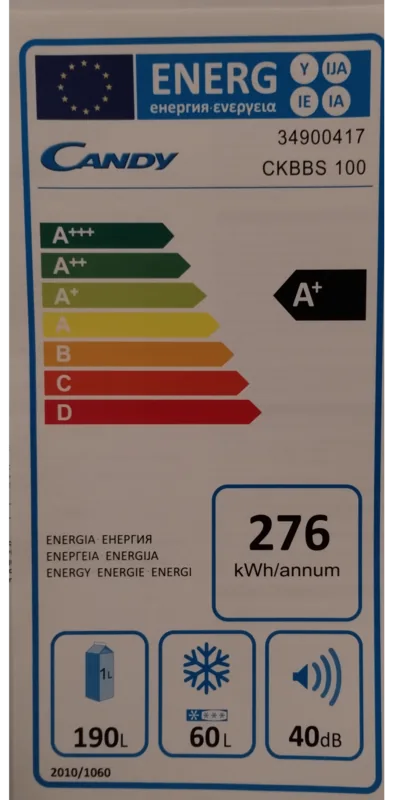
A+ (A+++ to D)
Old energy consumption
264kWh/year
Front color
white
Side color
white
Fridge compartment capacity
50.17gal (top)
Freezer compartment capacity
15.85gal (bottom)
Total capacity
66.04gal
Star rating
4
Freezing capacity in 24h
7.72lb
Storage time during power failure
19h
Display
no
Special features
Vegetable compartment, LED lighting, Door alarm
Climate class
N/ST
Noise level
40dB(A)
Dimensions
21.26x69.69x21.26in (WxHxD)
Product Description
Candy CKBBS 100 — Practical Guide and Overview
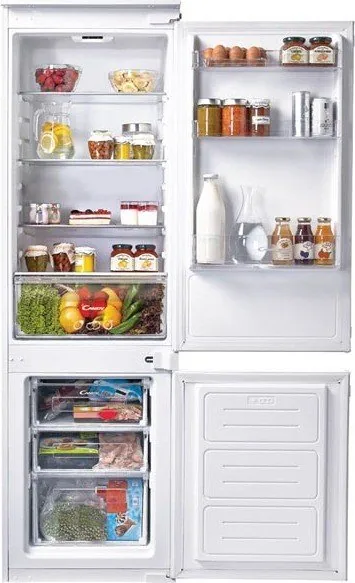
The Candy CKBBS 100 is a built-in refrigerator designed for everyday domestic use, combining compact built-in dimensions with practical features focused on food preservation, energy efficiency, and user safety. It uses modern refrigerant technologies (R600a/isobutane and cyclopentane insulation) that are environmentally friendlier while requiring standard safety precautions due to their flammability. The unit is intended for home kitchens and similar non-retail applications such as staff kitchens, B&Bs, small hospitality settings, and farmhouses.
Key features and operation
The control interface is simple: an ON/OFF button, a temperature-level selector (levels 1–4, with intermediate sub-levels available), and LED indicators showing the selected setting. The fridge offers an audible door-open alarm if left open for more than 90 seconds. Some models include a fan for better internal air circulation (recommend enabling it when ambient temperature exceeds ~28–30°C) and an indicator showing the coldest zone inside the refrigerated compartment.
Temperature settings are straightforward: level 1 is warmest, level 4 coldest; an intermediate advanced menu allows fine tuning. After installation, allow 2–3 hours for temperature stabilization before loading fresh or frozen foods. If power is disconnected, wait at least five minutes before restarting to protect the compressor.
Built-in design and installation
The CKBBS 100 is designed for column or built-in installation with clear guidance for hinge reversal, panel coupling, and ventilation spacing (3–5 mm gap). Proper ventilation around the condenser is essential for reliable operation; built-in columns should have a rear chimney and ventilation grille. Hinge reversal and panel coupling should be performed by qualified technicians.
Food storage, freezing and defrosting
Shelving layout and compartment recommendations help preserve flavor and freshness: wrap foods or use sealed containers to avoid cross-contamination, store fruits/vegetables in the designated drawer (preferably wrapped), and avoid placing bottles in the freezer. Freezing guidance emphasizes freezing small batches, sealing items airtight, labeling containers, and not refreezing thawed foods. The fridge typically defrosts automatically; the freezer may require manual defrosting when frost exceeds about 3 mm.
Maintenance, cleaning and energy tips
Clean internal parts and gaskets with warm water and baking soda or neutral soap; avoid solvents, bleach, or abrasives. Keep the drainage tube clear and vacuum dust from the rear to improve efficiency. To save energy: install away from heat sources and direct sunlight, avoid overloading, minimize door openings, defrost when needed, and keep rear dust-free.
Safety and troubleshooting
Follow electrical and refrigerant safety rules: unplug before servicing, do not use sharp tools to remove ice, avoid open flames, and do not store flammable or volatile substances inside. For issues like inadequate cooling, excessive noise, water in drawers, or Wi‑Fi connectivity signals, consult the troubleshooting section for likely causes (door not sealed, wrong temperature setting, excessive loading, ambient temperature out of spec) and contact authorized service if unresolved.
Notes
- Allow 2–3 hours after installation for stabilization.
- Wait at least 5 minutes before restarting after power loss.
- Hinge reversal is a technical service task and not covered by warranty.
Search for 67,706 Manuals online


Type-in Brand or Model