
Broadcom MegaRAID SAS 9361-8i Manual
PDF manual · 53 Pages
English



Quick check
Incorrect answer, please try again.
Chat with your Broadcom MegaRAID SAS 9361-8i manual using AI
Get instant AI answers from your Broadcom MegaRAID SAS 9361-8i manual
Ask anything about the Broadcom MegaRAID SAS 9361-8i. Answers come from this manual, with the pages they are based on.
Ask a Question
Do you recommend MegaRAID SAS 9361-8i?
Yes NoFrequently Asked Questions
It uses a PCIe 3.0 x8 interface.
Is this answer helpful?
Yes, it supports 6Gb/s SATA III connections.
Is this answer helpful?
Yes, online capacity expansion is supported.
Is this answer helpful?
It supports RAID 0, 1, 5, 10, 50, and 60.
Is this answer helpful?
Yes, with specific flash and power modules.
Is this answer helpful?
It has eight internal ports via two connectors.
Is this answer helpful?
Advantages and Disadvantages
Advantages

- High bandwidth PCIe 3.0 x8 interface
- Dual SFF-8643 internal connectors
- CacheVault power support for data integrity
- Online RAID level migration support
- Wide operating system compatibility
Disadvantages

- Requires specific PCIe power settings
- No external ports on standard config
- Power modules need system shutdown to change
- Low-profile form factor may limit airflow
- Configuration complexity for new users
Product Specification
Connection
PCIe 3.0 x8
Interfaces
8x SAS 12Gb/s or SATA 6Gb/s
Internal
2x SFF-8643
External
N/A
RAID Level
0/1/5/6/10/50/60
Chipset
Broadcom SAS3108, 2x 1.20 GHz
Cache
1GB DDR3 (PC3-14900U)
Features
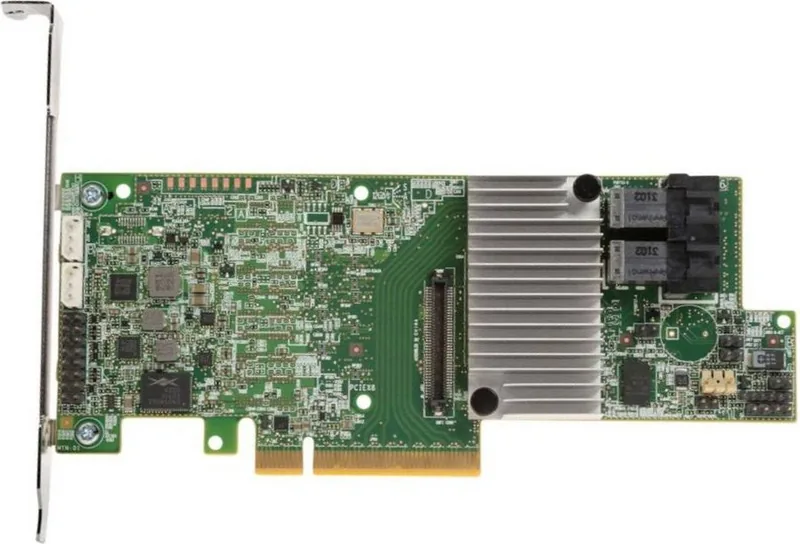
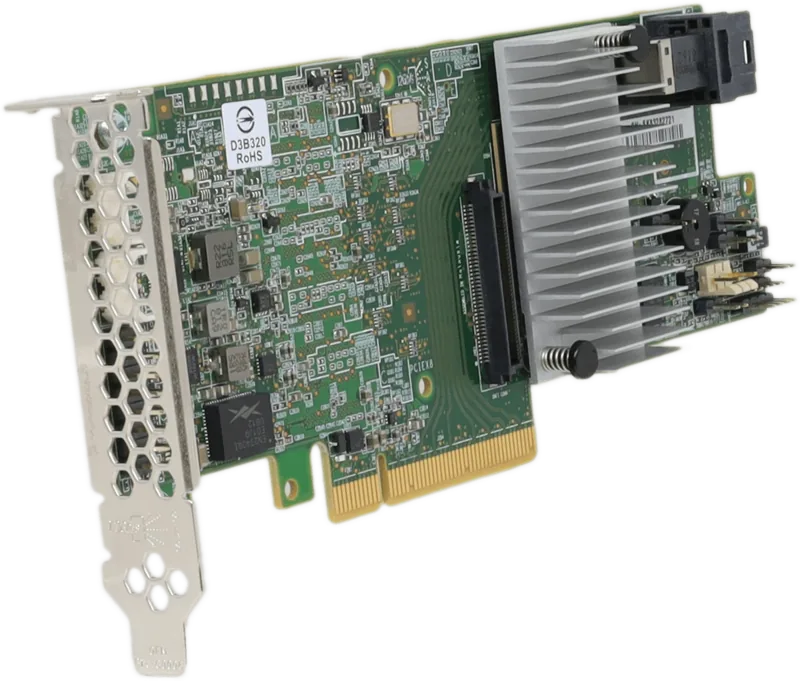
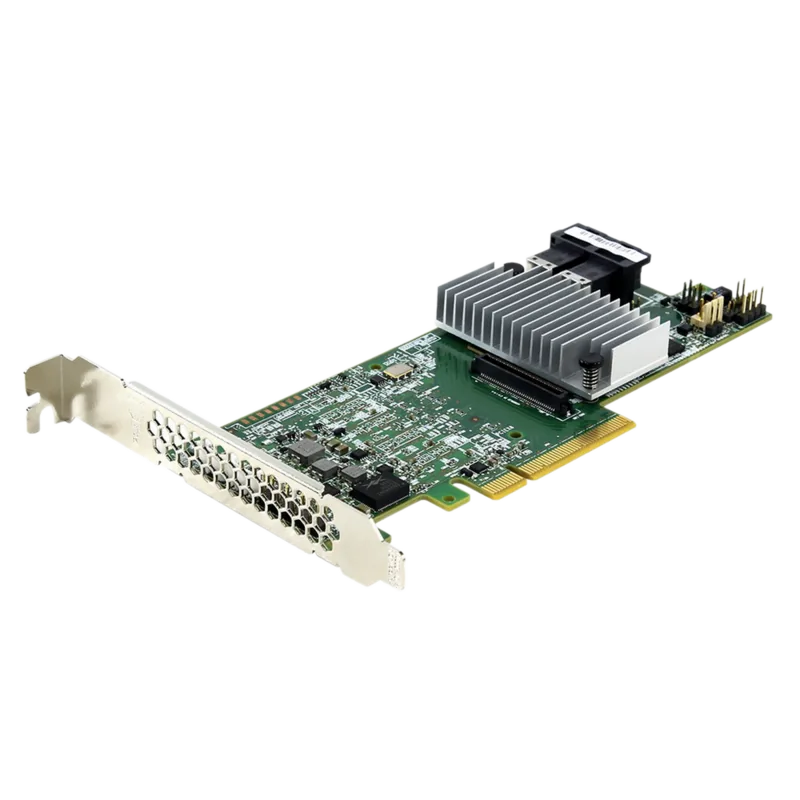
Low-profile PCB
Manufacturer Warranty
3 years
Product Description
Unlocking Storage Potential with Broadcom MegaRAID SAS 9361-8i
The Broadcom MegaRAID SAS 9361-8i stands as a premier choice for modern enterprise storage architectures. Designed to deliver high performance and reliability, this PCIe 3.0 x8 controller supports both 12Gb/s SAS and 6Gb/s SATA III connections. It addresses growing demands for increased data throughput and scalability across midrange and enterprise-class server platforms. Ideal for internal storage needs in workgroup or departmental systems, it offers a cost-effective way to implement robust RAID solutions. This controller is suitable for high-demand environments requiring stability.
Performance and Architecture
At its core, the controller utilizes the Fusion-MPT architecture to minimize CPU usage while maximizing data transfer rates. It features a dedicated PCIe bus that supports x8 lane configurations with transfer rates up to 8Gb/s per lane. The hardware includes onboard Flash ROM and serial EEPROM for efficient configuration storage. CacheVault technology provides critical protection by offloading cache data to flash memory and backing it with power modules in the event of sudden power failures. This architecture ensures high throughput and low CPU use to offload the host processor effectively. It is vital to ensure the power supply meets the specifications for the CacheVault modules to function correctly during operation.
Configuration and Management
System integrators find the deployment process straightforward yet flexible. The card supports up to eight internal ports using two SFF-8643 mini-SAS HD-4i connectors. Management utilities allow for online capacity expansion and RAID level migration without requiring system reboots. Support for global and dedicated hot spares ensures continuous operation even if a drive fails. The controller works with various operating systems including Microsoft Windows Server, Red Hat Linux, and VMware ESXi. Advanced array configuration tools enable user-defined strip sizes for optimized performance.
Reliability and Safety
Reliability is paramount in server environments. Features like SMART drive monitoring detect potential failures before they cause data loss. The physical design includes LED indications for drive activity and fault conditions to simplify troubleshooting. Compliance with major safety standards ensures safe operation in professional data centers. Cabling requirements are minimal due to the serial point-to-point architecture, which improves airflow and reduces clutter inside chassis. Drive roaming allows drives to be moved to different ports while maintaining configuration integrity. Maintenance tasks are simple when you understand how LED signals indicate specific error conditions on the board.
Final Thoughts
Choosing the right RAID controller is vital for business continuity. This controller delivers the necessary tools for maintaining data integrity and availability. Whether used for internal connectivity or expanded via external enclosures, it offers proven stability. Proper installation follows standard PCIe protocols, ensuring compatibility with existing infrastructure. Users should verify power supply requirements before installing the hardware to prevent issues.
Search for 67,706 Manuals online


Type-in Brand or Model
Lukas Schmidt
5 months ago
Is the CPU impact really negligible on this RAID controller during heavy stress tests?
Manual.ly
5 months ago
Yes, verified reviews confirm that the dedicated hardware handles data processing without significant CPU load. Even with 64 concurrent threads, performance remains stable. The speeds are high enough that some users noted their boot SSD could not keep up. It is also praised for higher stability under load compared to software-based RAID solutions, reducing data loss risks for RAID 0 setups until hardware failure occurs.