
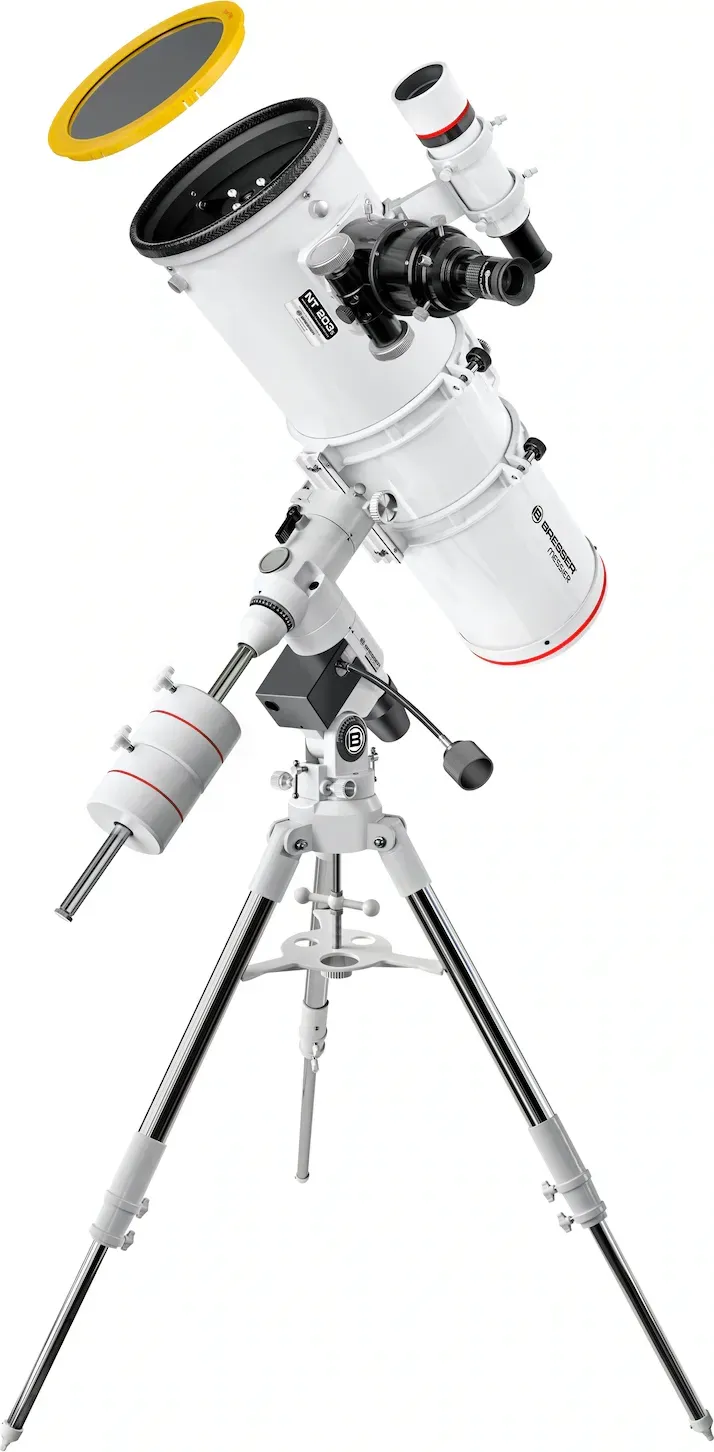
Bresser Messier NT-203S/800 EXOS-2/EQ5 Manual
PDF manual · 44 Pages
English



Quick check
Incorrect answer, please try again.
Chat with your Bresser Messier NT-203S/800 EXOS-2/EQ5 manual using AI
Get instant AI answers from your Bresser Messier NT-203S/800 EXOS-2/EQ5 manual
Ask anything about the Bresser Messier NT-203S/800 EXOS-2/EQ5. Answers come from this manual, with the pages they are based on.
Messier NT-203S/800 EXOS-2/EQ5 Maintenance Schedule
Replace the dust cover after each session. Allow dew on optical surfaces to evaporate in warm indoor air before covering.
Remove dust gently with a camel hair brush or ear syringe. Do not use commercial lens cleaners.
Use solution of distilled water, isopropyl alcohol, and dish soap with soft tissues. Avoid scented or lotioned tissues.
Wipe entire telescope with dry cloth if condensation occurs. Do not wipe optical surfaces directly.
Verify alignment using star test if rough handling occurred. Adjust diagonal and primary mirror screws if circles are not concentric.
Ask a Question
Do you recommend Messier NT-203S/800 EXOS-2/EQ5?
Yes NoFrequently Asked Questions
It is a 203 mm Newtonian reflector paired with an equatorial EXOS-2/EQ5-style mount. The large aperture helps gather more light, making it well suited for visual astronomy, especially bright deep-sky objects and detailed lunar or planetary viewing.
Is this answer helpful?
It performs well on the Moon, planets, star clusters, nebulae, and galaxies. The large mirror makes faint objects easier to detect, while the 800 mm focal length gives enough scale for satisfying views of brighter solar system targets.
Is this answer helpful?
Yes, Newtonian reflectors should be checked for collimation from time to time. The telescope is factory-adjusted, but rough transport or heavy use can shift alignment. A quick star test and mirror adjustment can restore sharp performance.
Is this answer helpful?
Balancing keeps the telescope stable on the mount and helps it move smoothly on both axes. When the tube and counterweight are correctly adjusted, tracking objects is easier and the mount is under less strain.
Is this answer helpful?
Start with a low-power eyepiece, such as the included 25 mm option. Lower power gives a wider field of view, making it easier to find targets and achieve focus before switching to stronger magnification if the seeing is good.
Is this answer helpful?
No. Never point the telescope at the Sun, even briefly. Direct solar viewing can cause instant, permanent eye damage and can also harm the telescope itself. Use only approved solar equipment if solar observing is ever intended.
Is this answer helpful?
Advantages and Disadvantages
Advantages

- 203 mm aperture collects strong light for lunar, planetary, and deep-sky observing.
- EXOS-2/EQ5 equatorial mount supports smoother manual tracking and precise axis control.
- Setting circles and polar-alignment tools help with finding and following celestial targets.
- The manual covers setup, balancing, collimation, and maintenance for long-term use.
Disadvantages

- Assembly and alignment take time, so it is less plug-and-play than a small beginner scope.
- Newtonian optics may need occasional collimation to keep images sharp.
- High magnification depends heavily on stable atmospheric conditions.
- The telescope is not intended for solar viewing and requires careful safety discipline.
Product Specification
Type
Refractor (Lens Telescope)
Design
Newton
Magnification
20-200x
Aperture
8"
Focal Length
31.50in, f/3.9
Resolution in Arcseconds
0.56
Primary Mirror
parabolic
Mount
azimuthal
Included Eyepieces
1.02in
Weight
41.89lbs
Manufacturer's Warranty
10 Years
Product Description
Bresser Explore Scientific NT-203S/800 EXOS-2/EQ5 Telescope
The Bresser Explore Scientific NT-203S/800 EXOS-2/EQ5 Telescope is a bold choice for observers who want real light-gathering power and a classic manual observing experience. With its 203 mm Newtonian reflector and 800 mm focal length, it is built to reveal fine lunar structure, bright planetary detail, and a surprising amount of deep-sky contrast when conditions are steady.
What stands out most is the combination of aperture and mount. The EXOS-2/EQ5 equatorial mount is designed to keep tracking smooth and controlled, while the counterweight system, latitude adjustments, and right ascension/declination locks help the tube move precisely. For visual astronomy, that means less fighting the instrument and more time exploring the sky. Once the telescope is balanced and the finder is aligned, pointing to objects becomes much easier and more rewarding.
This telescope also encourages a thoughtful setup routine. The manual highlights balancing the optical tube, aligning the viewfinder, setting the polar home position, and, for Newtonian optics, checking collimation. These steps may sound technical, but they are exactly what help the telescope perform at its best. The reward is sharper stars, cleaner contrast, and a more confident observing session. A low-power eyepiece is the best way to start, especially for locating targets before increasing magnification.
For lunar and planetary viewing, the NT-203S/800 has the scale to make details satisfying, from crater rims and mountain shadows on the Moon to cloud bands on Jupiter and the rings of Saturn. It also shines on deep-sky objects such as nebulae, star clusters, and galaxies, where its larger aperture makes faint light easier to detect. The telescope is equally appealing to beginners who want to learn serious observing skills and to hobbyists who enjoy hands-on control.
Notes
- Always avoid solar viewing unless using proper solar equipment.
- Keep the optics clean only when necessary, and protect them from dew.
- Use lower magnification first; let the atmosphere decide how far you can push power.
- Re-check balance and finder alignment after moving the telescope.
Search for 67,706 Manuals online


Type-in Brand or Model