
Bosch DIY PSM 200 AES Manual
PDF manual · 75 Pages
English



Quick check
Incorrect answer, please try again.
Chat with your Bosch DIY PSM 200 AES manual using AI
Get instant AI answers from your Bosch DIY PSM 200 AES manual
Ask anything about the Bosch DIY PSM 200 AES. Answers come from this manual, with the pages they are based on.
PSM 200 AES Maintenance Schedule
Check for misalignment, binding, breakage, or other conditions affecting operation; repair damaged parts before use.
Tap dust box to loosen dust from filter element, open filter, empty box, and clean filter lamellae with a soft brush.
Remove dust or debris from the sanding plate using a brush to ensure optimum adhesion and dust extraction.
Maintain cleanliness of the machine and ventilation slots to ensure safe and proper operation.
Free maintenance reminders
Timed to your purchase date. Always free, unsubscribe anytime.
Ask a Question
Do you recommend PSM 200 AES?
Yes NoFrequently Asked Questions
It is made for dry sanding and polishing on wood, plastic, metal, filler, and painted surfaces. It is especially useful for profiles, corners, and hard-to-reach areas where a larger sander is less practical.
Is this answer helpful?
Yes. The speed regulator lets you choose the working speed based on the material and the finish you want. Lower speeds are better for polishing, while higher speeds help with more aggressive sanding.
Is this answer helpful?
The sander includes a Microfilter dust box that collects debris during use. It can also connect to an external vacuum through the extraction outlet for improved dust control.
Is this answer helpful?
Yes. It supports a two-part sanding plate and a rectangular sanding plate, plus specialty accessories. This makes it easier to adapt the tool to flat areas, edges, and detailed shapes.
Is this answer helpful?
Yes. The pad extenders and narrow sanding accessories are intended for slats, slots, curved areas, and other difficult spots where precision matters.
Is this answer helpful?
Use the tool only for dry sanding, wear eye and hearing protection, keep the work area clean, and empty the dust box regularly. Also make sure the sanding sheets are mounted correctly and the machine is unplugged before changes.
Is this answer helpful?
Advantages and Disadvantages
Advantages

- Compact 200 W multi-sander for sanding and polishing a wide range of materials.
- Interchangeable plates and pad extenders improve access to corners, slats, and curves.
- Speed control helps match sanding aggressiveness to the task and surface.
- Microfilter dust box and vacuum connection support cleaner, more controlled work.
Disadvantages

- Designed only for dry sanding, so it is not suitable for wet applications.
- Best results depend on choosing the right sanding sheet and grit for each material.
- Dust box capacity is limited and needs regular emptying during longer sessions.
- Special sanding plates require the rear plate to be mounted correctly for safe use.
Product Specification
Type
Multi-sander
Power
200 W (230 V)
No-load speed
3000-13000/min
No-load oscillation rate
6000-26000/min
Oscillation diameter
0.07 in
Sanding surface
7.17x3.62 in (LxW)
Sanding paper size
7.28x3.66 in (Hook-and-loop), 3.66x3.66x3.66 in (Hook-and-loop)
Tool attachment
Hook-and-loop fastening
Features
Speed control, Oscillation rate control, Soft grip, Dust extraction
Weight
3.09 lb
Product Description
Bosch DIY PSM 200 AES Electric Multi-Sander
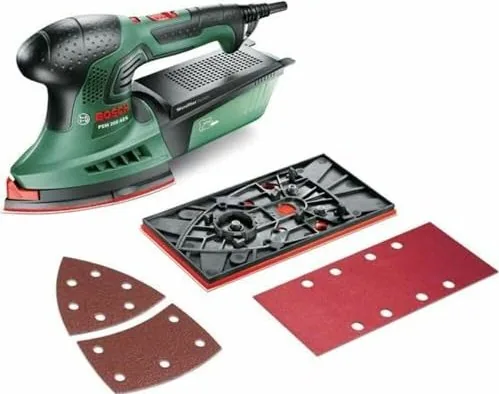
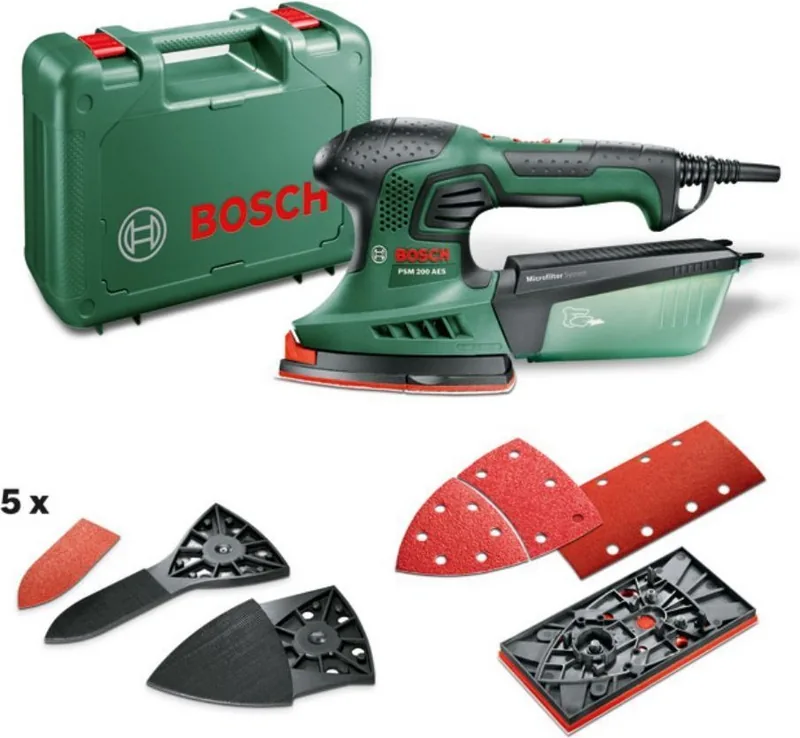
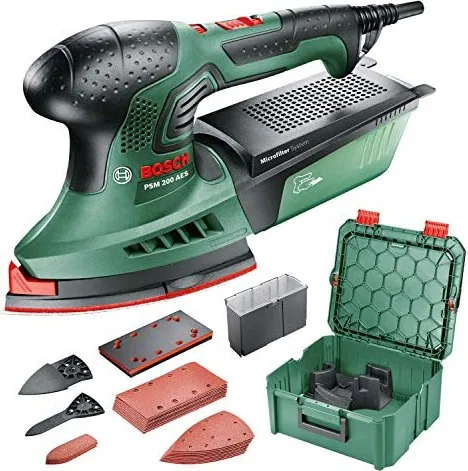
The Bosch DIY PSM 200 AES Electric multi-sander is built for makers who want one compact tool to handle a wide range of finishing tasks. With a 200 W motor, adjustable speed control, and interchangeable sanding plates, it is designed for dry sanding and polishing on wood, plastic, metal, filler, and painted surfaces. It also shines in tight areas, where profiles, corners, edges, and awkward contours usually slow the job down. If you are looking for practical setup guidance, the Bosch DIY PSM 200 AES Electric multi-sander Manual is the best starting point for understanding plate changes, dust collection, and safe operation.
A versatile tool for detail work
What makes this sander especially useful is its flexibility. The standard setup includes both a two-part sanding plate and a rectangular sanding plate, so you can adapt the tool to broad flat areas or focused precision work. Bosch also adds specialized pad extenders for slats, narrow gaps, and rounded inward surfaces. That means the same multi-sander can move from a cabinet edge to a window shutter or radiator curve without feeling out of place.
Controlled sanding with cleaner results
Speed control is another highlight. The machine runs at 3,000 to 13,000 no-load revolutions and 16,000 to 26,000 orbital strokes, giving you enough range to match the material and the finish you want. Lower speeds work well for polishing and delicate surfaces, while stronger settings help with faster stock removal. The Velcro-style sanding plate system makes sheet changes quick, and the dust box with Microfilter system helps keep the workspace cleaner. For even better extraction, it can also connect to an external vacuum.
Designed for comfortable handling
At just 1.4 kg, the sander is easy to guide, even during longer jobs. The insulated grip improves control, and the dual-hand design helps you maintain stability on detailed work. Bosch also emphasizes using the right grain size for the job, from coarse sanding of rough timber to fine finishing on hardwoods. That practical approach makes the tool suitable for home projects, furniture refreshes, and renovation touch-ups.
Notes
- Use the tool only for dry sanding and polishing.
- Empty the dust box regularly to reduce fire risk and maintain performance.
- Match the sanding sheet holes with the plate openings for better dust removal.
- Wear eye protection and hearing protection during use.
- Choose the correct grit to avoid unnecessary wear and achieve smoother results.
Search for 67,706 Manuals online


Type-in Brand or Model