
Bosch DIY PSM 18 LI Manual
PDF manual · 87 Pages
English



Quick check
Incorrect answer, please try again.
Chat with your Bosch DIY PSM 18 LI manual using AI
Get instant AI answers from your Bosch DIY PSM 18 LI manual
Ask anything about the Bosch DIY PSM 18 LI. Answers come from this manual, with the pages they are based on.
PSM 18 LI Maintenance Schedule
Check for misalignment or binding of moving parts, breakage of parts, and any condition affecting operation. Repair damaged parts before use.
Keep the machine and ventilation slots clean to ensure safe and proper working conditions.
Ask a Question
Do you recommend PSM 18 LI?
Yes NoFrequently Asked Questions
The PSM 18 LI is intended for dry sanding and polishing of wood, filler compounds and coated surfaces (paint, lacquer). It’s suitable for profiles, corners and hard-to-reach places. Do not use it on asbestos-containing materials; those must be handled by specialists.
Is this answer helpful?
No. The PSM 18 LI in the ‘solo’ configuration is supplied without battery or charger. Use only Bosch 18 V Li‑Ion PBA batteries and the manufacturer‑recommended chargers to ensure safe operation and avoid fire or damage.
Is this answer helpful?
The sander has an integrated microfilter dust box for self-extraction and an extraction adapter for a 19 mm vacuum hose. For especially hazardous or carcinogenic dusts, use a specialist vacuum and wear appropriate respiratory protection (P2 filter recommended).
Is this answer helpful?
The battery is protected by Electronic Cell Protection (ECP) against deep discharge. The tool’s electronics also provide temperature-dependent overload protection and will shut down operation if the battery temperature exceeds safe limits.
Is this answer helpful?
Sanding sheets attach via Velcro backing for fast changes. Clean debris from the sanding plate before mounting a new sheet. The sanding plate is removable using the SDS release slider to swap plates or rotate the plate to use fresh edges.
Is this answer helpful?
Yes: coarse (≈40 grit) for heavy material removal, medium (≈80–120 grit) for leveling and planing, and fine (≈180 grit) for finishing. Use metal-grade sheets only for metal and avoid cross‑contamination between materials.
Is this answer helpful?
Keep ventilation slots and the tool clean, empty the dust box regularly, inspect moving parts and replace worn components. Lock the On/Off switch before maintenance. For repairs, contact an authorized Bosch service center and use original spare parts.
Is this answer helpful?
Advantages and Disadvantages
Advantages

- Lightweight and compact (≈1.3 kg) for comfortable handling in tight spaces and profiles.
- Microfilter dust box plus external extraction adapter reduces dust exposure and keeps the work area cleaner.
- Velcro-backed dual sanding sheets and SDS plate release allow quick accessory and sheet changes.
- Electronic Cell Protection and temperature-dependent overload protect battery and tool from damage.
- Wide accessory range (pad extenders, lamella pad, narrow/oval tongues) increases versatility.
Disadvantages

- Sold solo — batteries and chargers are not included, adding to initial cost.
- Limited to dry sanding; not suitable for wet applications or certain heavy-duty tasks.
- Performance may be reduced at temperatures below 0 °C and suffers if battery overheats.
- Noise and vibration levels can be significant — hearing protection recommended.
- Dust box capacity limited; frequent emptying required during extended use.
Product Specification
Type
Multi-sander
Battery
18V, Li-ion
No-load speed
11,000/min
No-load oscillation rate
22,000/min
Orbit diameter
0.06 in
Tool attachment
Quick-change system (SDS), Hook and loop fastening
Features
Soft grip, Dust extraction
Scope of delivery
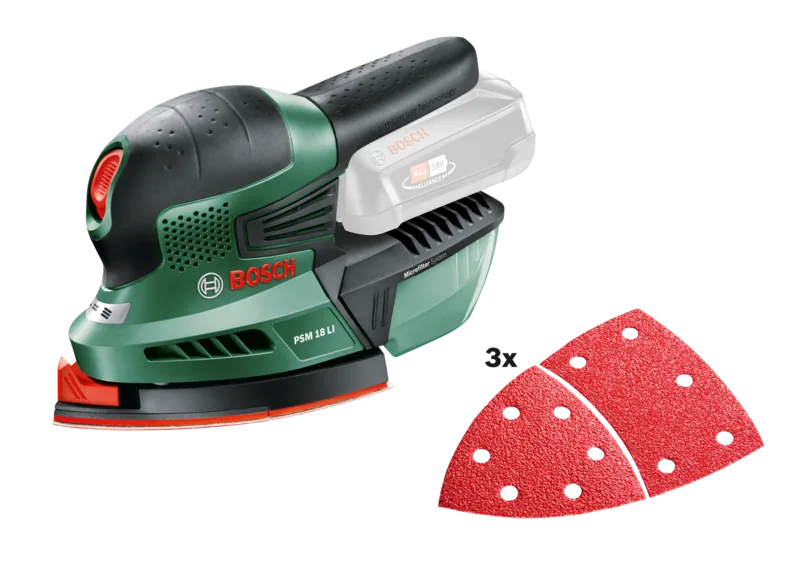
without charger and battery, incl. 3-pc. accessory set, dust box
Product Description
Bosch DIY PSM 18 LI Akku-Multischleifer solo Manual
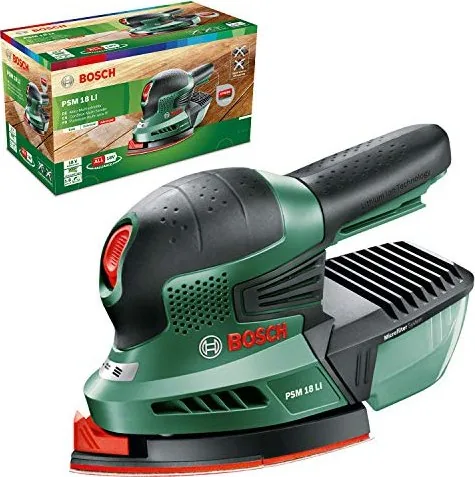
The Bosch DIY PSM 18 LI is a compact, battery-powered multi-sander designed for precise dry sanding and polishing of wood, fillers and coated surfaces. Lightweight and portable at about 1.3 kg (EPTA), it targets DIY enthusiasts who need access to profiles, corners and tight spaces where larger sanders struggle. The tool runs on an 18 V Bosch Li‑Ion battery (sold separately) and features a high no-load speed and orbital stroke for efficient material removal while minimizing swirl marks.
Key features and handling
Equipped with a microfilter dust box and an extraction adapter for external vacuum connection, the PSM 18 LI helps keep work areas cleaner and reduces airborne dust. The sanding pad uses Velcro-backed sheets for quick changes and accepts two replaceable sanding sheets to extend working life. An SDS-style release allows easy replacement of the sanding plate and optional specialty plates and accessories (pad extenders, lamella pad, narrow and oval tongues) make the tool versatile for window slats, rounded profiles and narrow gaps.
A battery charge-control indicator with three green LEDs displays remaining charge; electronic protections guard against deep discharge and temperature-dependent overload. The sander is intended strictly for dry sanding — wet use is unsafe — and its documentation stresses appropriate PPE (eye protection, respirator for hazardous dusts) and using recommended Bosch batteries and chargers to avoid fire or damage.
Performance and safety notes
Typical A-weighted sound pressure is around 72 dB(A) (work levels may exceed 80 dB(A)); vibration totals are provided per EN 60745. Bosch recommends hearing protection and other safety measures when sanding. Dust extraction is strongly advised when working with hazardous materials (certain woods, metals, lead paints), and special vacuum cleaners should be used for carcinogenic or particularly harmful dusts. The tool includes Electronic Cell Protection (ECP) to prevent deep discharge and an overload cutoff triggered by high battery temperature.
Practical use tips
Use consistent, moderate pressure for even sanding and extended abrasive life; overpressing accelerates wear without improving removal. Match abrasive grit to the task (40–180 grit range suggested). Empty the dust box regularly and keep ventilation slots clean. Only use Bosch original accessories and service by authorized centers when repairs or parts are required.
Notes
- Intended only for dry sanding/polishing of wood, fillers and coated surfaces. Do not use on asbestos-containing materials; those require specialists.
- Batteries shipped partially charged — fully charge before first use.
- Transport and disposal rules apply to lithium-ion batteries; do not dispose of in household waste.
Search for 67,706 Manuals online


Type-in Brand or Model
Hans Müller
9 months ago
My battery under 'Power for ALL' does not fit (too thick). Also, the article number shown in the listing seems to be wrong. Which battery fits, and what should I verify?
Manual.ly
9 months ago
For the correct replacement, please use the currently verified battery article number W855141. Some listings can show an outdated number, so if you encounter a 404 or no matching item, rely on W855141 for this model. Even with the right battery family, fit can depend on physical dimensions (thickness/clearance). Please check that your device has enough space for the battery body; if the grip area would block it, the battery will not seat properly. If you already ordered W855141 and it still does not fit, contact us with your order number and a photo of the battery slot so we can confirm compatibility.